
脐带间充质干细胞治疗 COVID-19 急性呼吸窘迫综合征:一项双盲、1/2a 期、随机对照临床试验。
Umbilical cord mesenchymal stem cells for COVID-19 acute respiratory distress syndrome: A double-blind, phase 1/2a, randomized controlled trial.
机构信息
Diabetes Research Institute, Cell Transplant Center, University of Miami Miller School of Medicine, Miami, Florida, USA.
Department of Biochemistry and Molecular Biology, University of Miami Miller School of Medicine, Miami, Florida, USA.
出版信息
Stem Cells Transl Med. 2021 May;10(5):660-673. doi: 10.1002/sctm.20-0472. Epub 2021 Jan 5.
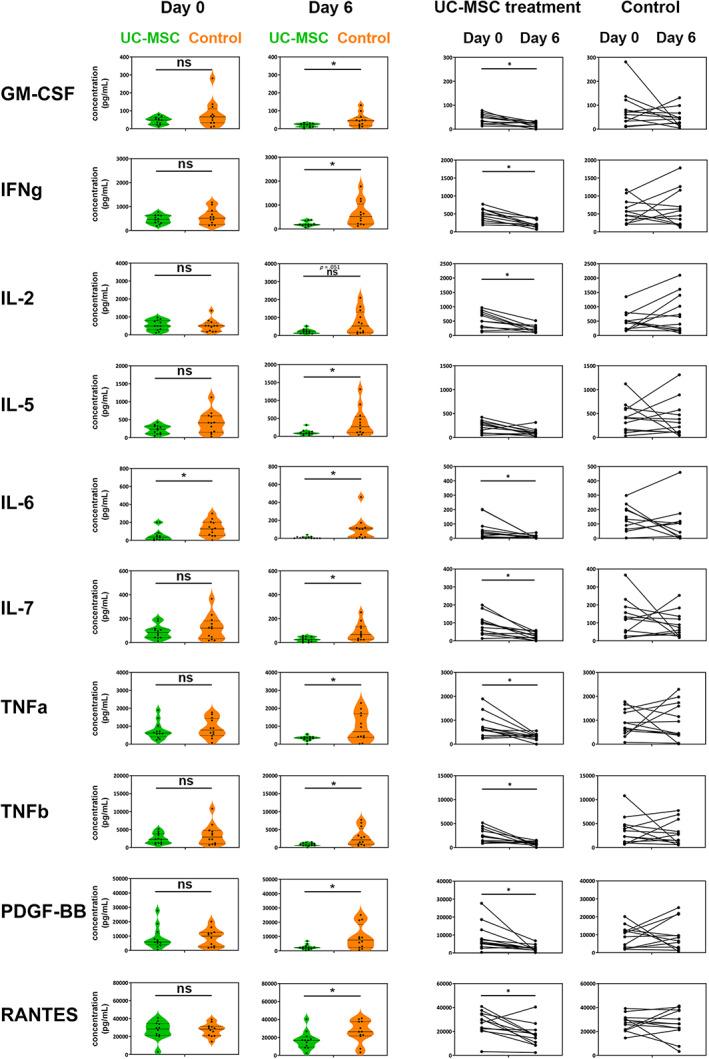
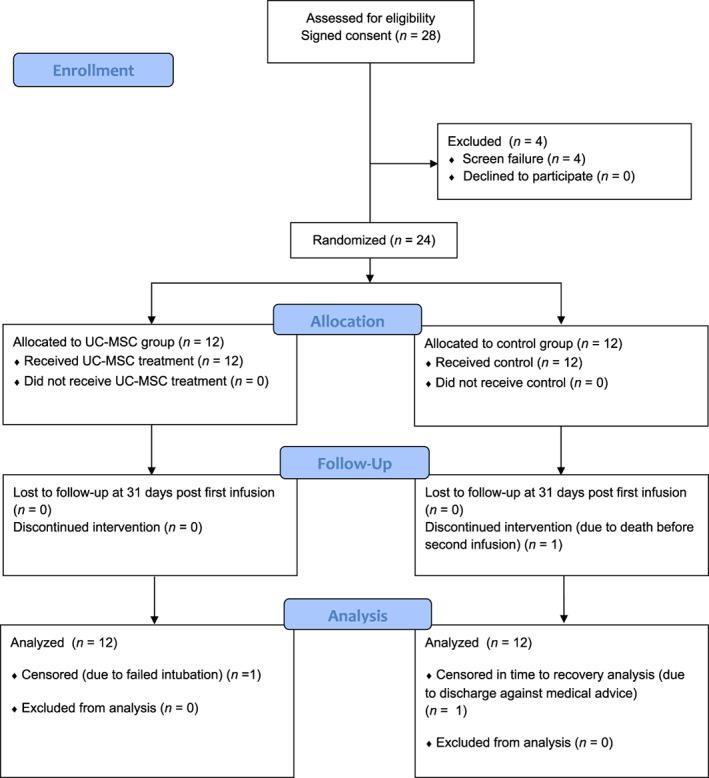
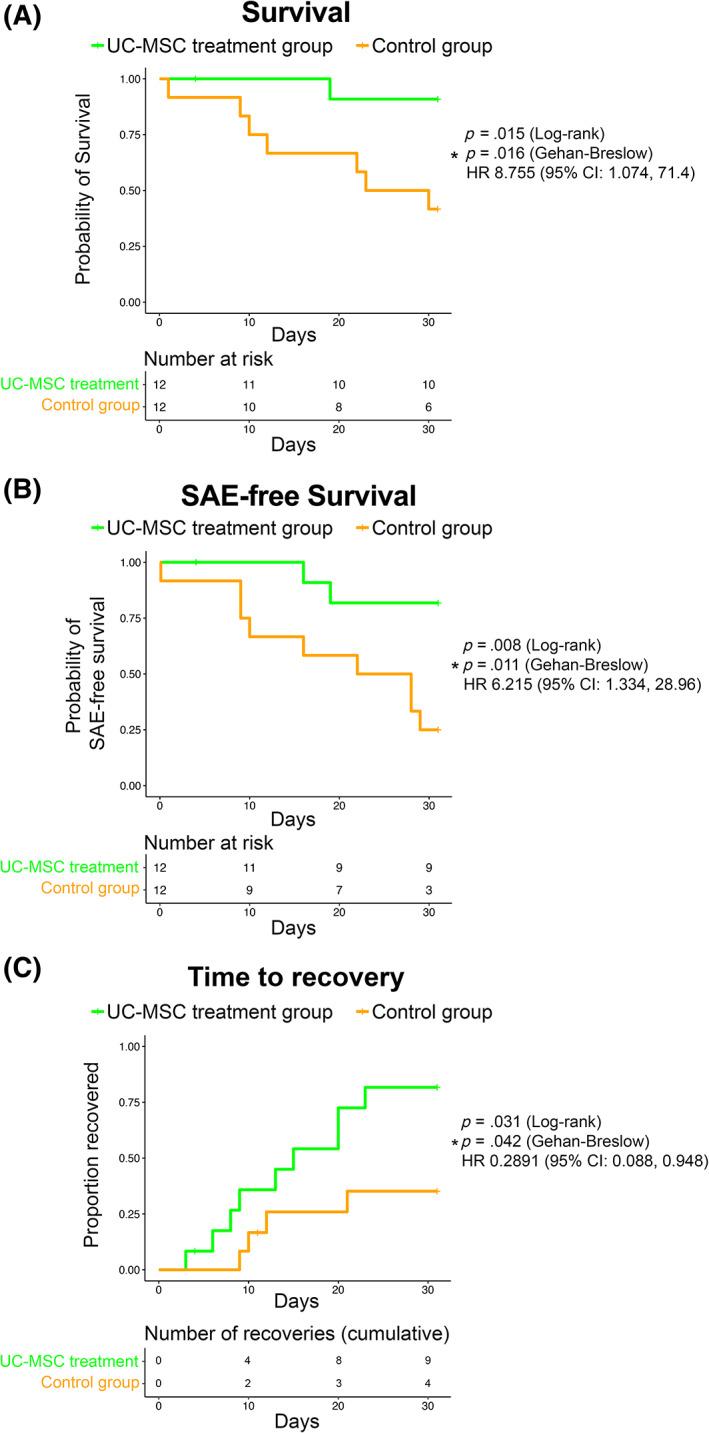
Acute respiratory distress syndrome (ARDS) in COVID-19 is associated with high mortality. Mesenchymal stem cells are known to exert immunomodulatory and anti-inflammatory effects and could yield beneficial effects in COVID-19 ARDS. The objective of this study was to determine safety and explore efficacy of umbilical cord mesenchymal stem cell (UC-MSC) infusions in subjects with COVID-19 ARDS. A double-blind, phase 1/2a, randomized, controlled trial was performed. Randomization and stratification by ARDS severity was used to foster balance among groups. All subjects were analyzed under intention to treat design. Twenty-four subjects were randomized 1:1 to either UC-MSC treatment (n = 12) or the control group (n = 12). Subjects in the UC-MSC treatment group received two intravenous infusions (at day 0 and 3) of 100 ± 20 × 10 UC-MSCs; controls received two infusions of vehicle solution. Both groups received best standard of care. Primary endpoint was safety (adverse events [AEs]) within 6 hours; cardiac arrest or death within 24 hours postinfusion). Secondary endpoints included patient survival at 31 days after the first infusion and time to recovery. No difference was observed between groups in infusion-associated AEs. No serious adverse events (SAEs) were observed related to UC-MSC infusions. UC-MSC infusions in COVID-19 ARDS were found to be safe. Inflammatory cytokines were significantly decreased in UC-MSC-treated subjects at day 6. Treatment was associated with significantly improved patient survival (91% vs 42%, P = .015), SAE-free survival (P = .008), and time to recovery (P = .03). UC-MSC infusions are safe and could be beneficial in treating subjects with COVID-19 ARDS.
新型冠状病毒肺炎(COVID-19)导致的急性呼吸窘迫综合征(ARDS)具有较高的死亡率。间充质干细胞具有免疫调节和抗炎作用,可能对 COVID-19 所致 ARDS 有益。本研究旨在确定脐带间充质干细胞(UC-MSC)输注治疗 COVID-19 ARDS 的安全性并探索其疗效。这是一项双盲、1/2a 期、随机、对照试验。采用 ARDS 严重程度分层随机化,以促进各组间的平衡。所有患者均采用意向治疗设计进行分析。24 例患者按 1:1 随机分为 UC-MSC 治疗组(n = 12)和对照组(n = 12)。UC-MSC 治疗组患者接受两次静脉输注(第 0 天和第 3 天),每次 100±20×10 UC-MSCs;对照组接受两次载体溶液输注。两组均接受最佳标准治疗。主要终点为输注后 6 小时内的安全性(不良事件[AE]);输注后 24 小时内心脏骤停或死亡。次要终点包括首次输注后 31 天的患者生存率和恢复时间。两组间输注相关 AE 无差异。未观察到与 UC-MSC 输注相关的严重不良事件(SAE)。COVID-19 ARDS 患者中 UC-MSC 输注是安全的。UC-MSC 治疗组患者在第 6 天的炎症细胞因子显著降低。治疗与患者生存率(91% vs. 42%,P = 0.015)、SAE 无生存率(P = 0.008)和恢复时间(P = 0.03)的显著改善相关。UC-MSC 输注安全,可能有益于治疗 COVID-19 ARDS 患者。
 Zotero 插件