
利用OvineSNP50k数据对来自不同生产系统的南非绵羊品种进行纯合性分析。
Runs of homozygosity analysis of South African sheep breeds from various production systems investigated using OvineSNP50k data.
作者信息
Dzomba E F, Chimonyo M, Pierneef R, Muchadeyi F C
机构信息
Discipline of Genetics, School of Life Sciences, University of KwaZulu-Natal, Private Bag X01, Scottsville, 3209, South Africa.
Discipline of Animal & Poultry Science; School of Agricultural, Earth & Environmental Sciences, University of KwaZulu-Natal, Private Bag X01, Scottsville, 3209, South Africa.
出版信息
BMC Genomics. 2021 Jan 6;22(1):7. doi: 10.1186/s12864-020-07314-2.
BACKGROUND
Population history, production system and within-breed selection pressure impacts the genome architecture resulting in reduced genetic diversity and increased frequency of runs of homozygosity islands. This study tested the hypothesis that production systems geared towards specific traits of importance or natural or artificial selection pressures influenced the occurrence and distribution of runs of homozygosity (ROH) in the South African sheep population. The Illumina OvineSNP50 BeadChip was used to genotype 400 sheep belonging to 13 breeds from South Africa representing mutton, pelt and mutton and wool dual-purpose breeds, including indigenous non-descript breeds that are reared by smallholder farmers. To get more insight into the autozygosity and distribution of ROH islands of South African breeds relative to global populations, 623 genotypes of sheep from worldwide populations were included in the analysis. Runs of homozygosity were computed at cut-offs of 1-6 Mb, 6-12 Mb, 12-24 Mb, 24-48 Mb and > 48 Mb, using the R package detectRUNS. The Golden Helix SVS program was used to investigate the ROH islands.
RESULTS
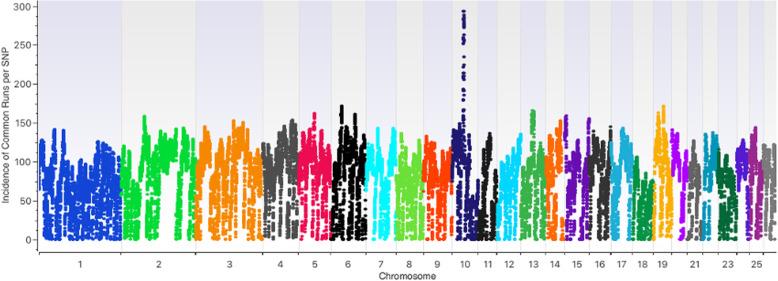
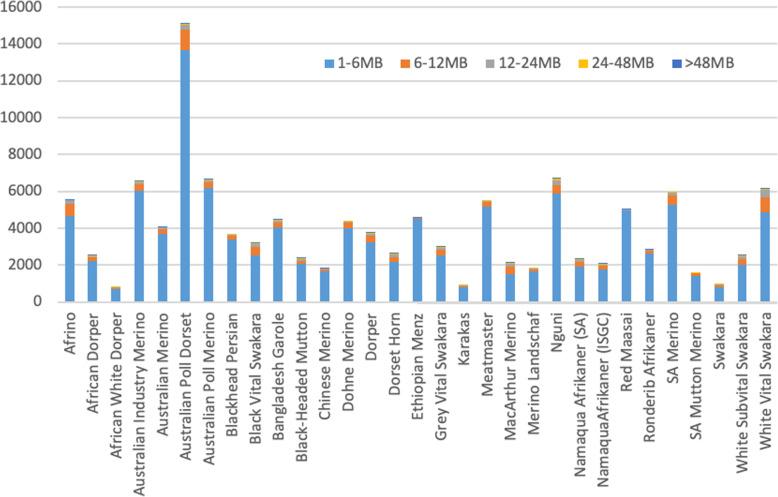
A total of 121,399 ROH with mean number of ROH per animal per breed ranging from 800 (African White Dorper) to 15,097 (Australian Poll Dorset) were obtained. Analysis of the distribution of ROH according to their size showed that, for all breeds, the majority of the detected ROH were in the short (1-6 Mb) category (88.2%). Most animals had no ROH > 48 Mb. Of the South African breeds, the Nguni and the Blackhead Persian displayed high ROH based inbreeding (F) of 0.31 ± 0.05 and 0.31 ± 0.04, respectively. Highest incidence of common runs per SNP across breeds was observed on chromosome 10 with over 250 incidences of common ROHs. Mean proportion of SNPs per breed per ROH island ranged from 0.02 ± 0.15 (island ROH224 on chromosome 23) to 0.13 ± 0.29 (island ROH175 on chromosome 15). Seventeen (17) of the islands had SNPs observed in single populations (unique ROH islands). The MacArthur Merino (MCM) population had five unique ROH islands followed by Blackhead Persian and Nguni with three each whilst the South African Mutton Merino, SA Merino, White Vital Swakara, Karakul, Dorset Horn and Chinese Merino each had one unique ROH island. Genes within ROH islands were associated with predominantly metabolic and immune response traits and predomestic selection for traits such as presence or absence of horns.
CONCLUSIONS
Overall, the frequency and patterns of distribution of ROH observed in this study corresponds to the breed history and implied selection pressures exposed to the sheep populations under study.
背景
种群历史、生产系统和品种内选择压力会影响基因组结构,导致遗传多样性降低和纯合子岛的出现频率增加。本研究检验了以下假设:针对重要特定性状的生产系统或自然或人工选择压力会影响南非绵羊群体中纯合子片段(ROH)的出现和分布。使用Illumina OvineSNP50 BeadChip对来自南非的400只绵羊进行基因分型,这些绵羊分属于13个品种,代表了肉用、皮用以及肉毛兼用品种,包括由小农户饲养的本土非特定品种。为了更深入了解南非品种相对于全球群体的纯合性和ROH岛的分布情况,分析中纳入了来自全球群体的623只绵羊的基因型。使用R包detectRUNS在1 - 6 Mb、6 - 12 Mb、12 - 24 Mb、24 - 48 Mb和>48 Mb的阈值下计算纯合子片段。使用Golden Helix SVS程序研究ROH岛。
结果
共获得121,399个ROH,每个品种每只动物的ROH平均数从800(非洲白多珀羊)到15,097(澳大利亚无角陶赛特羊)不等。根据ROH大小对其分布进行分析表明,对于所有品种,检测到的ROH大多数属于短片段(1 - 6 Mb)类别(88.2%)。大多数动物没有>48 Mb的ROH。在南非品种中,恩古尼羊和黑头波斯羊显示出较高的基于ROH的近交系数(F),分别为0.31±0.05和0.31±0.04。在10号染色体上观察到各品种中每个单核苷酸多态性(SNP)的常见ROH发生率最高,有超过250个常见ROH实例。每个品种每个ROH岛的SNP平均比例范围从0.02±0.15(23号染色体上的ROH岛ROH224)到0.13±0.29(15号染色体上的ROH岛ROH175)。其中17个岛在单个群体中观察到SNP(独特的ROH岛)。麦克阿瑟美利奴羊(MCM)群体有5个独特的ROH岛,其次是黑头波斯羊和恩古尼羊,各有3个,而南非肉用美利奴羊、南非美利奴羊、白维塔尔斯瓦卡拉羊、卡拉库尔羊、多塞特角羊和中国美利奴羊各有1个独特的ROH岛。ROH岛内的基因主要与代谢和免疫反应性状以及诸如有无角等性状的驯化前选择相关。
结论
总体而言,本研究中观察到的ROH的频率和分布模式与所研究绵羊群体的品种历史以及隐含的选择压力相符。

 Zotero 插件