
一项系统评价,旨在探索影响阿拉伯移民身体活动水平的因素的定性研究。
A systematic review of qualitative studies exploring the factors influencing the physical activity levels of Arab migrants.
机构信息
School of Health Sciences, Western Sydney University, Penrith, NSW, 2751, Australia.
Translational Health Research Institute, Western Sydney University, Penrith, Australia.
出版信息
Int J Behav Nutr Phys Act. 2021 Jan 6;18(1):2. doi: 10.1186/s12966-020-01056-w.
BACKGROUND
Evidence suggests that Arab migrant populations engage in low levels of physical activity. To our knowledge, there are no reviews that explore the perspectives of Arab migrant populations on the factors influencing physical activity. The aim of this systematic review was to thematically synthesise qualitative literature on the factors influencing physical activity among Arab migrant populations.
METHODS
Five electronic databases (CINAHL, SPORTDiscus, PsychoInfo, MEDLINE, Embase) were searched in July 2018 and searched again in April 2020. A manual search in Google Scholar was also performed using keywords and the reference lists of included studies were also screened to identify further articles. The eligibility criteria for inclusion were studies that sampled adult (≥18 years) Arab migrant populations, used qualitative methodology, explored the factors influencing physical activity as a primary aim, and were published in English. The 10-item Critical Appraisal Skills Programme (CASP) checklist was used to assess methodological quality of individual studies. The results of the studies were thematically synthesised using the qualitative software Quirkos v1.6.
RESULTS
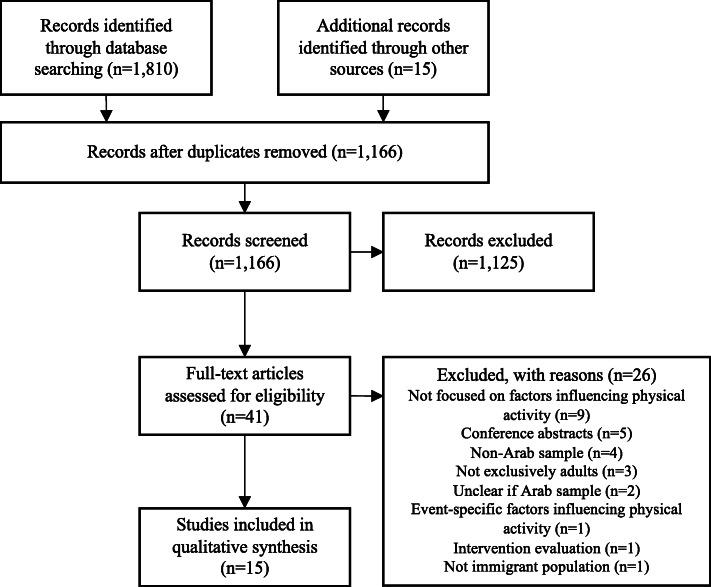
A total of 15 studies were included, with the largest proportion of studies conducted in Australia, followed by the United States, Netherlands, Sweden, and then Canada. Five studies exclusively sampled Arab migrant populations in their study. A total of 7 major themes influencing physical activity among Arab migrants emerged from the synthesis: culture and religion, competing commitments and time, social factors, health-related influences, accessibility issues, outdoor environment, and the migratory experience.
CONCLUSIONS
The findings of this review highlighted the various factors influencing the physical activity levels of Arab migrant adults. While many of the factors influencing physical activity are shared with those experienced by other populations (e.g., time constraints), for Arab migrant populations there are other more unique factors closely associated with culture and religion that appear to influence their levels of physical activity. The findings of this review could be used to inform the design of physical activity interventions targeting Arab migrant populations.
背景
有证据表明,阿拉伯移民人群的身体活动水平较低。据我们所知,目前还没有综述探讨阿拉伯移民人群对影响身体活动因素的看法。本系统综述的目的是对影响阿拉伯移民人群身体活动的因素进行主题综合分析。
方法
2018 年 7 月在 CINAHL、SPORTDiscus、PsychoInfo、MEDLINE、Embase 这 5 个电子数据库进行了检索,并于 2020 年 4 月再次进行了检索。还使用关键词在 Google Scholar 上进行了手动搜索,并对纳入研究的参考文献进行了筛选,以确定其他文章。纳入标准为:以成年(≥18 岁)阿拉伯移民人群为样本、使用定性方法、主要探讨影响身体活动的因素且以英文发表的研究。采用 10 项批判性评估技能计划(CASP)检查表评估单个研究的方法学质量。使用定性软件 Quirkos v1.6 对研究结果进行主题综合分析。
结果
共纳入 15 项研究,其中澳大利亚开展的研究比例最大,其次是美国、荷兰、瑞典,然后是加拿大。共有 5 项研究专门在研究中对阿拉伯移民人群进行了抽样。综合分析后得出影响阿拉伯移民身体活动的 7 个主要主题:文化和宗教、竞争承诺和时间、社会因素、健康相关影响、可达性问题、户外环境和移民经历。
结论
本综述结果强调了影响阿拉伯成年移民身体活动水平的各种因素。虽然许多影响身体活动的因素与其他人群(如时间限制)相同,但对于阿拉伯移民人群,还有其他与文化和宗教密切相关的更独特因素,这些因素似乎影响了他们的身体活动水平。本综述的结果可用于为针对阿拉伯移民人群的身体活动干预措施的设计提供信息。
 Zotero 插件