
宏基因组下一代测序在感染性疾病中的诊断价值。
The diagnostic value of metagenomic next⁃generation sequencing in infectious diseases.
机构信息
Department of Respiratory Medicine, Shanghai 10th People's Hospital, Tongji University School of Medicine, #301, Mid Yanchang Rd, Shanghai, 200072, China.
Department of Emergency, Shanghai 10th People's Hospital, Tongji University School of Medicine, Shanghai, 200072, China.
出版信息
BMC Infect Dis. 2021 Jan 13;21(1):62. doi: 10.1186/s12879-020-05746-5.
BACKGROUND
Although traditional diagnostic techniques of infection are mature and price favorable at present, most of them are time-consuming and with a low positivity. Metagenomic next⁃generation sequencing (mNGS) was studied widely because of identification and typing of all pathogens not rely on culture and retrieving all DNA without bias. Based on this background, we aim to detect the difference between mNGS and traditional culture method, and to explore the relationship between mNGS results and the severity, prognosis of infectious patients.
METHODS
109 adult patients were enrolled in our study in Shanghai Tenth People's Hospital from October 2018 to December 2019. The diagnostic results, negative predictive values, positive predictive values, false positive rate, false negative rate, pathogen and sample types were analyzed by using both traditional culture and mNGS methods. Then, the samples and clinical information of 93 patients in the infected group (ID) were collected. According to whether mNGS detected pathogens, the patients in ID group were divided into the positive group of 67 cases and the negative group of 26 cases. Peripheral blood leukocytes, C-reactive protein (CRP), procalcitonin (PCT) and neutrophil counts were measured, and the concentrations of IL-2, IL-4, IL-6, TNF-α, IL-17A, IL-10 and INF-γ in the serum were determined by ELISA. The correlation between the positive detection of pathogens by mNGS and the severity of illness, hospitalization days, and mortality were analyzed.
RESULTS
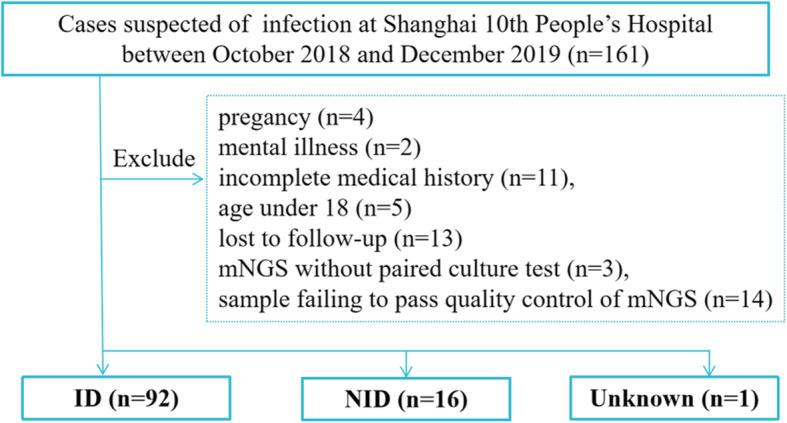
109 samples were assigned into infected group (ID, 92/109, 84.4%), non-infected group (NID, 16/109, 14.7%), and unknown group (1/109, 0.9%). Blood was the most abundant type of samples with 37 cases, followed by bronchoalveolar lavage fluid in 36 cases, tissue, sputum, pleural effusion, cerebrospinal fluid (CSF), pus, bone marrow and nasal swab. In the ID group, the majority of patients were diagnosed with lower respiratory system infections (73/109, 67%), followed by bloodstream infections, pleural effusion and central nervous system infections. The sensitivity of mNGS was significantly higher than that of culture method (67.4% vs 23.6%; P < 0.001), especially in sample types of bronchoalveolar lavage fluid (P = 0.002), blood (P < 0.001) and sputum (P = 0.037), while the specificity of mNGS was not significantly different from culture method (68.8% vs 81.3%; P = 0.41). The number of hospitals stays and 28-day-motality in the positive mNGS group were significantly higher than those in the negative group, and the difference was statistically significant (P < 0.05). Age was significant in multivariate logistic analyses of positive results of mNGS.
CONCLUSIONS
The study found that mNGS had a higher sensitivity than the traditional method, especially in blood, bronchoalveolar lavage fluid and sputum samples. And positive mNGS group had a higher hospital stay, 28-day-mortality, which means the positive of pathogen nucleic acid sequences detection may be a potential high-risk factor for poor prognosis of adult patients and has significant clinical value. MNGS should be used more in early pathogen diagnosis in the future.
背景
尽管传统的感染诊断技术目前已经成熟且价格合理,但大多数技术都需要花费大量时间,且阳性率较低。宏基因组下一代测序(mNGS)因其不依赖培养和无偏检索所有 DNA 而能够鉴定和分型所有病原体而受到广泛研究。基于此背景,我们旨在检测 mNGS 与传统培养方法的差异,并探讨 mNGS 结果与感染患者严重程度和预后的关系。
方法
2018 年 10 月至 2019 年 12 月,我们在上海第十人民医院招募了 109 例成年患者。使用传统培养和 mNGS 方法分析诊断结果、阴性预测值、阳性预测值、假阳性率、假阴性率、病原体和样本类型。然后,收集感染组(ID)93 例患者的样本和临床信息。根据 mNGS 是否检测到病原体,将 ID 组患者分为阳性组 67 例和阴性组 26 例。测量外周血白细胞、C 反应蛋白(CRP)、降钙素原(PCT)和中性粒细胞计数,并通过 ELISA 测定血清中 IL-2、IL-4、IL-6、TNF-α、IL-17A、IL-10 和 INF-γ 的浓度。分析 mNGS 检测到病原体的阳性与疾病严重程度、住院天数和死亡率的相关性。
结果
109 份样本分为感染组(ID,92/109,84.4%)、非感染组(NID,16/109,14.7%)和未知组(1/109,0.9%)。血液是样本中最丰富的类型,有 37 例,其次是支气管肺泡灌洗液 36 例,组织、痰、胸腔积液、脑脊液(CSF)、脓液、骨髓和鼻拭子。在 ID 组中,大多数患者被诊断为下呼吸道感染(73/109,67%),其次是血流感染、胸腔积液和中枢神经系统感染。mNGS 的灵敏度明显高于培养方法(67.4% vs 23.6%;P < 0.001),尤其是在支气管肺泡灌洗液(P = 0.002)、血液(P <0.001)和痰(P = 0.037)样本类型中,而 mNGS 的特异性与培养方法无显著差异(68.8% vs 81.3%;P = 0.41)。阳性 mNGS 组的住院天数和 28 天死亡率明显高于阴性组,差异有统计学意义(P < 0.05)。年龄在 mNGS 阳性结果的多因素逻辑分析中具有统计学意义。
结论
本研究发现 mNGS 比传统方法具有更高的灵敏度,尤其是在血液、支气管肺泡灌洗液和痰样本中。阳性 mNGS 组的住院时间、28 天死亡率更高,这意味着病原体核酸序列检测阳性可能是成年患者预后不良的潜在高危因素,具有显著的临床价值。未来应更多地将 mNGS 应用于早期病原体诊断。



 Zotero 插件