
系统性分析自噬相关基因对肉瘤患者的诊断和预后价值。
Systematic profiling of diagnostic and prognostic value of autophagy-related genes for sarcoma patients.
机构信息
Department of Orthopaedic Surgery, The Affiliated Hospital of Qingdao University, Qingdao, 266071, China.
Department of Spinal Surgery, Yantai Affiliated Hospital of Binzhou Medical University, Yantai, 264100, China.
出版信息
BMC Cancer. 2021 Jan 12;21(1):58. doi: 10.1186/s12885-020-07596-5.
BACKGROUND
Autophagy-related genes (ARGs) have been confirmed to have an important role in tumorigenesis and tumor microenvironment formation. Nevertheless, a systematic analysis of ARGs and their clinical significance in sarcoma patients is lacking.
METHODS
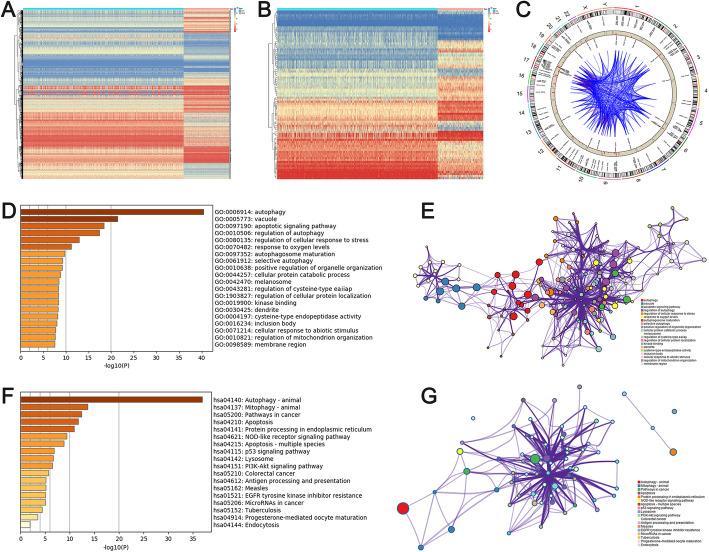
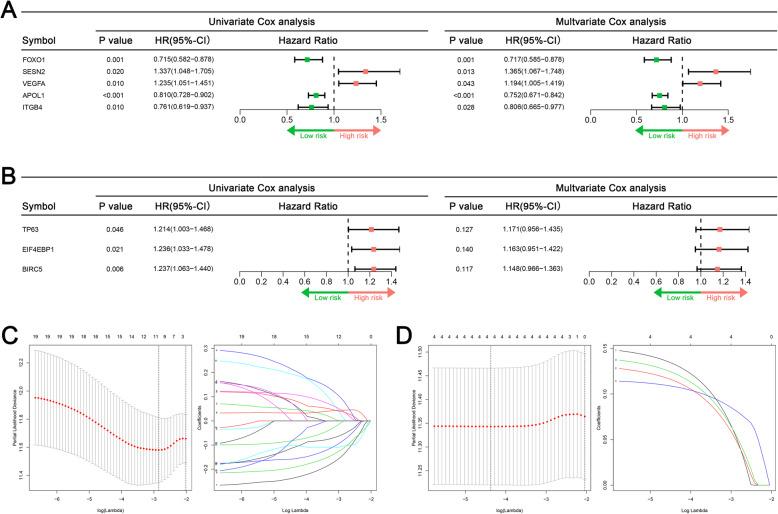
Gene expression files from The Cancer Genome Atlas (TCGA) database and Genotype-Tissue Expression (GTEx) were used to select differentially expressed genes (DEGs). Differentially expressed ARGs (DEARGs) were determined by matching the DEG and HADb gene sets, which were evaluated by functional enrichment analysis. Unsupervised clustering of the identified DEARGs was conducted, and associations with tumor microenvironment (TME), immune checkpoints, and immune cells were analyzed simultaneously. Two prognostic signatures, one for overall survival (OS) and one for disease-free survival (DFS), were established and validated in an independent set.
RESULTS
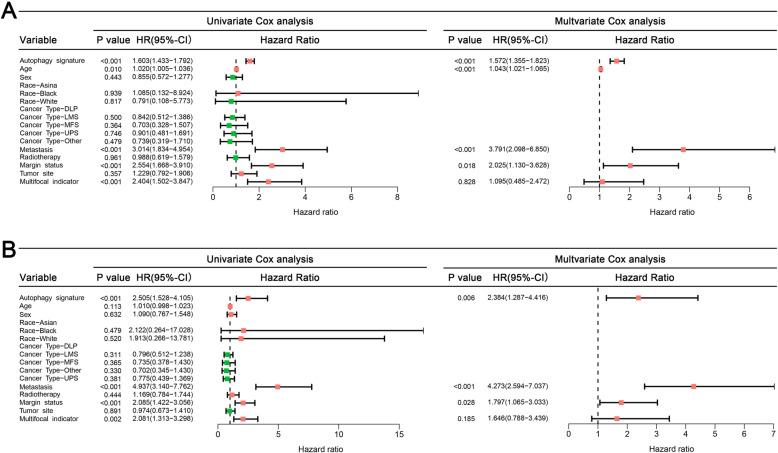
In total, 84 DEARGs and two clusters were identified. TME scores, five immune checkpoints, and several types of immune cells were found to be significantly different between two clusters. Two prognostic signatures incorporating DEARGs showed favorable discrimination and were successfully validated. Two nomograms combining signature and clinical variables were generated. The C-indexes were 0.818 and 0.747 for the OS and DFS nomograms, respectively.
CONCLUSION
This comprehensive analyses of the ARG landscape in sarcoma showed novel ARGs related to carcinogenesis and the immune microenvironment. These findings have implications for prognosis and therapeutic responses, which reveal novel potential prognostic biomarkers, promote precision medicine, and provide potential novel targets for immunotherapy.
背景
自噬相关基因(ARGs)已被证实在肿瘤发生和肿瘤微环境形成中具有重要作用。然而,缺乏对肉瘤患者 ARGs 及其临床意义的系统分析。
方法
使用来自癌症基因组图谱(TCGA)数据库和基因-组织表达(GTEx)的基因表达文件来选择差异表达基因(DEGs)。通过匹配 DEG 和 HADb 基因集来确定差异表达的 ARGs(DEARGs),并通过功能富集分析进行评估。对鉴定出的 DEARGs 进行无监督聚类分析,并同时分析与肿瘤微环境(TME)、免疫检查点和免疫细胞的关联。在独立数据集建立和验证了两个用于总生存期(OS)和无病生存期(DFS)的预后签名。
结果
共鉴定出 84 个 DEARGs 和 2 个聚类。发现两个聚类之间 TME 评分、五个免疫检查点和几种类型的免疫细胞存在显著差异。纳入 DEARGs 的两个预后签名显示出良好的区分能力,并得到了成功验证。生成了两个结合签名和临床变量的列线图。OS 和 DFS 列线图的 C 指数分别为 0.818 和 0.747。
结论
这项对肉瘤中 ARG 景观的综合分析显示了与致癌作用和免疫微环境相关的新型 ARGs。这些发现对预后和治疗反应具有重要意义,揭示了新的潜在预后生物标志物,促进精准医学,并为免疫治疗提供了新的潜在靶点。




 Zotero 插件