
可改变和不可改变的 COVID-19 风险因素,以及与流感和肺炎风险因素的比较:来自英国生物银行前瞻性队列研究的结果。
Modifiable and non-modifiable risk factors for COVID-19, and comparison to risk factors for influenza and pneumonia: results from a UK Biobank prospective cohort study.
机构信息
Institute of Health and Wellbeing, University of Glasgow, Glasgow, UK.
Institute of Cardiovascular and Medical Sciences, University of Glasgow, Glasgow, UK.
出版信息
BMJ Open. 2020 Nov 19;10(11):e040402. doi: 10.1136/bmjopen-2020-040402.
OBJECTIVES
We aimed to investigate demographic, lifestyle, socioeconomic and clinical risk factors for COVID-19, and compared them to risk factors for pneumonia and influenza in UK Biobank.
DESIGN
Cohort study.
SETTING
UK Biobank.
PARTICIPANTS
49-83 year olds (in 2020) from a general population study.
MAIN OUTCOME MEASURES
Confirmed COVID-19 infection (positive SARS-CoV-2 test). Incident influenza and pneumonia were obtained from primary care data. Poisson regression was used to study the association of exposure variables with outcomes.
RESULTS
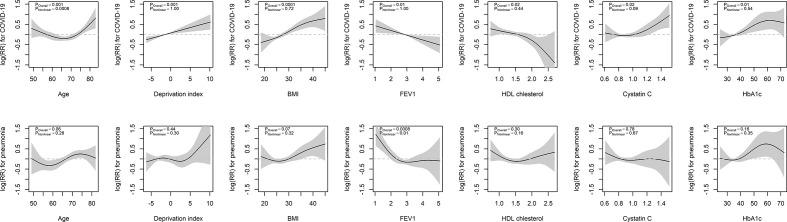
Among 235 928 participants, 397 had confirmed COVID-19. After multivariable adjustment, modifiable risk factors were higher body mass index and higher glycated haemoglobin (HbA1C) (RR 1.28 and RR 1.14 per SD increase, respectively), smoking (RR 1.39), slow walking pace as a proxy for physical fitness (RR 1.53), and use of blood pressure medications as a proxy for hypertension (RR 1.33). Higher forced expiratory volume in 1 s (FEV1) and high-density lipoprotein (HDL) cholesterol were both associated with lower risk (RR 0.84 and RR 0.83 per SD increase, respectively). Non-modifiable risk factors included male sex (RR 1.72), black ethnicity (RR 2.00), socioeconomic deprivation (RR 1.17 per SD increase in Townsend Index), and high cystatin C (RR 1.13 per SD increase). The risk factors overlapped with pneumonia somewhat, less so for influenza. The associations with modifiable risk factors were generally stronger for COVID-19, than pneumonia or influenza.
CONCLUSION
These findings suggest that modification of lifestyle may help to reduce the risk of COVID-19 and could be a useful adjunct to other interventions, such as social distancing and shielding of high risk.
目的
我们旨在研究 COVID-19 的人口统计学、生活方式、社会经济和临床危险因素,并将其与英国生物银行中肺炎和流感的危险因素进行比较。
设计
队列研究。
设置
英国生物银行。
参与者
来自一般人群研究的 49-83 岁(2020 年)的人群。
主要观察指标
确诊的 COVID-19 感染(SARS-CoV-2 检测阳性)。通过初级保健数据获得流感和肺炎的发病情况。采用泊松回归研究暴露变量与结局的关系。
结果
在 235928 名参与者中,有 397 人确诊 COVID-19。经过多变量调整后,可改变的危险因素包括较高的体重指数和糖化血红蛋白(HbA1C)(分别增加 1 个标准差时 RR 为 1.28 和 1.14)、吸烟(RR 1.39)、作为身体适应性的步行速度较慢(RR 1.53)以及作为高血压的替代指标的血压药物的使用(RR 1.33)。较高的用力呼气量(FEV1)和高密度脂蛋白(HDL)胆固醇都与较低的风险相关(分别增加 1 个标准差时 RR 为 0.84 和 0.83)。不可改变的危险因素包括男性(RR 1.72)、黑人种族(RR 2.00)、社会经济贫困(Townsend 指数每增加 1 个标准差时 RR 为 1.17)和高胱氨酸蛋白酶 C(RR 1.13)。这些危险因素与肺炎有一定的重叠,与流感的重叠较少。与可改变的危险因素的相关性对于 COVID-19 来说通常更强,而对于肺炎或流感则较弱。
结论
这些发现表明,生活方式的改变可能有助于降低 COVID-19 的风险,并且可能是社交隔离和高危人群保护等其他干预措施的有益补充。

 Zotero 插件