
在一个具有全国代表性的美国样本中,年龄、性别、种族/民族和教育与 13 个表观遗传钟的关联:健康与退休研究。
Associations of Age, Sex, Race/Ethnicity, and Education With 13 Epigenetic Clocks in a Nationally Representative U.S. Sample: The Health and Retirement Study.
机构信息
Davis School of Gerontology, University of Southern California, Los Angeles, USA.
Department of Laboratory Medicine and Pathology, University of Minnesota Medical School, Minneapolis, USA.
出版信息
J Gerontol A Biol Sci Med Sci. 2021 May 22;76(6):1117-1123. doi: 10.1093/gerona/glab016.
BACKGROUND
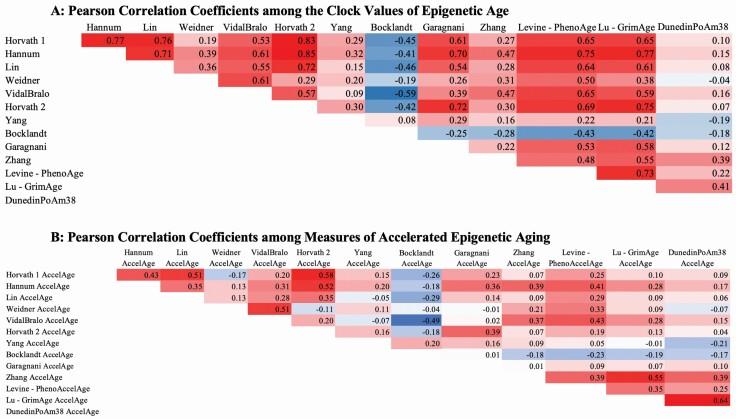
Many DNA methylation-based indicators have been developed as summary measures of epigenetic aging. We examine the associations between 13 epigenetic clocks, including 4 second generation clocks, as well as the links of the clocks to social, demographic, and behavioral factors known to be related to health outcomes: sex, race/ethnicity, socioeconomic status, obesity, and lifetime smoking pack-years.
METHODS
The Health and Retirement Study is the data source which is a nationally representative sample of Americans over age 50. Assessment of DNA methylation was based on the EPIC chip and epigenetic clocks were developed based on existing literature.
RESULTS
The clocks vary in the strength of their relationships with age, with each other and with independent variables. Second generation clocks trained on health-related characteristics tend to relate more strongly to the sociodemographic and health behaviors known to be associated with health outcomes in this age group.
CONCLUSIONS
Users of this publicly available data set should be aware that epigenetic clocks vary in their relationships to age and to variables known to be related to the process of health change with age.
背景
许多基于 DNA 甲基化的指标已被开发为表观遗传衰老的综合衡量指标。我们研究了包括 4 个第二代时钟在内的 13 个表观遗传时钟之间的关联,以及这些时钟与已知与健康结果相关的社会、人口统计学和行为因素(性别、种族/民族、社会经济地位、肥胖和终生吸烟包年数)之间的联系。
方法
健康与退休研究是数据来源,是一个年龄在 50 岁以上的美国人的全国代表性样本。DNA 甲基化的评估基于 EPIC 芯片,并且根据现有文献开发了表观遗传时钟。
结果
这些时钟与年龄、彼此以及与独立变量的关系强度不同。基于健康相关特征训练的第二代时钟往往与年龄组中已知与健康结果相关的社会人口统计学和健康行为更密切相关。
结论
使用这个公开可用数据集的用户应该意识到,表观遗传时钟与年龄以及与已知与年龄相关的健康变化过程相关的变量之间的关系各不相同。
 Zotero 插件