
Cbl-b 的缺失抑制了 CD8 T 细胞衰竭并增强了 CAR T 细胞的功能。
Deletion of Cbl-b inhibits CD8 T-cell exhaustion and promotes CAR T-cell function.
机构信息
Internal Medicine, UT Southwestern Medical Center, Dallas, Texas, USA.
Immunology, UT Southwestern Medical Center, Dallas, Texas, USA.
出版信息
J Immunother Cancer. 2021 Jan;9(1). doi: 10.1136/jitc-2020-001688.
BACKGROUND
Chimeric antigen receptor (CAR) T-cell therapy is an emerging option for cancer treatment, but its efficacy is limited, especially in solid tumors. This is partly because the CAR T cells become dysfunctional and exhausted in the tumor microenvironment. However, the key pathways responsible for impaired function of exhausted cells remain unclear, which is essential to overcome CAR T-cell exhaustion.
METHODS
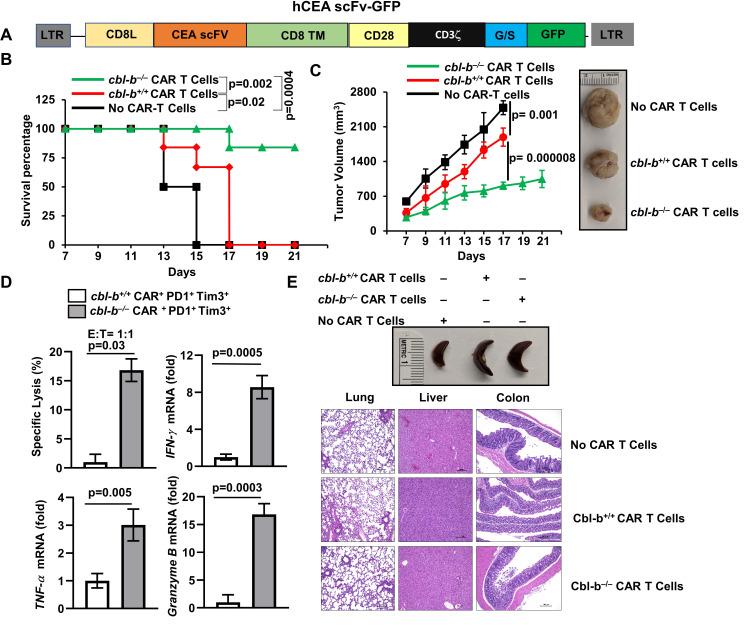
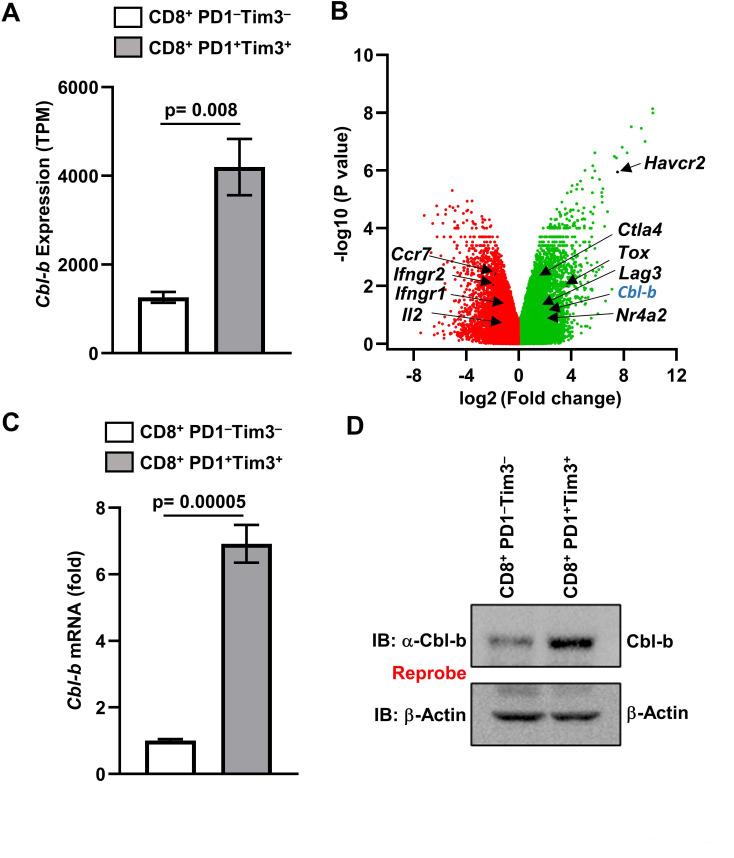
Analysis of RNA-sequencing data from CD8 tumor-infiltrating lymphocytes (TILs) led to identification of Cbl-b as a potential target. The sequencing data were validated using a syngeneic MC38 colon cancer model. To analyze the in vivo role of Cbl-b in T-cell exhaustion, tumor growth, % PD1Tim3 cells, and expression of effector cytokines were analyzed in and mice. To evaluate the therapeutic potential of Cbl-b depletion, we generated a new CAR construct, hCEAscFv-CD28-CD3ζ.GFP, that recognizes human carcinoembryonic antigen (CEA). and CEA-CAR T cells were generated by retroviral transduction. mice bearing MC38-CEA cells were injected with and ; CEA-CAR T cells, tumor growth, % PD1Tim3 cells and expression of effector cytokines were analyzed.
RESULTS
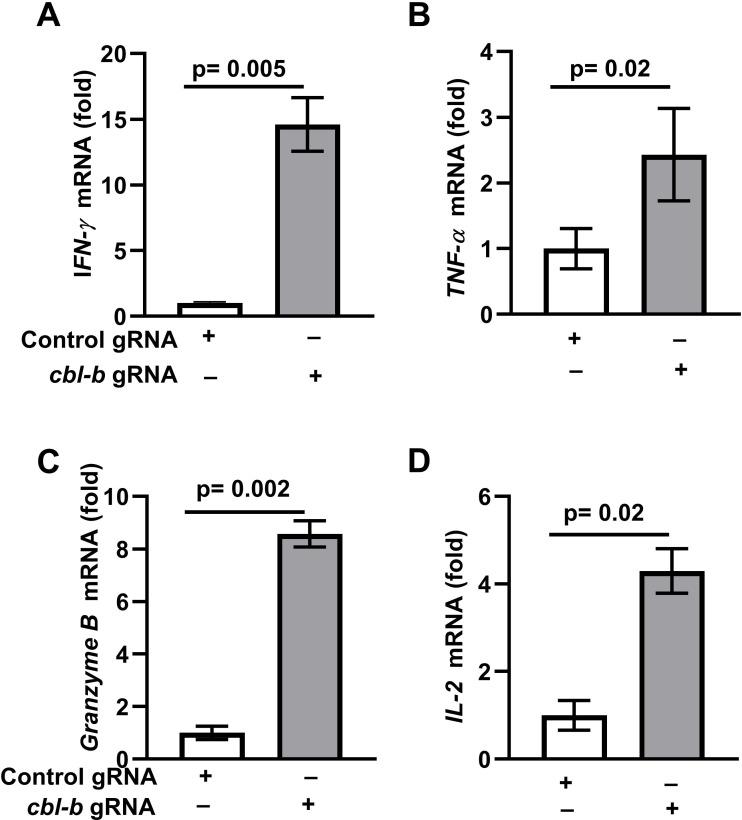
Our results show that the E3 ubiquitin ligase Cbl-b is upregulated in exhausted (PD1Tim3) CD8 TILs. CRISPR-Cas9-mediated inhibition of Cbl-b restores the effector function of exhausted CD8 TILs. Importantly, the reduced growth of syngeneic MC38 tumors in mice was associated with a marked reduction of PD1Tim3 CD8 TILs. Depletion of Cbl-b inhibited CAR T-cell exhaustion, resulting in reduced MC38-CEA tumor growth, reduced PD1Tim3 cells and increased expression of interferon gamma, tumor necrosis factor alpha, and increased tumor cell killing.
CONCLUSION
Our studies demonstrate that deficiency of Cbl-b overcomes endogenous CD8 T-cell exhaustion, and deletion of Cbl-b in CAR T cells renders them resistant to exhaustion. Our results could facilitate the development of efficient CAR T-cell therapy for solid tumors by targeting Cbl-b.
背景
嵌合抗原受体(CAR)T 细胞疗法是癌症治疗的一种新兴选择,但疗效有限,尤其是在实体瘤中。这在一定程度上是因为 CAR T 细胞在肿瘤微环境中功能失调和衰竭。然而,负责衰竭细胞功能障碍的关键途径仍不清楚,这对于克服 CAR T 细胞衰竭至关重要。
方法
对 CD8 肿瘤浸润淋巴细胞(TIL)的 RNA 测序数据进行分析,导致鉴定出 Cbl-b 作为一个潜在的靶点。使用同源 MC38 结肠癌细胞模型对测序数据进行验证。为了分析 Cbl-b 在 T 细胞衰竭中的体内作用,在 和 小鼠中分析肿瘤生长、%PD1Tim3 细胞和效应细胞因子的表达。为了评估 Cbl-b 耗竭的治疗潜力,我们生成了一种新的 CAR 构建体,hCEAscFv-CD28-CD3ζ.GFP,它识别人癌胚抗原(CEA)。通过逆转录病毒转导生成 和 CEA-CAR T 细胞。将携带 MC38-CEA 细胞的 小鼠注射 和 ;CEA-CAR T 细胞、肿瘤生长、%PD1Tim3 细胞和效应细胞因子的表达进行分析。
结果
我们的结果表明,E3 泛素连接酶 Cbl-b 在衰竭(PD1Tim3)CD8 TIL 中上调。CRISPR-Cas9 介导的 Cbl-b 抑制恢复了衰竭的 CD8 TIL 的效应功能。重要的是,在 小鼠中,同源 MC38 肿瘤生长减少与 PD1Tim3 CD8 TIL 的显著减少有关。Cbl-b 的耗竭抑制了 CAR T 细胞衰竭,导致 MC38-CEA 肿瘤生长减少、PD1Tim3 细胞减少和干扰素γ、肿瘤坏死因子α表达增加以及肿瘤细胞杀伤增加。
结论
我们的研究表明,Cbl-b 的缺乏克服了内源性 CD8 T 细胞衰竭,并且 CAR T 细胞中 Cbl-b 的缺失使它们对衰竭具有抗性。我们的结果可以通过靶向 Cbl-b 促进针对实体瘤的有效 CAR T 细胞疗法的发展。

 Zotero 插件