
新型冠状病毒病-2019 大流行对儿童肥胖和维生素 D 状况的影响。
The Impact of the Coronavirus Disease-2019 Pandemic on Childhood Obesity and Vitamin D Status.
机构信息
Department of Pediatrics, College of Medicine, The Catholic University of Korea, Seoul, Korea.
出版信息
J Korean Med Sci. 2021 Jan 18;36(3):e21. doi: 10.3346/jkms.2021.36.e21.
BACKGROUND
The risk of weight gain as a consequence of school closure in children during the coronavirus disease-2019 (COVID-19) pandemic has been recognized. This study was performed to investigate changes in anthropometric and metabolic parameters in children following a 6-month period of social distancing and school closure due to the pandemic.
METHODS
This retrospective cohort study was conducted in school-aged children that were on routine follow-up at the Growth Clinic of Seoul St. Mary's Hospital. Changes in body mass index (BMI) standard deviation scores (z-scores), lipid profiles, and vitamin D levels were investigated. The 1-year period prior to school closure was defined as "pre-COVID-19 period," and the subsequent 6-month period as "COVID-19 period."
RESULTS
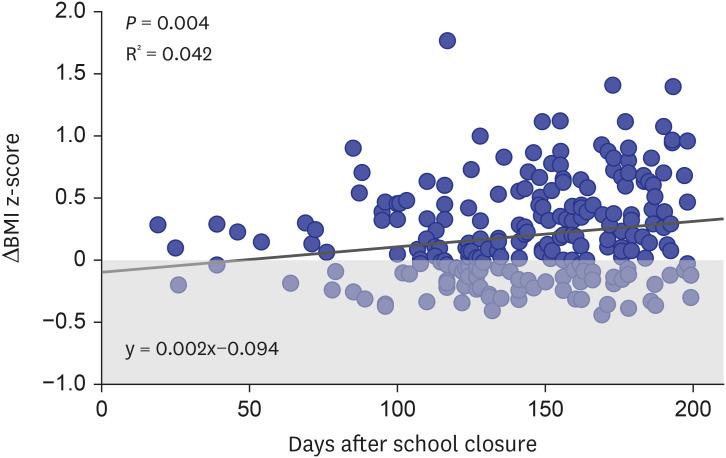
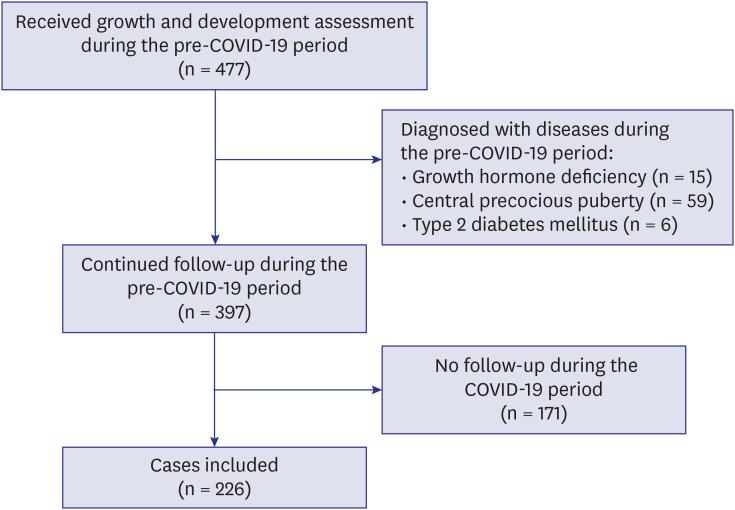
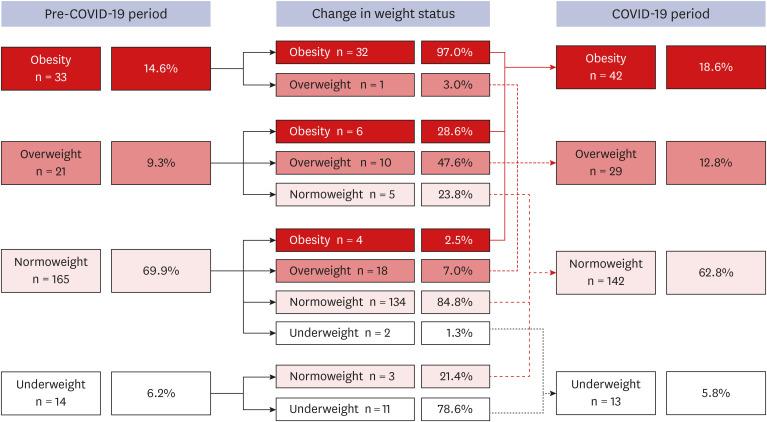
Overall, 226 children between 4 to 14 years old without comorbidities were assessed. On average, their BMI z-scores increased by 0.219 (95% confidence interval [CI], 0.167-0.271; < 0.001) in the COVID-19 period compared to the pre-COVID-19 period, and the proportion of overweight or obesity increased from 23.9% in the pre-COVID-19 period to 31.4% in the COVID-19 period. The number of days after school closure ( = 0.004) and being in the normoweight category in the pre-COVID-19 period ( = 0.017) were factors associated with an increased BMI in the COVID-19 period. The mean triglyceride (105.8 mg/dL vs. 88.6 mg/dL, < 0.001) and low-density lipoprotein-cholesterol (100.2 mg/dL vs. 94.0 mg/dL, = 0.002) levels were higher, whereas the calcidiol level (18.9 mg/dL vs. 23.8 mg/dL, < 0.001) was lower in the COVID-19 period compared to the pre-COVID-19 period.
CONCLUSION
Within 6 months, increased childhood obesity and vitamin D deficiencies were observed. The duration of school closure was significantly associated with an increased BMI and being normoweight does not exclude the risks for gaining weight.
背景
人们已经认识到,在 2019 冠状病毒病(COVID-19)大流行期间,学校关闭可能导致儿童体重增加。本研究旨在调查由于大流行而进行 6 个月的社交隔离和学校关闭后,儿童的人体测量和代谢参数的变化。
方法
本回顾性队列研究纳入了在首尔圣玛丽医院生长诊所进行常规随访的学龄儿童。研究调查了体重指数(BMI)标准差评分(z 评分)、血脂谱和维生素 D 水平的变化。学校关闭前的 1 年定义为“COVID-19 前时期”,随后的 6 个月定义为“COVID-19 时期”。
结果
共有 226 名无合并症的 4 至 14 岁儿童接受了评估。平均而言,与 COVID-19 前时期相比,他们的 BMI z 评分在 COVID-19 时期增加了 0.219(95%置信区间 [CI],0.167-0.271;<0.001),超重或肥胖的比例从 COVID-19 前时期的 23.9%增加到 COVID-19 时期的 31.4%。学校关闭后的天数(=0.004)和 COVID-19 前时期处于正常体重类别(=0.017)是与 COVID-19 时期 BMI 增加相关的因素。COVID-19 时期的平均甘油三酯(105.8 mg/dL 比 88.6 mg/dL,<0.001)和低密度脂蛋白胆固醇(100.2 mg/dL 比 94.0 mg/dL,=0.002)水平较高,而 25-羟维生素 D 水平(18.9 mg/dL 比 23.8 mg/dL,<0.001)较低。
结论
在 6 个月内,儿童肥胖和维生素 D 缺乏症的发生率增加。学校关闭的持续时间与 BMI 增加显著相关,而处于正常体重并不排除体重增加的风险。

 Zotero 插件