
Stenoparib,一种细胞多聚(ADP-核糖)聚合酶抑制剂,可阻断 SARS-CoV-2 和 HCoV-NL63 人类冠状病毒的复制。
Stenoparib, an Inhibitor of Cellular Poly(ADP-Ribose) Polymerase, Blocks Replication of the SARS-CoV-2 and HCoV-NL63 Human Coronaviruses .
机构信息
Pathogen and Microbiome Institute, Northern Arizona University, Flagstaff, Arizona, USA.
Department of Biological Sciences, Northern Arizona University, Flagstaff, Arizona, USA.
出版信息
mBio. 2021 Jan 19;12(1):e03495-20. doi: 10.1128/mBio.03495-20.
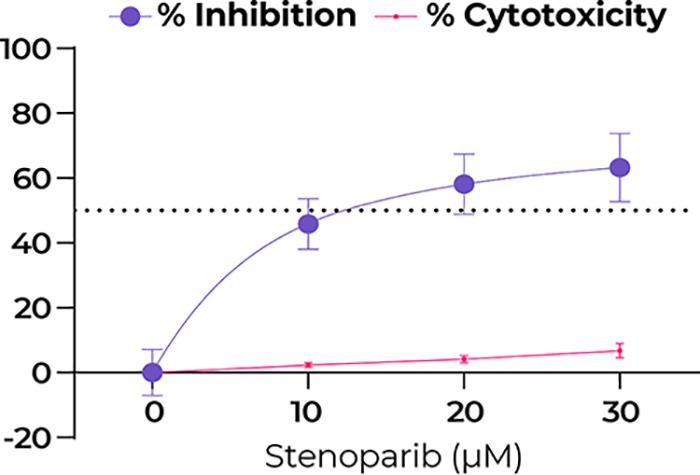
By late 2020, the coronavirus disease 2019 (COVID-19) pandemic, caused by severe acute respiratory syndrome coronavirus 2 (SARS-CoV-2), had caused tens of millions of infections and over 1 million deaths worldwide. A protective vaccine and more effective therapeutics are urgently needed. We evaluated a new poly(ADP-ribose) polymerase (PARP) inhibitor, stenoparib, that recently advanced to phase II clinical trials for treatment of ovarian cancer, for activity against human respiratory coronaviruses, including SARS-CoV-2, Stenoparib exhibits dose-dependent suppression of SARS-CoV-2 multiplication and spread in Vero E6 monkey kidney and Calu-3 human lung adenocarcinoma cells. Stenoparib was also strongly inhibitory to the human seasonal respiratory coronavirus HCoV-NL63. Compared to remdesivir, which inhibits viral replication downstream of cell entry, stenoparib impedes entry and postentry processes, as determined by time-of-addition (TOA) experiments. Moreover, a 10 μM dosage of stenoparib-below the approximated 25.5 μM half-maximally effective concentration (EC)-combined with 0.5 μM remdesivir suppressed coronavirus growth by more than 90%, indicating a potentially synergistic effect for this drug combination. Stenoparib as a stand-alone or as part of combinatorial therapy with remdesivir should be a valuable addition to the arsenal against COVID-19. New therapeutics are urgently needed in the fight against COVID-19. Repurposing drugs that are either already approved for human use or are in advanced stages of the approval process can facilitate more rapid advances toward this goal. The PARP inhibitor stenoparib may be such a drug, as it is currently in phase II clinical trials for the treatment of ovarian cancer and its safety and dosage in humans have already been established. Our results indicate that stenoparib possesses strong antiviral activity against SARS-CoV-2 and other coronaviruses This activity appears to be based on multiple modes of action, where both pre-entry and postentry viral replication processes are impeded. This may provide a therapeutic advantage over many current options that have a narrower target range. Moreover, our results suggest that stenoparib and remdesivir in combination may be especially potent against coronavirus infection.
到 2020 年末,由严重急性呼吸系统综合征冠状病毒 2(SARS-CoV-2)引起的 2019 年冠状病毒病(COVID-19)大流行已在全球范围内导致数千万例感染和超过 100 万人死亡。迫切需要一种保护性疫苗和更有效的疗法。我们评估了一种新的多聚(ADP-核糖)聚合酶(PARP)抑制剂 stenoparib,该抑制剂最近已进入治疗卵巢癌的 II 期临床试验,其对人类呼吸道冠状病毒,包括 SARS-CoV-2,有活性。stenoparib 以剂量依赖的方式抑制vero E6 猴肾和 Calu-3 人肺腺癌细胞中的 SARS-CoV-2 繁殖和传播。stenoparib 对人类季节性呼吸道冠状病毒 HCoV-NL63 也具有强烈的抑制作用。与抑制病毒进入细胞下游复制的瑞德西韦不同,stenoparib 通过添加时间(TOA)实验来阻碍进入和进入后过程。此外,10 μM 的 stenoparib 剂量(低于近似的 25.5 μM 半最大有效浓度(EC))与 0.5 μM 的瑞德西韦联合使用,可抑制冠状病毒生长超过 90%,表明该药物组合具有潜在的协同作用。stenoparib 作为一种单独的药物或与瑞德西韦联合使用的组合疗法,应该是对抗 COVID-19 的有力补充。在抗击 COVID-19 的斗争中,急需新的治疗方法。重新利用已经批准用于人类使用或处于批准过程后期的药物可以更迅速地推进这一目标。PARP 抑制剂 stenoparib 可能就是这样一种药物,因为它目前正在进行治疗卵巢癌的 II 期临床试验,其在人体中的安全性和剂量已经确定。我们的研究结果表明,stenoparib 对 SARS-CoV-2 和其他冠状病毒具有很强的抗病毒活性。这种活性似乎基于多种作用模式,其中包括进入前和进入后的病毒复制过程都受到阻碍。这可能比许多当前选择具有更窄的靶范围提供治疗优势。此外,我们的研究结果表明,stenoparib 和瑞德西韦联合使用可能对冠状病毒感染特别有效。


 Zotero 插件