
特泽佩umab可减少重度未控制哮喘患者全年的病情加重:PATHWAY 2b期研究的事后分析
Tezepelumab Reduces Exacerbations Across All Seasons in Patients with Severe, Uncontrolled Asthma: A Post Hoc Analysis of the PATHWAY Phase 2b Study.
作者信息
Corren Jonathan, Karpefors Martin, Hellqvist Åsa, Parnes Jane R, Colice Gene
机构信息
Departments of Medicine and Pediatrics, David Geffen School of Medicine, University of California, Los Angeles, CA, USA.
Data Science and AI, AstraZeneca, Gothenburg, Sweden.
出版信息
J Asthma Allergy. 2021 Jan 11;14:1-11. doi: 10.2147/JAA.S286036. eCollection 2021.
INTRODUCTION
Tezepelumab is a human monoclonal antibody that blocks thymic stromal lymphopoietin (TSLP), an epithelial cytokine implicated in airway inflammation in asthma, from binding to its heterodimeric receptor. In the PATHWAY phase 2b study, tezepelumab significantly reduced exacerbation rates compared with placebo in adults with severe, uncontrolled asthma, irrespective of baseline disease characteristics.
OBJECTIVE
To evaluate the effect of tezepelumab on asthma exacerbations on a seasonal basis.
METHODS
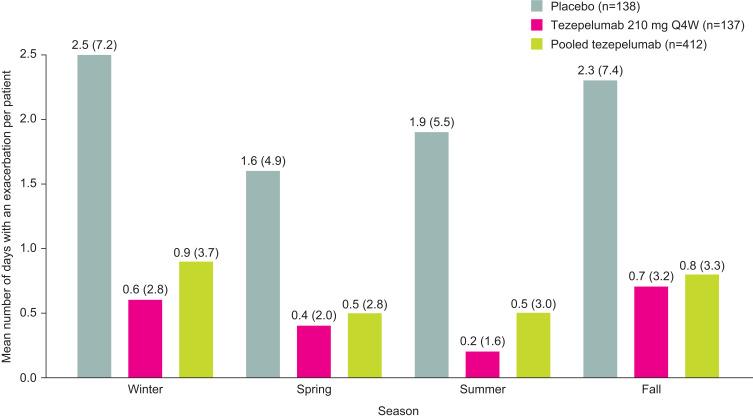
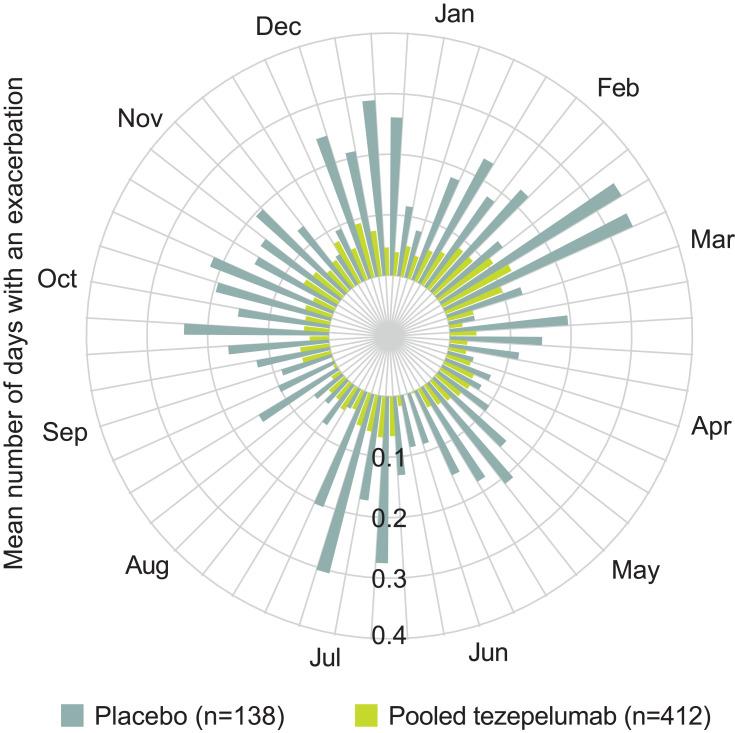
This was a post hoc analysis of the PATHWAY study (NCT02054130). Adults (N=550) with severe, uncontrolled asthma were randomized 1:1:1:1 to receive subcutaneous tezepelumab 70 mg every 4 weeks (Q4W), 210 mg Q4W or 280 mg every 2 weeks (Q2W), or placebo Q2W, for 52 weeks. The annualized asthma exacerbation rate (AAER), total number of days with an exacerbation, proportion of patients with at least one exacerbation or 0, 1 or ≥2 exacerbations, and proportion of patients experiencing an exacerbation per day were evaluated by season and over the year, by treatment in the overall study population and in subgroups according to baseline blood eosinophil count (≥300 cells/µL or <300 cells/µL) or atopic asthma status (fluoro-enzyme immunoassay [FEIA]+ or FEIA-).
RESULTS
Seasonal variations in exacerbation rates were found, with peaks observed in fall and winter, and greater variations in patients with high blood eosinophil counts (≥300 cells/µL). Tezepelumab treatment consistently reduced exacerbation rates across all seasons compared with placebo. Furthermore, there was a trend, which was not significant, toward a reduction in the total number of days with exacerbations and in the proportion of patients with exacerbations during each season in patients treated with tezepelumab compared with those who received placebo, irrespective of blood eosinophil count or atopic asthma status.
CONCLUSION
Tezepelumab reduced exacerbations across all seasons, irrespective of evaluated baseline disease characteristics. These data support the efficacy of tezepelumab in a broad population of patients with severe, uncontrolled asthma.
简介
tezepelumab是一种人源单克隆抗体,可阻断胸腺基质淋巴细胞生成素(TSLP)(一种与哮喘气道炎症相关的上皮细胞因子)与其异二聚体受体的结合。在PATHWAY 2b期研究中,与安慰剂相比,tezepelumab在患有严重、未得到控制的哮喘的成人中显著降低了加重率,且与基线疾病特征无关。
目的
评估tezepelumab在季节性基础上对哮喘加重的影响。
方法
这是对PATHWAY研究(NCT02054130)的一项事后分析。患有严重、未得到控制的哮喘的成人(N = 550)按1:1:1:1随机分组,每4周皮下注射70 mg tezepelumab(每4周一次)、每4周注射210 mg tezepelumab或每2周注射280 mg tezepelumab,或每2周注射安慰剂,共治疗52周。通过季节和全年,在总体研究人群以及根据基线血嗜酸性粒细胞计数(≥300个细胞/µL或<300个细胞/µL)或特应性哮喘状态(荧光酶免疫测定法[FEIA]+或FEIA-)划分的亚组中,评估年化哮喘加重率(AAER)、加重天数总数、至少有一次加重或0、1或≥2次加重的患者比例,以及每天经历加重的患者比例。
结果
发现加重率存在季节性变化,在秋季和冬季出现峰值,且血嗜酸性粒细胞计数高(≥300个细胞/µL)的患者变化更大。与安慰剂相比,tezepelumab治疗在所有季节均持续降低加重率。此外,与接受安慰剂的患者相比,tezepelumab治疗的患者在每个季节的加重天数总数和加重患者比例有降低趋势,但不显著,且与血嗜酸性粒细胞计数或特应性哮喘状态无关。
结论
无论评估的基线疾病特征如何,tezepelumab在所有季节均降低了加重率。这些数据支持tezepelumab在广泛的严重、未得到控制的哮喘患者群体中的疗效。




 Zotero 插件