
波多黎各成年人心血管风险评估和踝臂指数变化模式。
Patterns of change in cardiovascular risk assessments and ankle brachial index among Puerto Rican adults.
机构信息
Department of Biomedical and Nutritional Sciences, University of Massachusetts Lowell, Lowell, Massachusetts, United States of America.
Health Assessment Laboratory, University of Massachusetts Lowell, Lowell, Massachusetts, United States of America.
出版信息
PLoS One. 2021 Jan 20;16(1):e0245236. doi: 10.1371/journal.pone.0245236. eCollection 2021.
BACKGROUND
Puerto Rican adults have higher odds of peripheral artery disease (PAD) compared with Mexican Americans. Limited studies have examined relationships between clinical risk assessment scores and ABI measures in this population.
METHODS
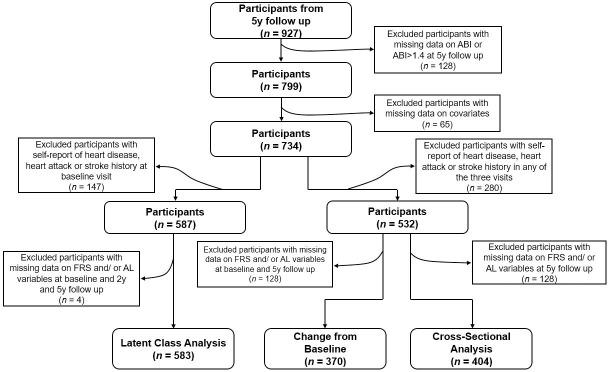
Using 2004-2015 data from the Boston Puerto Rican Health Study (BPRHS) (n = 370-583), cross-sectional, 5-y change, and patterns of change in Framingham Risk Score (FRS) and allostatic load (AL) with ankle brachial index (ABI) at 5-y follow-up were assessed among Puerto Rican adults (45-75 y). FRS and AL were calculated at baseline, 2-y and 5-y follow-up. Multivariable linear regression models were used to examine cross-sectional and 5-y changes in FRS and AL with ABI at 5-y. Latent growth mixture modeling identified trajectories of FRS and AL over 5-y, and multivariable linear regression models were used to test associations between trajectory groups at 5-y.
RESULTS
Greater FRS at 5-y and increases in FRS from baseline were associated with lower ABI at 5-y (β = -0.149, P = 0.010; β = -0.171, P = 0.038, respectively). AL was not associated with ABI in cross-sectional or change analyses. Participants in low-ascending (vs. no change) FRS trajectory, and participants in moderate-ascending (vs. low-ascending) AL trajectory, had lower 5-y ABI (β = -0.025, P = 0.044; β = -0.016, P = 0.023, respectively).
CONCLUSIONS
FRS was a better overall predictor of ABI, compared with AL. Puerto Rican adults, an understudied population with higher FRS over 5 years, may benefit from intensive risk factor modification to reduce risk of PAD. Additional research examining relationships between FRS and AL and development of PAD is warranted.
背景
与墨西哥裔美国人相比,波多黎各成年人患外周动脉疾病(PAD)的几率更高。有限的研究检查了在该人群中临床风险评估评分与踝臂指数(ABI)之间的关系。
方法
使用 2004-2015 年波士顿波多黎各健康研究(BPRHS)的数据(n=370-583),评估了 45-75 岁的波多黎各成年人中Framingham 风险评分(FRS)和全身性负荷(AL)与 5 年随访时的踝肱指数(ABI)之间的横断面、5 年变化和变化模式。FRS 和 AL 是在基线、2 年和 5 年随访时计算的。多变量线性回归模型用于检查 FRS 和 AL 与 5 年时 ABI 的横断面和 5 年变化。潜在增长混合模型确定了 FRS 和 AL 在 5 年内的轨迹,并使用多变量线性回归模型检验了 5 年内轨迹组之间的关联。
结果
5 年时 FRS 较高,以及从基线到 5 年的 FRS 增加与 5 年时较低的 ABI 相关(β=-0.149,P=0.010;β=-0.171,P=0.038)。AL 在横断面或变化分析中与 ABI 无关。处于低上升(与无变化相比)FRS 轨迹的参与者,以及处于中上升(与低上升相比)AL 轨迹的参与者,5 年 ABI 较低(β=-0.025,P=0.044;β=-0.016,P=0.023)。
结论
与 AL 相比,FRS 是 ABI 的更好的整体预测指标。波多黎各成年人是一个研究不足的人群,5 年内 FRS 较高,可能受益于强化危险因素的改变,以降低 PAD 的风险。需要进一步研究 FRS 和 AL 之间的关系以及 PAD 的发生。

 Zotero 插件