
癌症免疫治疗中 PD-1/PD-L1 阻断抗体低临床反应的机制:外泌体 PD-L1 的关键作用。
Mechanisms underlying low-clinical responses to PD-1/PD-L1 blocking antibodies in immunotherapy of cancer: a key role of exosomal PD-L1.
机构信息
Department of General Surgery, Guangdong Provincial People's Hospital, Guangdong Academy of Medical Science, Guangzhou, China
Department of General Surgery, Guangdong Provincial People's Hospital, Guangdong Academy of Medical Science, Guangzhou, China.
出版信息
J Immunother Cancer. 2021 Jan;9(1). doi: 10.1136/jitc-2020-001698.
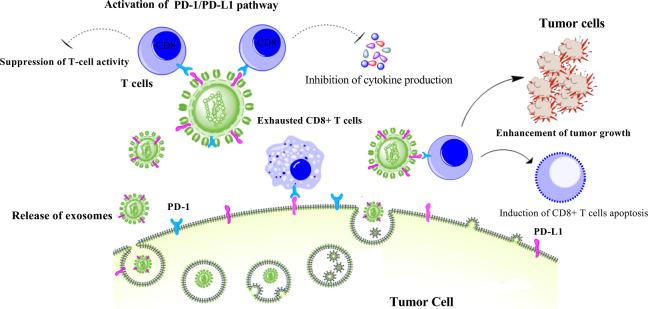
Exosomes, as the main group of extracellular vesicles, are biologically active lipid-bilayer vesicles that are naturally released from different types of normal or tumor cells. These vesicles play an important role in intercellular communication and influence the extracellular environment and the immune system. Emerging evidence demonstrates that cancer-derived exosomes are enriched in immunosuppressive proteins, such as the programmed death-ligand 1 (PD-L1). PD-L1 and its receptor programmed cell death protein 1 (PD-1) are the key immune checkpoint molecules that promote tumor progression via negative regulation of immune responses. PDL-1 is highly expressed on the surface of tumor cells and binds to PD-1 on the surface of activated T cells, leading to suppression of T cells, which consequently enables cancer cells to escape antitumor immunity. Currently, there are several Food and Drug Administration-approved monoclonal antibodies blocking PD-1/PD-L1 interaction, which are clinically used for cancer treatment. However, despite impressive treatment outcomes, some patients show poor response to PD-1/PD-L1 blockade. Of note, tumor-derived exosomes containing PD-L1 can recapitulate the effect of cell-surface PD-L1. There is evidence that reveals a significant association between levels of circulating exosomal PD-L1 and rate of response to anti-PD-1/PD-L1 antibody therapy. The present article reviews the role of exosomal PDL-1 in the therapeutic resistance to anti-PD-1/PD-L1 treatment. Importantly, it is suggested that the removal of exosomal PDL-1 could serve as a therapeutic adjuvant for enhancing the efficacy of anti-PD-1/PD-L1 therapy in patients with cancer.
外泌体作为细胞外囊泡的主要群体,是天然从不同类型的正常或肿瘤细胞中释放出来的具有生物活性的脂质双层囊泡。这些囊泡在细胞间通讯中发挥重要作用,并影响细胞外环境和免疫系统。新出现的证据表明,癌症来源的外泌体富含免疫抑制蛋白,如程序性死亡配体 1(PD-L1)。PD-L1 和其受体程序性死亡蛋白 1(PD-1)是关键的免疫检查点分子,通过负向调节免疫反应促进肿瘤进展。PDL-1 在肿瘤细胞表面高度表达,并与激活的 T 细胞表面的 PD-1 结合,导致 T 细胞抑制,从而使癌细胞逃避抗肿瘤免疫。目前,有几种食品和药物管理局批准的单克隆抗体阻断 PD-1/PD-L1 相互作用,临床上用于癌症治疗。然而,尽管治疗效果令人印象深刻,但一些患者对 PD-1/PD-L1 阻断的反应不佳。值得注意的是,含有 PD-L1 的肿瘤衍生外泌体可以重现细胞表面 PD-L1 的作用。有证据表明,循环外泌体 PD-L1 的水平与抗 PD-1/PD-L1 抗体治疗的反应率之间存在显著相关性。本文综述了外泌体 PD-L1 在抗 PD-1/PD-L1 治疗耐药中的作用。重要的是,有人提出,去除外泌体 PD-L1 可以作为一种治疗辅助手段,增强癌症患者抗 PD-1/PD-L1 治疗的疗效。

 Zotero 插件