
白色念珠菌定植小鼠对克林霉素挑战的肠道微生物群生态抵抗力降低。
Decreased Ecological Resistance of the Gut Microbiota in Response to Clindamycin Challenge in Mice Colonized with the Fungus Candida albicans.
机构信息
Graduate School of Biomedical Sciences, Tufts University School of Medicine, Boston, Massachusetts, USA.
Department of Molecular Biology and Microbiology, Tufts University School of Medicine, Boston, Massachusetts, USA.
出版信息
mSphere. 2021 Jan 20;6(1):e00982-20. doi: 10.1128/mSphere.00982-20.
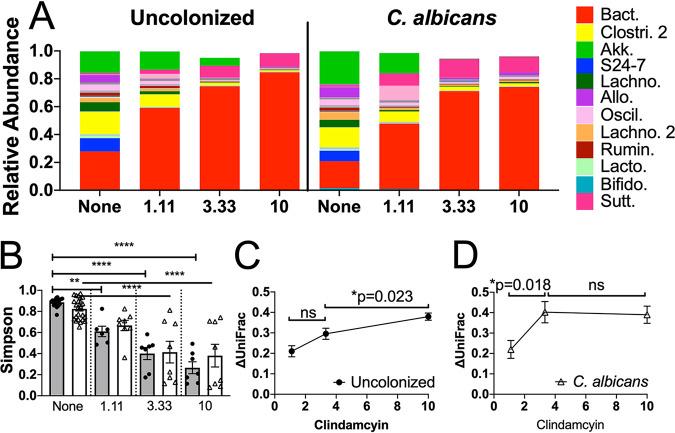
The mammalian gut microbiota is a complex community of microorganisms which typically exhibits remarkable stability. As the gut microbiota has been shown to affect many aspects of host health, the molecular keys to developing and maintaining a "healthy" gut microbiota are highly sought after. Yet, the qualities that define a microbiota as healthy remain elusive. We used the ability to resist change in response to antibiotic disruption, a quality we refer to as ecological resistance, as a metric for the health of the bacterial microbiota. Using a mouse model, we found that colonization with the commensal fungus decreased the ecological resistance of the bacterial microbiota in response to the antibiotic clindamycin such that increased microbiota disruption was observed in colonized mice compared to that in uncolonized mice. colonization resulted in decreased alpha diversity and small changes in abundance of bacterial genera prior to clindamycin challenge. Strikingly, co-occurrence network analysis demonstrated that colonization resulted in sweeping changes to the co-occurrence network structure, including decreased modularity and centrality and increased density. Thus, colonization resulted in changes to the bacterial microbiota community and reduced its ecological resistance. is the most common fungal member of the human gut microbiota, yet its ability to interact with and affect the bacterial gut microbiota is largely uncharacterized. Previous reports showed limited changes in microbiota composition as defined by bacterial species abundance as a consequence of colonization. We also observed only a few bacterial genera that were significantly altered in abundance in -colonized mice; however, colonization significantly changed the structure of the bacterial microbiota co-occurrence network. Additionally, colonization changed the response of the bacterial microbiota ecosystem to a clinically relevant perturbation, challenge with the antibiotic clindamycin.
哺乳动物肠道微生物群是一个复杂的微生物群落,通常表现出显著的稳定性。由于肠道微生物群已被证明会影响宿主健康的许多方面,因此,开发和维持“健康”肠道微生物群的分子关键因素备受关注。然而,定义微生物群为健康的特征仍然难以捉摸。我们使用抵抗抗生素破坏而发生变化的能力,即我们称之为生态抵抗力,作为细菌微生物群健康的衡量标准。使用小鼠模型,我们发现共生真菌 定植会降低细菌微生物群对克林霉素等抗生素的生态抵抗力,从而导致定植小鼠的微生物群破坏增加,而未定植小鼠则不会。 定植导致α多样性降低,在克林霉素挑战之前,细菌属的丰度也发生了微小变化。引人注目的是,共现网络分析表明, 定植导致共现网络结构发生广泛变化,包括降低模块性和中心性,以及增加密度。因此, 定植导致细菌微生物群群落发生变化,降低了其生态抵抗力。 是人类肠道微生物群中最常见的真菌成员,但它与肠道细菌相互作用并影响肠道细菌的能力在很大程度上尚未得到表征。先前的报告显示,由于 定植,微生物群落组成(定义为细菌物种丰度)的变化有限。我们还观察到,在 定植的小鼠中,只有少数细菌属的丰度发生了显著改变;然而, 定植显著改变了细菌微生物群共现网络的结构。此外, 定植改变了细菌微生物群生态系统对临床相关扰动(克林霉素挑战)的反应。


 Zotero 插件