
提取物通过上调解偶联蛋白1对 Zucker 肥胖大鼠和高脂饮食 Sprague Dawley 大鼠的抗肥胖作用。
Anti-Obesity Effects of Extract in Zucker Fatty Rats and High-Fat Diet Sprague Dawley Rats through Upregulation of Uncoupling Protein 1.
作者信息
Choi Eun-Yong, Park Chan Young, Ho Seong Hyun, Park Su-Jin, Kim Donghyun, Han Byoungduck, Kim Seon-Hee
机构信息
Sungkyun Biotech Co., Ltd., Suwon, Korea.
G&P Bioscience Co. LTD., Goyang, Korea.
出版信息
J Obes Metab Syndr. 2021 Mar 30;30(1):32-43. doi: 10.7570/jomes20097.
BACKGROUND
Obesity is a widespread disease and is caused mainly by excessive adipocyte differentiation and fat accumulation. Peroxisome proliferation-activated receptor γ (PPARγ) and CCAAT/enhancer-binding proteins (C/EBP) are major components for regulating adipocyte differentiation. Uncoupling protein 1 (UCP1) is a transmembrane protein that can convert white fat to brown adipose tissue. L. has long been used in East Asia as an herbal drug for anti-oxidant, anti-bacterial, and anti-obesity purposes.
METHODS
We investigated the effects of water extracts of (WEAA) in C3H10T1/2, a mesenchymal stem cell line, by measuring the level of intracellular fat accumulation and the expression of genes associated with adipocyte differentiation. We also evaluated anti-obesity effects of WEAA in Zucker rats, a genetic model for the study of obesity, and in Sprague Dawley rats with high-fat diet (HFD)-induced obesity.
RESULTS
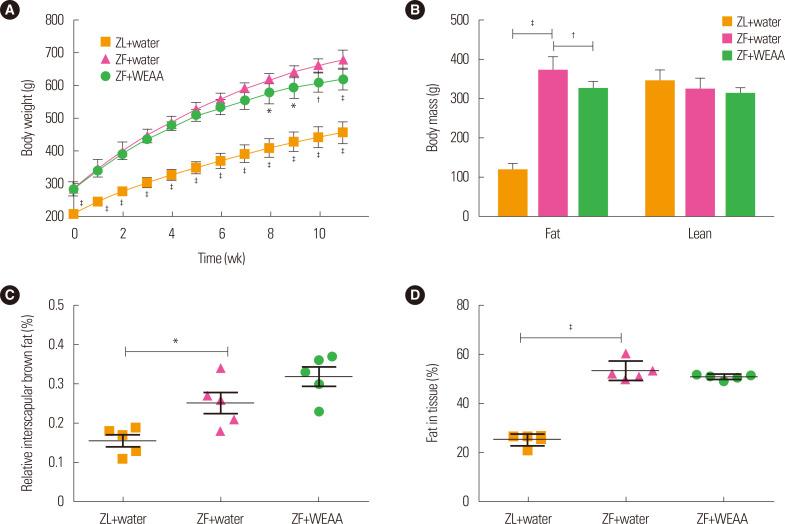
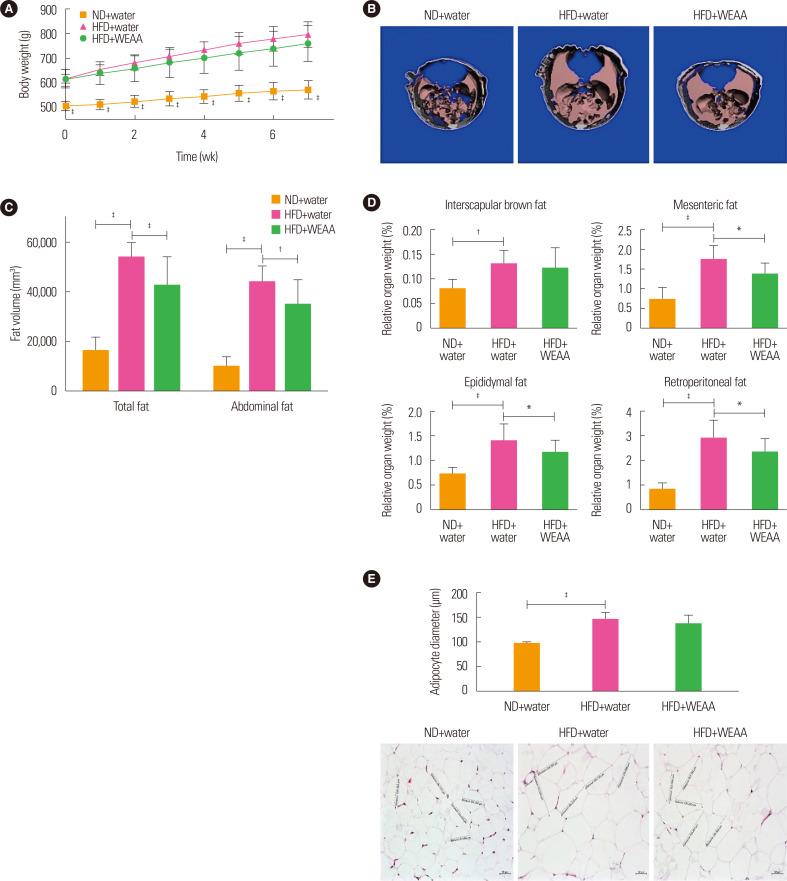
In this study, WEAA reduced the expression levels of PPARγ and C/EBPα in C3H10T1/2 cells, as well as the expression of enzymes that regulate fatty acid metabolism. In the Zucker fatty rat model and the HFD-induced obesity rat model, WEAA significantly decreased adipogenic differentiation and white fat accumulation between the scapulae, in contrast to the brown fat that remained unchanged between the groups. suppressed the expression of the adipocyte differentiation-promoting genes, while increasing the expression of UCP1.
CONCLUSION
These results indicated that WEAA could reduce adipocyte differentiation and fat accumulation in and model systems, resulting in suppression of obesity and the occurrence of fatty liver due to a HFD.
背景
肥胖是一种普遍存在的疾病,主要由脂肪细胞过度分化和脂肪堆积引起。过氧化物酶体增殖物激活受体γ(PPARγ)和CCAAT/增强子结合蛋白(C/EBP)是调节脂肪细胞分化的主要成分。解偶联蛋白1(UCP1)是一种跨膜蛋白,可将白色脂肪转化为棕色脂肪组织。在东亚,[植物名称]长期以来一直被用作具有抗氧化、抗菌和抗肥胖作用的草药。
方法
我们通过测量细胞内脂肪堆积水平和与脂肪细胞分化相关的基因表达,研究了[植物名称]水提取物(WEAA)对间充质干细胞系C3H10T1/2的影响。我们还评估了WEAA对肥胖研究的遗传模型 Zucker 大鼠以及高脂饮食(HFD)诱导肥胖的 Sprague Dawley 大鼠的抗肥胖作用。
结果
在本研究中,WEAA降低了C3H10T1/2细胞中PPARγ和C/EBPα的表达水平,以及调节脂肪酸代谢的酶的表达。在 Zucker 肥胖大鼠模型和HFD诱导肥胖大鼠模型中,与各组之间棕色脂肪保持不变形成对比的是,WEAA显著降低了肩胛间的脂肪生成分化和白色脂肪堆积。[植物名称]抑制了促进脂肪细胞分化的基因的表达,同时增加了UCP1的表达。
结论
这些结果表明,WEAA可以减少[植物名称]和模型系统中的脂肪细胞分化和脂肪堆积,从而抑制肥胖以及由HFD引起的脂肪肝的发生。


 Zotero 插件