
戴口罩与美国 SARS-CoV-2 传播的控制:一项横断面研究。
Mask-wearing and control of SARS-CoV-2 transmission in the USA: a cross-sectional study.
机构信息
Computational Epidemiology Lab, Boston Children's Hospital, Boston, MA, USA; Department of Epidemiology, Boston University School of Public Health, Boston, MA, USA.
Department of Biostatistics, Boston University School of Public Health, Boston, MA, USA.
出版信息
Lancet Digit Health. 2021 Mar;3(3):e148-e157. doi: 10.1016/S2589-7500(20)30293-4. Epub 2021 Jan 19.
BACKGROUND
Face masks have become commonplace across the USA because of the severe acute respiratory syndrome coronavirus 2 (SARS-CoV-2) epidemic. Although evidence suggests that masks help to curb the spread of the disease, there is little empirical research at the population level. We investigate the association between self-reported mask-wearing, physical distancing, and SARS-CoV-2 transmission in the USA, along with the effect of statewide mandates on mask uptake.
METHODS
Serial cross-sectional surveys were administered via a web platform to randomly surveyed US individuals aged 13 years and older, to query self-reports of face mask-wearing. Survey responses were combined with instantaneous reproductive number (R) estimates from two publicly available sources, the outcome of interest. Measures of physical distancing, community demographics, and other potential sources of confounding (from publicly available sources) were also assessed. We fitted multivariate logistic regression models to estimate the association between mask-wearing and community transmission control (R<1). Additionally, mask-wearing in 12 states was evaluated 2 weeks before and after statewide mandates.
FINDINGS
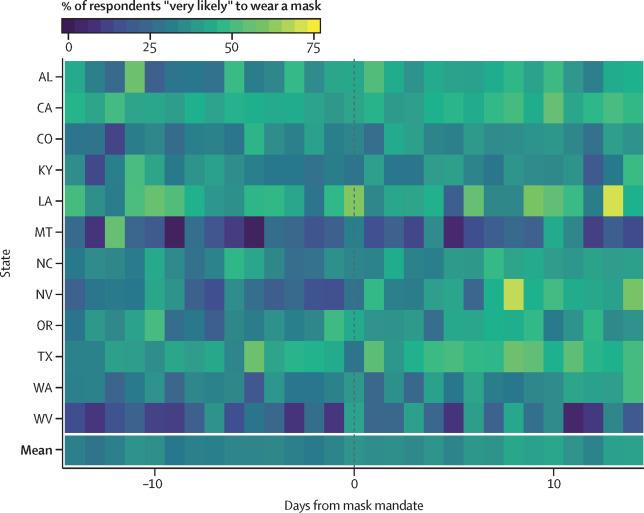
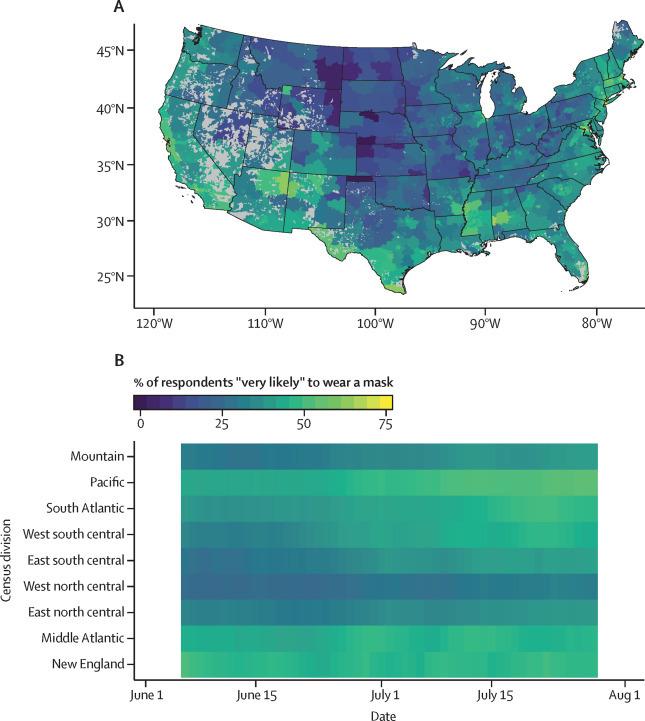
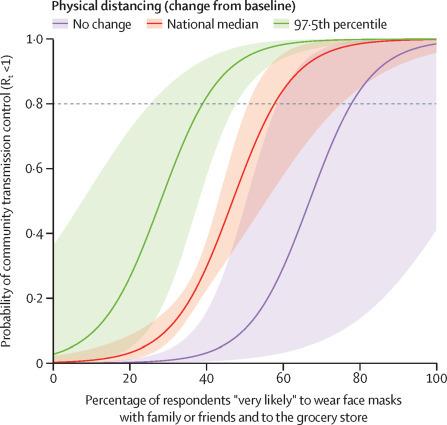
378 207 individuals responded to the survey between June 3 and July 27, 2020, of which 4186 were excluded for missing data. We observed an increasing trend in reported mask usage across the USA, although uptake varied by geography. A logistic model controlling for physical distancing, population demographics, and other variables found that a 10% increase in self-reported mask-wearing was associated with an increased odds of transmission control (odds ratio 3·53, 95% CI 2·03-6·43). We found that communities with high reported mask-wearing and physical distancing had the highest predicted probability of transmission control. Segmented regression analysis of reported mask-wearing showed no statistically significant change in the slope after mandates were introduced; however, the upward trend in reported mask-wearing was preserved.
INTERPRETATION
The widespread reported use of face masks combined with physical distancing increases the odds of SARS-CoV-2 transmission control. Self-reported mask-wearing increased separately from government mask mandates, suggesting that supplemental public health interventions are needed to maximise adoption and help to curb the ongoing epidemic.
FUNDING
Flu Lab, Google.org (via the Tides Foundation), National Institutes for Health, National Science Foundation, Morris-Singer Foundation, MOOD, Branco Weiss Fellowship, Ending Pandemics, Centers for Disease Control and Prevention (USA).
背景
由于严重急性呼吸系统综合征冠状病毒 2(SARS-CoV-2)疫情,口罩已成为美国的普遍现象。尽管有证据表明口罩有助于遏制疾病的传播,但在人群层面上几乎没有实证研究。我们调查了美国自我报告的口罩佩戴、身体距离和 SARS-CoV-2 传播之间的关联,以及全州范围内的强制佩戴口罩令对口罩使用率的影响。
方法
通过网络平台向随机抽取的年龄在 13 岁及以上的美国个人进行了一系列横断面调查,以查询他们对面罩佩戴的自我报告。将调查结果与从两个公开来源获得的即时繁殖数(R)估计值相结合,作为研究的结果。还评估了身体距离、社区人口统计数据和其他潜在混杂因素(来自公开来源)的措施。我们使用多变量逻辑回归模型来估计佩戴口罩与社区传播控制(R<1)之间的关联。此外,还评估了 12 个州在全州范围内颁布口罩令前后两周的口罩佩戴情况。
结果
2020 年 6 月 3 日至 7 月 27 日期间,共有 378207 人对调查做出了回应,其中 4186 人因数据缺失而被排除在外。我们观察到美国报告的口罩使用率呈上升趋势,尽管使用率因地理位置而异。一个控制了身体距离、人口统计学和其他变量的逻辑模型发现,自我报告的口罩使用率增加 10%,与传播控制的几率增加相关(比值比 3.53,95%置信区间 2.03-6.43)。我们发现,报告口罩使用率高和身体距离远的社区具有最高的预测传播控制概率。对报告的口罩佩戴情况进行分段回归分析后发现,引入强制令后斜率没有统计学意义上的变化;然而,报告的口罩佩戴率上升趋势得以保持。
解释
广泛报告的口罩使用和身体距离的结合增加了 SARS-CoV-2 传播控制的几率。自我报告的口罩佩戴率独立于政府口罩强制令而增加,这表明需要额外的公共卫生干预措施来提高口罩的采用率,并帮助遏制正在进行的疫情。
资助
流感实验室、谷歌基金会(通过潮汐基金会)、美国国立卫生研究院、美国国家科学基金会、莫里斯-辛格基金会、MOOD、布兰科·魏斯奖学金、终结流行病、疾病控制和预防中心(美国)。

 Zotero 插件