
全球癌症手术后死亡率和并发症的变化:82 个国家的多中心前瞻性队列研究。
Global variation in postoperative mortality and complications after cancer surgery: a multicentre, prospective cohort study in 82 countries.
出版信息
Lancet. 2021 Jan 30;397(10272):387-397. doi: 10.1016/S0140-6736(21)00001-5. Epub 2021 Jan 21.
BACKGROUND
80% of individuals with cancer will require a surgical procedure, yet little comparative data exist on early outcomes in low-income and middle-income countries (LMICs). We compared postoperative outcomes in breast, colorectal, and gastric cancer surgery in hospitals worldwide, focusing on the effect of disease stage and complications on postoperative mortality.
METHODS
This was a multicentre, international prospective cohort study of consecutive adult patients undergoing surgery for primary breast, colorectal, or gastric cancer requiring a skin incision done under general or neuraxial anaesthesia. The primary outcome was death or major complication within 30 days of surgery. Multilevel logistic regression determined relationships within three-level nested models of patients within hospitals and countries. Hospital-level infrastructure effects were explored with three-way mediation analyses. This study was registered with ClinicalTrials.gov, NCT03471494.
FINDINGS
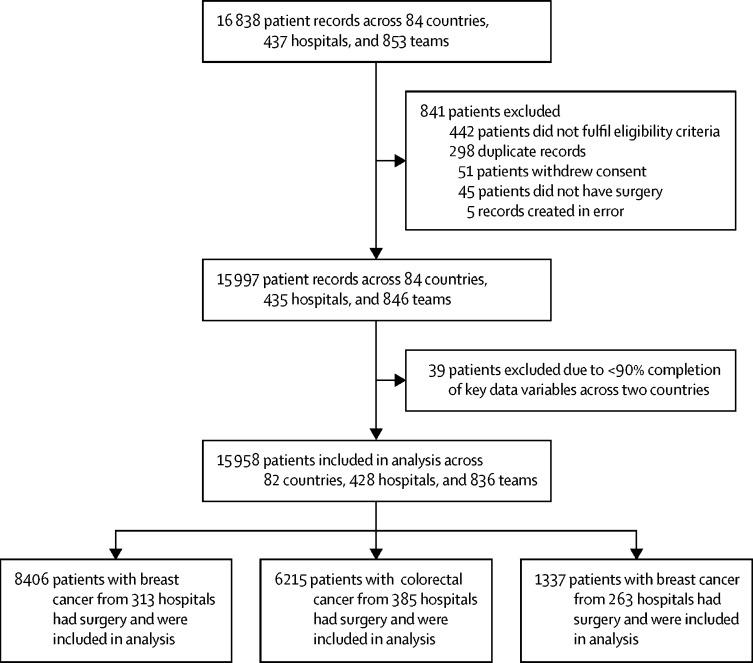
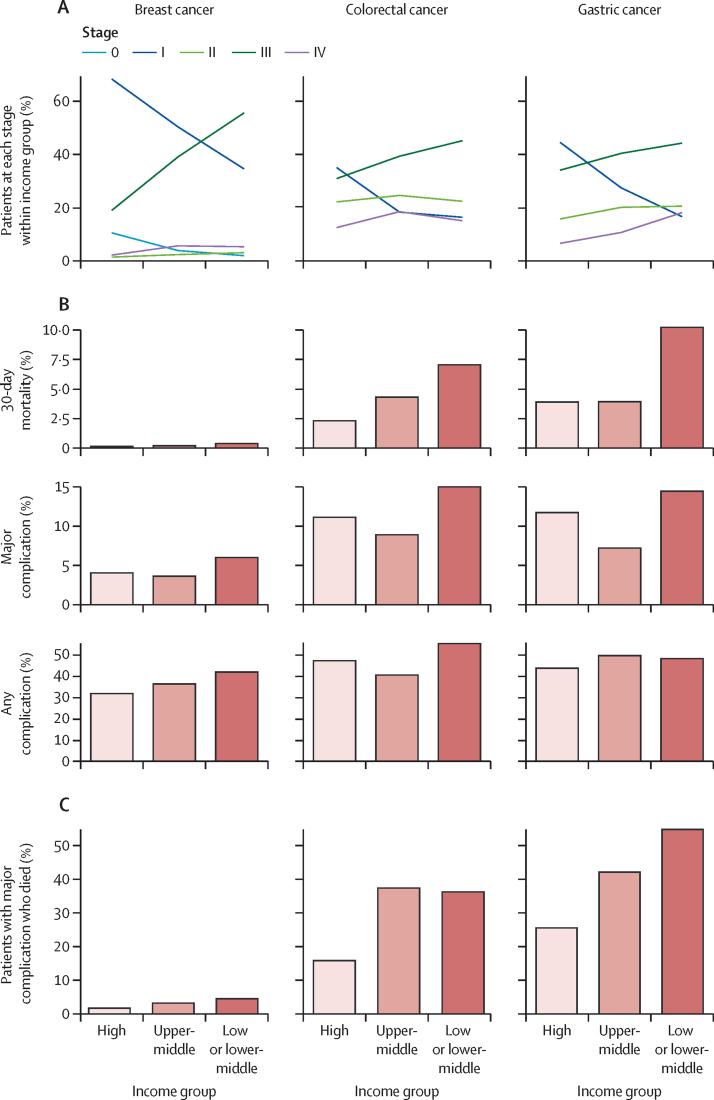
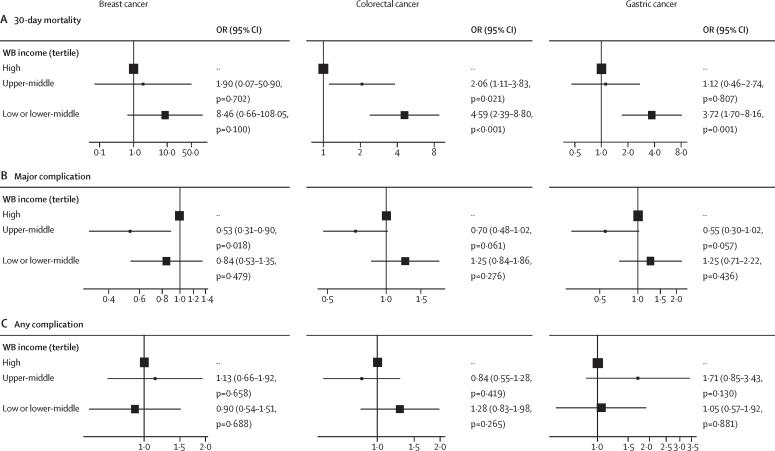
Between April 1, 2018, and Jan 31, 2019, we enrolled 15 958 patients from 428 hospitals in 82 countries (high income 9106 patients, 31 countries; upper-middle income 2721 patients, 23 countries; or lower-middle income 4131 patients, 28 countries). Patients in LMICs presented with more advanced disease compared with patients in high-income countries. 30-day mortality was higher for gastric cancer in low-income or lower-middle-income countries (adjusted odds ratio 3·72, 95% CI 1·70-8·16) and for colorectal cancer in low-income or lower-middle-income countries (4·59, 2·39-8·80) and upper-middle-income countries (2·06, 1·11-3·83). No difference in 30-day mortality was seen in breast cancer. The proportion of patients who died after a major complication was greatest in low-income or lower-middle-income countries (6·15, 3·26-11·59) and upper-middle-income countries (3·89, 2·08-7·29). Postoperative death after complications was partly explained by patient factors (60%) and partly by hospital or country (40%). The absence of consistently available postoperative care facilities was associated with seven to 10 more deaths per 100 major complications in LMICs. Cancer stage alone explained little of the early variation in mortality or postoperative complications.
INTERPRETATION
Higher levels of mortality after cancer surgery in LMICs was not fully explained by later presentation of disease. The capacity to rescue patients from surgical complications is a tangible opportunity for meaningful intervention. Early death after cancer surgery might be reduced by policies focusing on strengthening perioperative care systems to detect and intervene in common complications.
FUNDING
National Institute for Health Research Global Health Research Unit.
背景
80%的癌症患者需要接受手术,但在低收入和中等收入国家(LMICs),关于早期结果的比较数据很少。我们比较了全球医院中乳腺癌、结直肠癌和胃癌手术的术后结果,重点关注疾病分期和并发症对术后死亡率的影响。
方法
这是一项多中心、国际前瞻性队列研究,纳入了接受原发性乳腺癌、结直肠癌或胃癌手术的成年患者,这些手术需要在全身或神经轴麻醉下进行皮肤切口。主要结局是术后 30 天内死亡或发生主要并发症。多水平逻辑回归确定了患者在医院和国家三个层次嵌套模型中的关系。使用三向中介分析探讨了医院基础设施的影响。这项研究在 ClinicalTrials.gov 注册,NCT03471494。
结果
在 2018 年 4 月 1 日至 2019 年 1 月 31 日期间,我们从 82 个国家的 428 家医院招募了 15958 名患者(高收入国家 9106 名患者,31 个国家;中上收入国家 2721 名患者,23 个国家;或中下收入国家 4131 名患者,28 个国家)。与高收入国家的患者相比,中低收入国家的患者表现出更晚期的疾病。胃癌患者在低收入或中下收入国家(调整后的优势比 3.72,95%CI 1.70-8.16)和结直肠癌患者在低收入或中下收入国家(4.59,2.39-8.80)和中上收入国家(2.06,1.11-3.83)的 30 天死亡率更高。乳腺癌患者的 30 天死亡率没有差异。在低收入或中下收入国家(6.15,3.26-11.59)和中上收入国家(3.89,2.08-7.29)中,发生主要并发症后死亡的患者比例最高。在并发症后发生的术后死亡部分由患者因素(60%)和部分由医院或国家(40%)解释。缺乏一致的术后护理设施与中低收入国家每 100 例主要并发症多死亡 7 至 10 例有关。癌症分期本身对死亡率和术后并发症的早期变化解释甚少。
结论
在中低收入国家,癌症手术后死亡率较高的情况并不能完全用疾病晚期出现来解释。从手术并发症中拯救患者的能力是一个有意义的干预机会。通过关注加强围手术期护理系统以检测和干预常见并发症,可以降低癌症手术后的早期死亡。
资助
国家卫生研究院全球卫生研究单位。


 Zotero 插件