
钙成像与消极诅咒。
Calcium Imaging and the Curse of Negativity.
机构信息
Neural Circuits and Behavior Laboratory, Queensland Brain Institute, The University of Queensland, St Lucia, QLD, Australia.
出版信息
Front Neural Circuits. 2021 Jan 6;14:607391. doi: 10.3389/fncir.2020.607391. eCollection 2020.
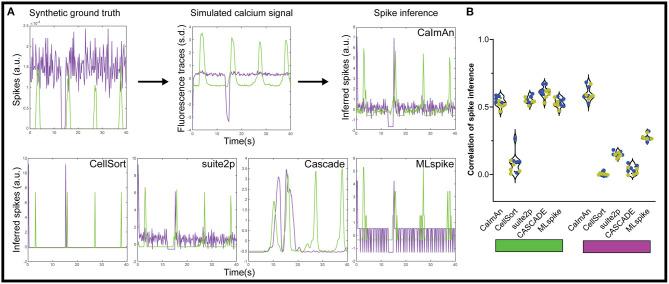
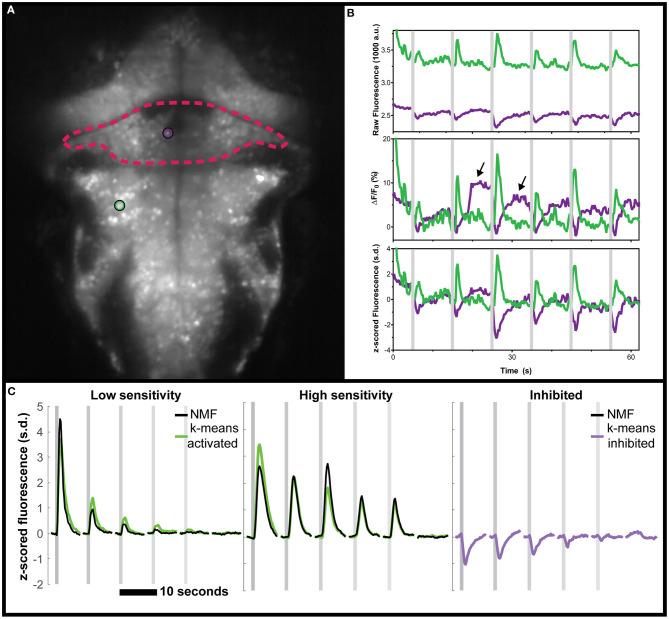
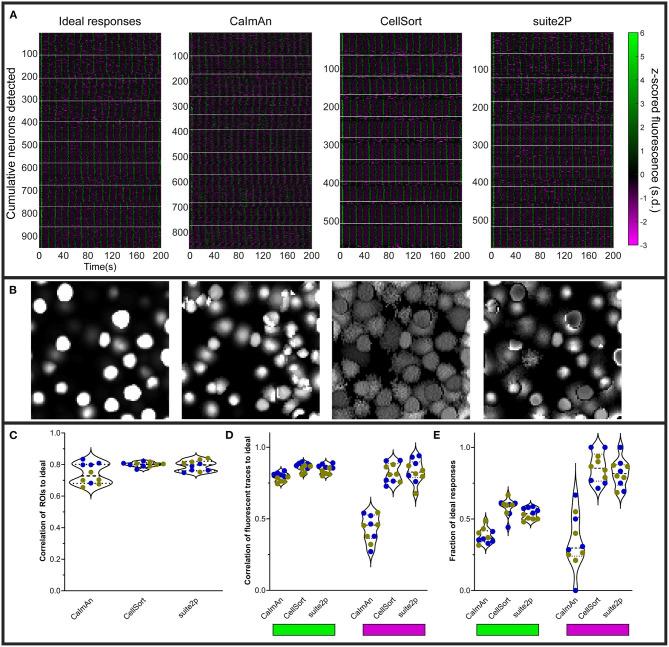
The imaging of neuronal activity using calcium indicators has become a staple of modern neuroscience. However, without ground truths, there is a real risk of missing a significant portion of the real responses. Here, we show that a common assumption, the non-negativity of the neuronal responses as detected by calcium indicators, biases all levels of the frequently used analytical methods for these data. From the extraction of meaningful fluorescence changes to spike inference and the analysis of inferred spikes, each step risks missing real responses because of the assumption of non-negativity. We first show that negative deviations from baseline can exist in calcium imaging of neuronal activity. Then, we use simulated data to test three popular algorithms for image analysis, CaImAn, suite2p, and CellSort, finding that suite2p may be the best suited to large datasets. We also tested the spike inference algorithms included in CaImAn, suite2p, and Cellsort, as well as the dedicated inference algorithms MLspike and CASCADE, and found each to have limitations in dealing with inhibited neurons. Among these spike inference algorithms, FOOPSI, from CaImAn, performed the best on inhibited neurons, but even this algorithm inferred spurious spikes upon the return of the fluorescence signal to baseline. As such, new approaches will be needed before spikes can be sensitively and accurately inferred from calcium data in inhibited neurons. We further suggest avoiding data analysis approaches that, by assuming non-negativity, ignore inhibited responses. Instead, we suggest a first exploratory step, using k-means or PCA for example, to detect whether meaningful negative deviations are present. Taking these steps will ensure that inhibition, as well as excitation, is detected in calcium imaging datasets.
利用钙指示剂对神经元活动进行成像已成为现代神经科学的重要手段。然而,如果没有真实数据作为参考,就有可能错过很大一部分真实反应。在这里,我们发现一个普遍的假设,即钙指示剂检测到的神经元反应是非负的,这会对这些数据常用的分析方法的所有层次产生偏差。从提取有意义的荧光变化到推断尖峰和分析推断出的尖峰,由于非负性的假设,每个步骤都有可能错过真实的反应。我们首先证明了在神经元活动的钙成像中可能存在偏离基线的负偏差。然后,我们使用模拟数据测试了三种常用的图像分析算法,CaImAn、suite2p 和 CellSort,发现 suite2p 可能最适合处理大型数据集。我们还测试了 CaImAn、suite2p 和 Cellsort 中包含的尖峰推断算法,以及专门的推断算法 MLspike 和 CASCADE,发现每个算法在处理抑制性神经元时都存在局限性。在这些尖峰推断算法中,来自 CaImAn 的 FOOPSI 在抑制性神经元上表现最好,但即使是这种算法,在荧光信号恢复到基线时,也会推断出虚假的尖峰。因此,在抑制性神经元中,需要新的方法才能从钙数据中敏感而准确地推断出尖峰。我们进一步建议避免使用数据分析方法,这些方法通过假设非负性来忽略抑制性反应。相反,我们建议首先进行探索性步骤,例如使用 k-means 或 PCA 来检测是否存在有意义的负偏离。采取这些步骤将确保在钙成像数据集中检测到抑制和兴奋。

 Zotero 插件