
循环肿瘤DNA甲基化模式作为肺鳞状细胞癌预后生物标志物的潜力研究。
Investigation on the potential of circulating tumor DNA methylation patterns as prognostic biomarkers for lung squamous cell carcinoma.
作者信息
Liu Yutao, Feng Yu, Hou Ting, Lizaso Analyn, Xu Feng, Xing Puyuan, Wang Hongyu, Kang Qiaolin, Zhang Lu, Shi Yuankai, Hu Xingsheng
机构信息
Department of Medical Oncology, Beijing Key Laboratory of Clinical Study on Anticancer Molecular Targeted Drugs, National Cancer Center/National Clinical Research Center for Cancer/Cancer Hospital, Chinese Academy of Medical Sciences & Peking Union Medical College, Beijing, China.
Burning Rock Biotech, Guangzhou, China.
出版信息
Transl Lung Cancer Res. 2020 Dec;9(6):2356-2366. doi: 10.21037/tlcr-20-1070.
BACKGROUND
Aberrant epigenetic modifications play a key role in lung tumorigenesis. In our study, we aimed to explore the clinical implications of baseline circulating tumor DNA (ctDNA) somatic and methylation profiles in patients with lung squamous cell carcinoma (LUSC).
METHODS
A total of 26 patients with LUSC of various stages were included in this study. Somatic mutations and methylation levels were profiled from the plasma-derived ctDNA obtained at the time of diagnosis using unique molecular identifier (UMI)-based targeted sequencing and bisulfite sequencing, respectively. The correlation between baseline ctDNA mutation and methylation profile, and overall survival (OS), were analyzed.
RESULTS
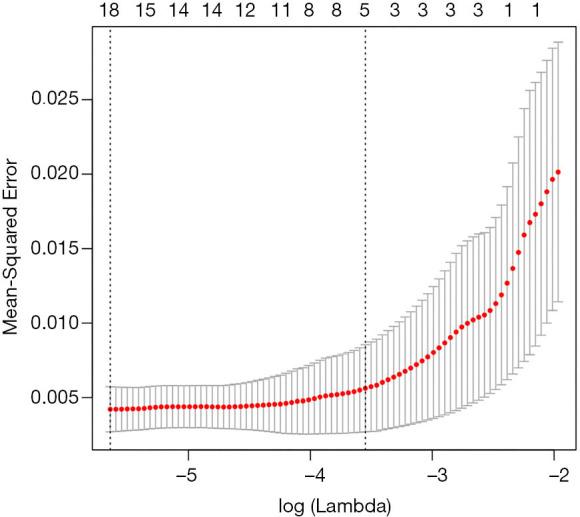
Somatic mutations were detected in 80.8% (20/26) of the patients. Patients harboring somatic mutations with maximum allelic fraction (maxAF) of >5% had significantly shorter OS compared to those with maxAF ≤5% (7.1 54.6 months; P=0.020). ctDNA methylation level was found to be strongly correlated with maxAF (Pearson correlation =0.934; P<0.001). Consistent with maxAF, higher methylation levels were also associated with poorer OS (hazard ratio =2.377; 95% CI: 1.283-4.405; P=0.006). Moreover, a total of 1,956 ctDNA methylation blocks were differentially methylated in patients with maxAF >0 (P<0.05). Least absolute shrinkage and selection operator (LASSO) regression analysis revealed a significant correlation between methylation signatures from 5 methylation blocks and OS (hazard ratio =183.20, 95% CI: 2.74-12,243.32; P=0.015). These 5 methylation blocks could serve as an alternative to maxAF and can be explored as prognostic biomarkers.
CONCLUSIONS
Our study identified several ctDNA methylation blocks that can potentially predict the prognosis of LUSC at the time of diagnosis.
背景
异常的表观遗传修饰在肺癌发生中起关键作用。在我们的研究中,我们旨在探讨肺鳞状细胞癌(LUSC)患者基线循环肿瘤DNA(ctDNA)的体细胞和甲基化谱的临床意义。
方法
本研究共纳入26例不同分期的LUSC患者。分别使用基于独特分子标识符(UMI)的靶向测序和亚硫酸氢盐测序,从诊断时获得的血浆来源的ctDNA中分析体细胞突变和甲基化水平。分析基线ctDNA突变与甲基化谱以及总生存期(OS)之间的相关性。
结果
80.8%(20/26)的患者检测到体细胞突变。最大等位基因分数(maxAF)>5%的体细胞突变患者的OS明显短于maxAF≤5%的患者(7.1对54.6个月;P=0.020)。发现ctDNA甲基化水平与maxAF密切相关(Pearson相关性=0.934;P<0.001)。与maxAF一致,较高的甲基化水平也与较差的OS相关(风险比=2.377;95%CI:1.283 - 4.405;P=0.006)。此外,maxAF>0的患者共有1956个ctDNA甲基化区域存在差异甲基化(P<0.05)。最小绝对收缩和选择算子(LASSO)回归分析显示,来自5个甲基化区域的甲基化特征与OS之间存在显著相关性(风险比=183.20,95%CI:2.74 - 12243.32;P=0.015)。这5个甲基化区域可作为maxAF的替代指标,并可作为预后生物标志物进行探索。
结论
我们的研究确定了几个ctDNA甲基化区域,它们可能在诊断时预测LUSC的预后。


 Zotero 插件