
晚期非小细胞肺癌患者疾病进展后的免疫治疗
Immunotherapy beyond progression in patients with advanced non-small cell lung cancer.
作者信息
Ge Xiangwei, Zhang Zhibo, Zhang Sujie, Yuan Fang, Zhang Fan, Yan Xiang, Han Xiao, Ma Junxun, Wang Lijie, Tao Haitao, Li Xiaoyan, Zhi Xiaoyu, Huang Zhiyue, Hofman Paul, Prelaj Arsela, Banna Giuseppe Luigi, Mutti Luciano, Hu Yi, Wang Jinliang
机构信息
Medical School of Chinese PLA, Beijing, China.
Department of Oncology, the Second Medical Center, Chinese PLA General Hospital, Beijing, China.
出版信息
Transl Lung Cancer Res. 2020 Dec;9(6):2391-2400. doi: 10.21037/tlcr-20-1252.
BACKGROUND
Immune checkpoint inhibitors (ICIs) represent a great breakthrough in the treatment of advanced non-small cell lung cancer (aNSCLC). However, whether immunotherapy beyond progression (IBP) is effective for aNSCLC has yet to be established. Therefore, a retrospective clinical study was conducted to investigate the efficacy of IBP in patients with aNSCLC under real-world conditions.
METHODS
A total of 125 Chinese patients with aNSCLC who experienced progressive disease (PD) after receiving monotherapy or combination therapy (combined with chemotherapy or/and antiangiogenic therapy) with programmed cell death-1 (PD-1)/programmed cell death ligand-1 (PD-L1) inhibitors between January 2015 and March 2019 were enrolled. Patients who were treated with ICIs for more than 6 weeks after PD were defined as IBP (n=39), while those who received ICI treatment for less than 6 weeks or discontinued it due to PD were defined as non-IBP (n=86). Patient clinical characteristics were evaluated. An optimization-based method was applied to balance the clinical baseline characteristics between the two groups.
RESULTS
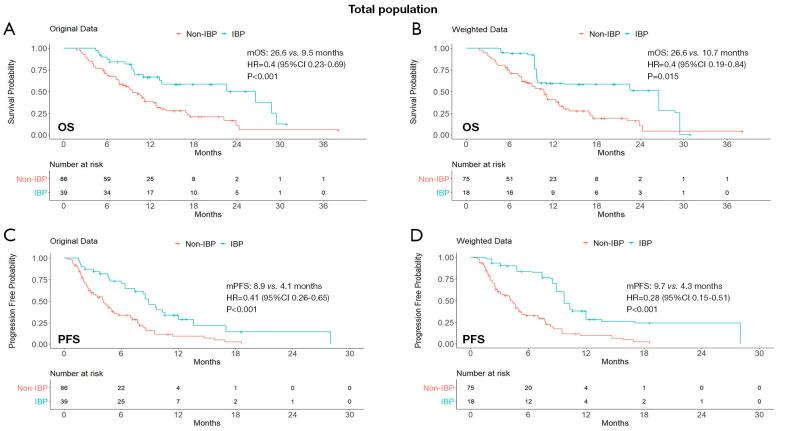
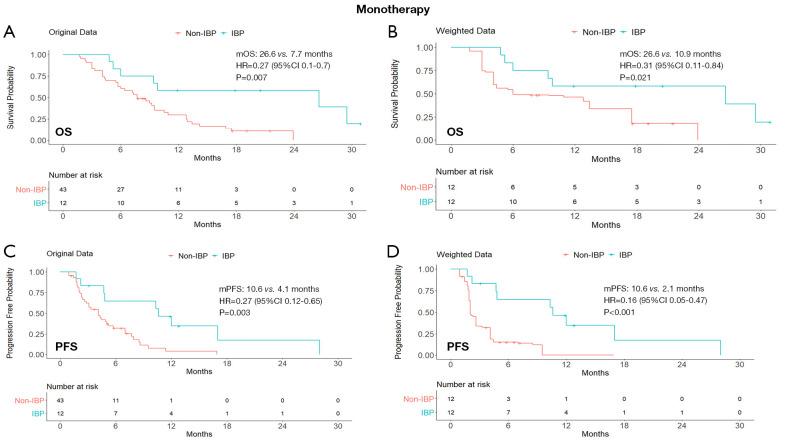
In total population, the IBP group had longer overall survival (median OS, 26.6 9.5 months; HR, 0.40; 95% CI: 0.23-0.69; P<0.001) and progression-free survival (median PFS, 8.9 4.1 months; HR, 0.41; 95% CI: 0.26-0.65; P<0.001), compared with the non-IBP group. Despite no significant difference in objective response rate (ORR, 15.4% 11.6%, P=0.560), disease control rate (DCR) was significantly higher in the IBP group (89.7% 61.6%, P<0.001). After balancing baseline covariates, the IBP group also had longer OS (median: 26.6 10.7 months; HR, 0.40; 95% CI: 0.19-0.84; P=0.015) and PFS (median: 9.7 4.3 months; HR, 0.28; 95% CI: 0.15-0.51; P<0.001), with a benefit in either of patients previously treated with ICI monotherapy or in combination therapy and with non-response to the previously ICI.
CONCLUSIONS
IBP is associated with longer OS and PFS in patients with aNSCLC. Our findings may suggest new therapeutic options for patients with aNSCLC who experienced disease progression after initial immunotherapy.
背景
免疫检查点抑制剂(ICIs)是晚期非小细胞肺癌(aNSCLC)治疗领域的一项重大突破。然而,免疫治疗超越疾病进展(IBP)对aNSCLC是否有效尚未明确。因此,开展了一项回顾性临床研究,以调查在真实世界条件下IBP对aNSCLC患者的疗效。
方法
纳入2015年1月至2019年3月期间接受程序性细胞死亡蛋白1(PD-1)/程序性细胞死亡配体1(PD-L1)抑制剂单药治疗或联合治疗(联合化疗或/和抗血管生成治疗)后出现疾病进展(PD)的125例中国aNSCLC患者。PD后接受ICIs治疗超过6周的患者被定义为IBP组(n=39),而接受ICI治疗少于6周或因PD停药的患者被定义为非IBP组(n=86)。评估患者的临床特征。采用基于优化的方法平衡两组之间的临床基线特征。
结果
在总人群中,与非IBP组相比,IBP组的总生存期更长(中位OS,26.6±9.5个月;HR,0.40;95%CI:0.23-0.69;P<0.001)和无进展生存期更长(中位PFS,8.9±4.1个月;HR,0.41;95%CI:0.26-0.65;P<0.001)。尽管客观缓解率无显著差异(ORR,15.4%±11.6%,P=0.560),但IBP组的疾病控制率显著更高(89.7%±61.6%,P<0.001)。在平衡基线协变量后,IBP组的OS(中位:26.6±10.7个月;HR,0.40;95%CI:0.19-0.84;P=0.015)和PFS(中位:9.7±4.3个月;HR,0.28;95%CI:0.15-0.51;P<0.001)也更长,对既往接受ICI单药治疗或联合治疗且对既往ICI无反应的患者均有益。
结论
IBP与aNSCLC患者更长的OS和PFS相关。我们的研究结果可能为初始免疫治疗后疾病进展的aNSCLC患者提供新的治疗选择。


 Zotero 插件