
血清 Epstein-Barr 病毒抗体的预后价值及其与局部晚期鼻咽癌 TNM 分期的相关性。
Prognostic Value of Serum Epstein-Barr Virus Antibodies and Their Correlation with TNM Classification in Patients with Locoregionally Advanced Nasopharyngeal Carcinoma.
机构信息
Department of Nasopharyngeal Carcinoma, Sun Yat-sen University Cancer Center, Guangzhou, China.
出版信息
Cancer Res Treat. 2021 Oct;53(4):991-1003. doi: 10.4143/crt.2020.1298. Epub 2021 Jan 13.
PURPOSE
This study assessed the correlation between Epstein-Barr virus (EBV) biomarkers and the eighth American Joint Committee on Cancer staging system and the prognostic values of IgG antibodies against replication and transcription activator (Rta-IgG), IgA antibodies against Epstein-Barr nuclear antigen 1, and BamH1 Z transactivator (Zta-IgA) in locoregionally advanced nasopharyngeal carcinoma (NPC) patients.
MATERIALS AND METHODS
Serum EBV antibody levels were measured by enzyme-linked immunosorbent assay in 435 newly diagnosed stage III-IVA NPC patients administered intensity-modulated radiation therapy±chemotherapy. The primary endpoint was progression-free survival (PFS).
RESULTS
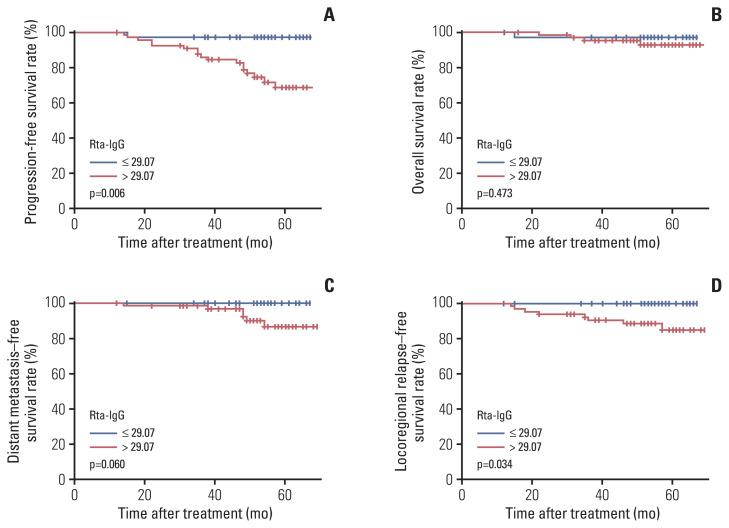
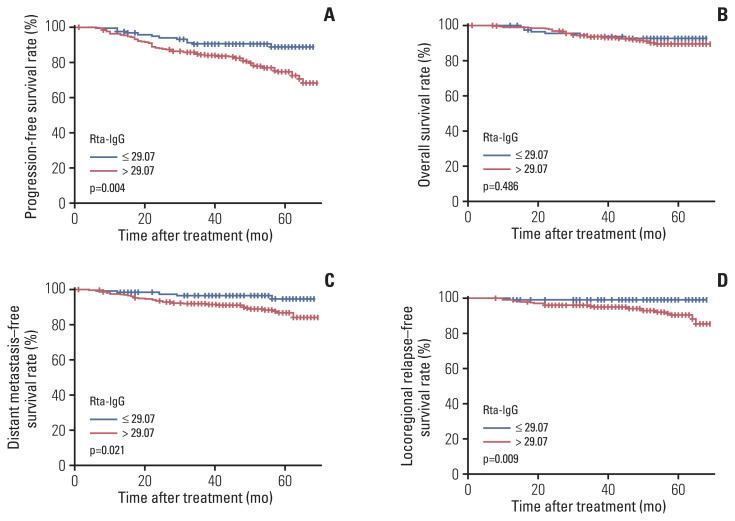
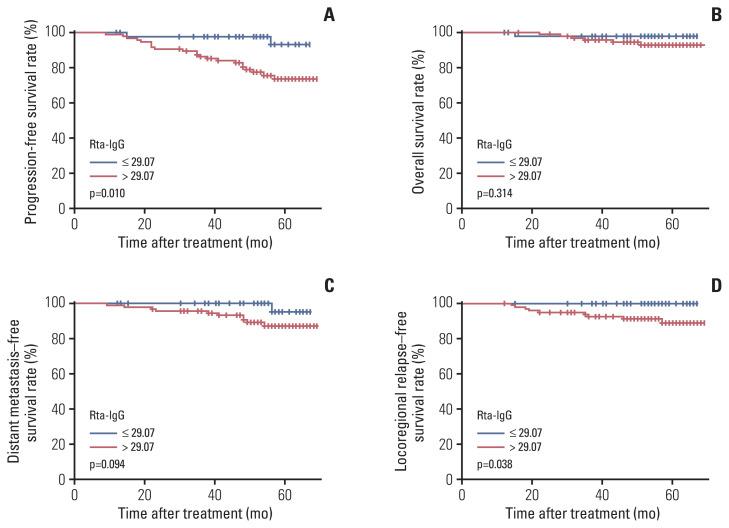
Rta-IgG and Zta-IgA levels were positively correlated with the N category and clinical stage. Patients with high Rta-IgG levels (> 29.07 U/mL) showed a significantly inferior prognosis as indicated by PFS (77% vs. 89.8%, p=0.004), distant metastasis-free survival (DMFS) (88.3% vs. 95.8%, p=0.021), and local recurrence-free survival (LRFS) (91.2% vs. 98.3%, p=0.009). High Rta-IgG levels were also significantly associated with inferior PFS and LRFS in multivariable analyses. In the low-level EBV DNA group (≤ 1,500 copies/mL), patients with high Rta-IgG levels had significantly inferior PFS and DMFS (both p < 0.05). However, in the high-level EBV DNA group, Rta-IgG levels were not significantly associated with PFS, DMFS, and LRFS. In the advanced T category (T3-4) subgroup, high Rta-IgG levels were also significantly associated with inferior PFS, DMFS, and LRFS (both p < 0.05).
CONCLUSION
Rta-IgG and Zta-IgA levels were strongly correlated with the TNM classification. Rta-IgG level was a negative prognostic factor in locoregionally advanced NPC patients, especially those with advanced T category or low EBV DNA level.
目的
本研究评估了 Epstein-Barr 病毒(EBV)生物标志物与第八版美国癌症联合委员会分期系统之间的相关性,以及针对复制和转录激活剂(Rta-IgG)、EBV 核抗原 1 的 IgA 抗体和 BamH1 Z 转录激活剂(Zta-IgA)的 IgG 抗体在局部晚期鼻咽癌(NPC)患者中的预后价值。
材料与方法
对 435 例新诊断为 III-IVA 期 NPC 并接受调强放疗±化疗的患者,采用酶联免疫吸附试验检测血清 EBV 抗体水平。主要终点为无进展生存期(PFS)。
结果
Rta-IgG 和 Zta-IgA 水平与 N 分期和临床分期呈正相关。Rta-IgG 水平较高(>29.07 U/mL)的患者 PFS(77% vs. 89.8%,p=0.004)、无远处转移生存期(DMFS)(88.3% vs. 95.8%,p=0.021)和无局部复发生存期(LRFS)(91.2% vs. 98.3%,p=0.009)均明显较差。多变量分析显示,Rta-IgG 水平较高与 PFS 和 LRFS 较差显著相关。在低水平 EBV DNA 组(≤1500 拷贝/mL)中,Rta-IgG 水平较高的患者 PFS 和 DMFS 明显较差(均 p<0.05)。然而,在高水平 EBV DNA 组中,Rta-IgG 水平与 PFS、DMFS 和 LRFS 均无显著相关性。在晚期 T 分期(T3-4)亚组中,Rta-IgG 水平较高也与 PFS、DMFS 和 LRFS 较差显著相关(均 p<0.05)。
结论
Rta-IgG 和 Zta-IgA 水平与 TNM 分类密切相关。Rta-IgG 水平是局部晚期 NPC 患者的一个不良预后因素,尤其是 T 分期较高或 EBV DNA 水平较低的患者。


 Zotero 插件