
基于细胞的荧光素酶互补测定法的开发用于鉴定 SARS-CoV-2 3CL 抑制剂。
Development of a Cell-Based Luciferase Complementation Assay for Identification of SARS-CoV-2 3CL Inhibitors.
机构信息
Viral Recombination Section, HIV Dynamics and Replication Program, National Cancer Institute, Frederick, MD 21702, USA.
Viral Mutation Section, HIV Dynamics and Replication Program, National Cancer Institute, Frederick, MD 21702, USA.
出版信息
Viruses. 2021 Jan 24;13(2):173. doi: 10.3390/v13020173.
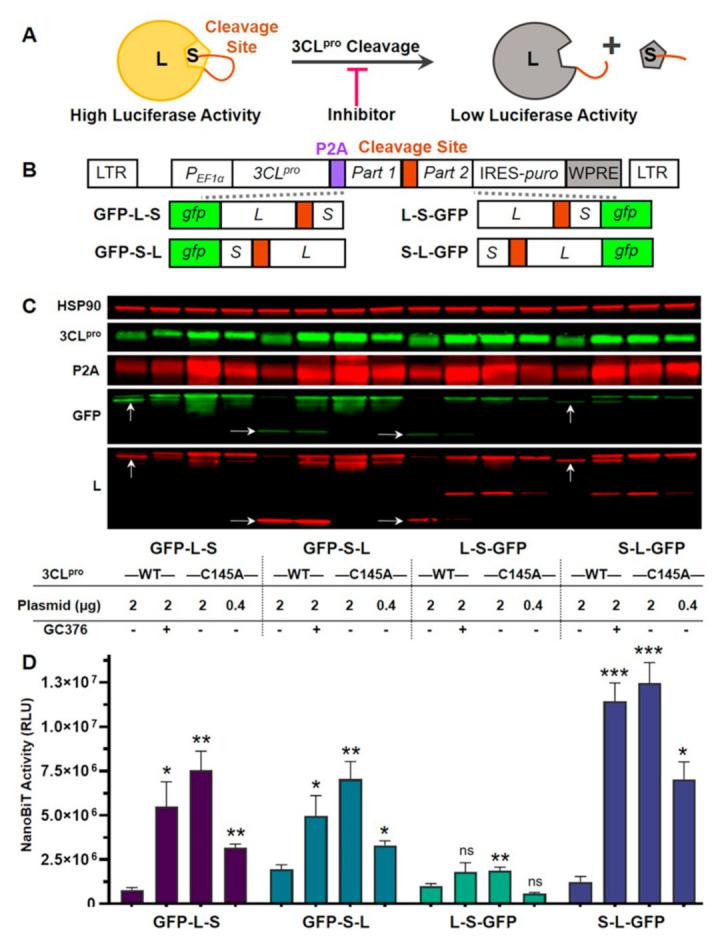
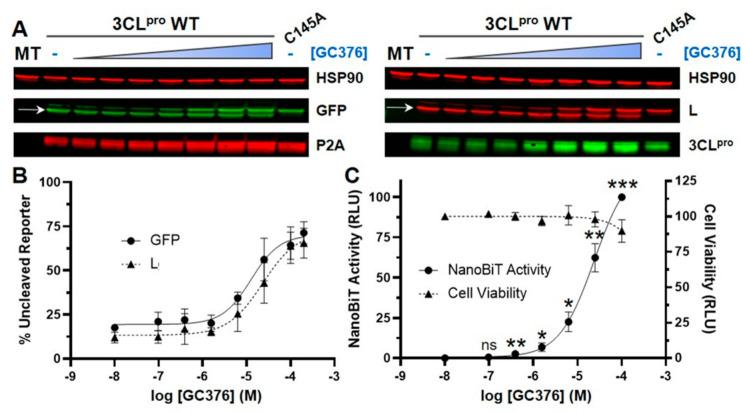
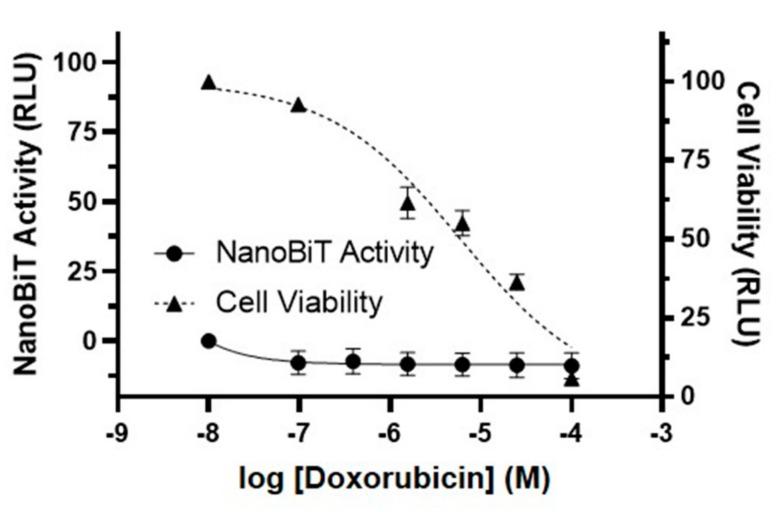
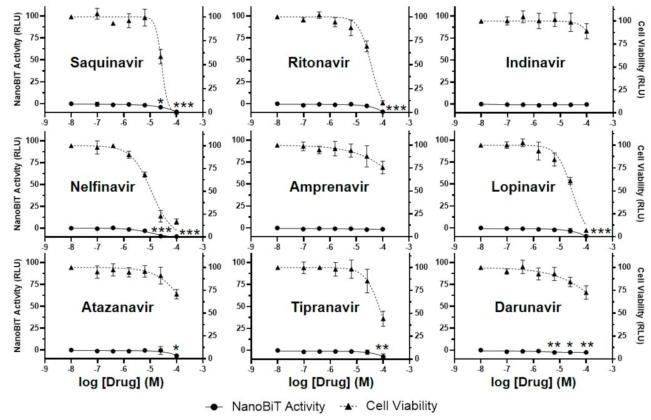
The 3C-like protease (3CL) of SARS-CoV-2 is considered an excellent target for COVID-19 antiviral drug development because it is essential for viral replication and has a cleavage specificity distinct from human proteases. However, drug development for 3CL has been hindered by a lack of cell-based reporter assays that can be performed in a BSL-2 setting. Current efforts to identify 3CL inhibitors largely rely upon in vitro screening, which fails to account for cell permeability and cytotoxicity of compounds, or assays involving replication-competent virus, which must be performed in a BSL-3 facility. To address these limitations, we have developed a novel cell-based luciferase complementation reporter assay to identify inhibitors of SARS-CoV-2 3CL in a BSL-2 setting. The assay is based on a lentiviral vector that co-expresses 3CL and two luciferase fragments linked together by a 3CL cleavage site. 3CL-mediated cleavage results in a loss of complementation and low luciferase activity, whereas inhibition of 3CL results in 10-fold higher levels of luciferase activity. The luciferase reporter assay can easily distinguish true 3CL inhibition from cytotoxicity, a powerful feature that should reduce false positives during screening. Using the assay, we screened 32 small molecules for activity against SARS-CoV-2 3CL, including HIV protease inhibitors, HCV protease inhibitors, and various other compounds that have been reported to inhibit SARS-CoV-2 3CL. Of these, only five exhibited significant inhibition of 3CL in cells: GC376, boceprevir, Z-FA-FMK, calpain inhibitor XII, and GRL-0496. This assay should greatly facilitate efforts to identify more potent inhibitors of SARS-CoV-2 3CL.
新型冠状病毒 3C 样蛋白酶(3CL)被认为是开发 COVID-19 抗病毒药物的理想靶点,因为它是病毒复制所必需的,并且其切割特异性与人体蛋白酶不同。然而,由于缺乏可在生物安全二级实验室(BSL-2)环境下进行的基于细胞的报告检测,因此 3CL 的药物研发受到了阻碍。目前,识别 3CL 抑制剂的主要努力依赖于体外筛选,但这种方法无法考虑化合物的细胞通透性和细胞毒性,或者涉及复制型病毒的检测,而这些都必须在 BSL-3 设施中进行。为了解决这些限制,我们开发了一种新型基于细胞的荧光素酶互补报告检测,以在 BSL-2 环境下鉴定 SARS-CoV-2 3CL 的抑制剂。该检测基于一种慢病毒载体,该载体共表达 3CL 和两个通过 3CL 切割位点连接在一起的荧光素酶片段。3CL 介导的切割导致互补丧失和低荧光素酶活性,而 3CL 的抑制则导致荧光素酶活性增加 10 倍。荧光素酶报告检测可以轻松区分真正的 3CL 抑制与细胞毒性,这一强大的特性应该会减少筛选过程中的假阳性。我们使用该检测方法筛选了 32 种小分子对 SARS-CoV-2 3CL 的活性,包括 HIV 蛋白酶抑制剂、HCV 蛋白酶抑制剂以及各种据报道可抑制 SARS-CoV-2 3CL 的其他化合物。其中,只有五种化合物在细胞中对 3CL 表现出显著抑制作用:GC376、博赛泼维、Z-FA-FMK、钙蛋白酶抑制剂 XII 和 GRL-0496。该检测方法应极大地促进识别更有效的 SARS-CoV-2 3CL 抑制剂的努力。

 Zotero 插件