
基于疼痛神经科学教育的结构化团体干预对初级保健中纤维肌痛患者的疗效:一项多中心随机开放标签对照试验。
Effectiveness of a structured group intervention based on pain neuroscience education for patients with fibromyalgia in primary care: A multicentre randomized open-label controlled trial.
机构信息
Primary Health Care Center Sáenz de Buruaga, Osakidetza Basque Health Service, OSI Bilbao-Basurto, Bilbao, Spain.
Working Group on Fibromyalgia, Migraine and Chronic Pain, Osatzen Sociedad Vasca de Medicina Familiar y Comunitaria, Bilbao, Spain.
出版信息
Eur J Pain. 2021 May;25(5):1137-1149. doi: 10.1002/ejp.1738. Epub 2021 Feb 18.
BACKGROUND
There has been increased interest in pain neuroscience education (PNE) as a therapeutic approach for the management of fibromyalgia (FM).
METHODS
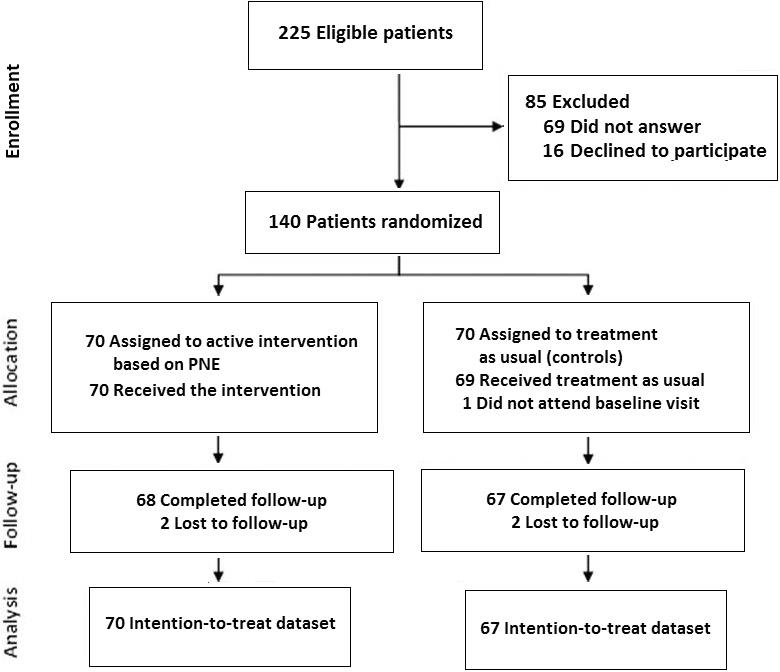
A multicentre randomized, open-label, controlled trial was conducted to assess the effectiveness of a structured group intervention based on PNE in patients with FM. A total of 139 patients were included in the study and randomized to the intervention group (7 group sessions of education in neurobiology of pain) or to the control group (treatment as usual only). The primary outcome was the improvement of functional status and pain measured with the Fibromyalgia Impact Questionnaire (FIQ), and secondary outcomes were the reduction in the impact of pain and other symptoms (catastrophizing, anxiety and depression) and number of patients reaching no worse than moderate functional impairment (FIQ score <39). Differences between groups were calculated by linear mixed-effects (intention-to-treat approach) and mediational models through path analyses.
RESULTS
At 1 year, improvements in FIQ scores were higher in the intervention group with moderate or high effect size, and decreases of ≥20% in 69.1% of patients (20.9% in the control group) and of ≥50% in 39.7% (4.5% in the control group). Also, 52.9% of patients had a FIQ <39 points (13.4% in the control group).
CONCLUSIONS
In this sample of patients with FM, the improvement in quality of life and control of symptoms obtained by adding a PNE intervention showed promising results, equalling or surpassing previously reported outcomes.
SIGNIFICANCE
A structured group intervention based on pain neuroscience education for 1 year in patients with fibromyalgia was associated with significant amelioration of the impact of the disease on scores of the Fibromyalgia Impact Questionnaire, the Health Assessment Questionnaire, the Hospital Anxiety and Depression Scale, the Pain Catastrophizing Scale and the Polysymptomatic Distress Scale as compared with only treatment as usual. These findings are clinically relevant considering the challenges posed by fibromyalgia to clinicians and patients alike.
背景
疼痛神经科学教育(PNE)作为纤维肌痛(FM)管理的一种治疗方法,越来越受到关注。
方法
进行了一项多中心随机、开放标签、对照试验,以评估基于 PNE 的结构化小组干预对 FM 患者的有效性。共有 139 名患者入组研究,并随机分为干预组(7 次神经生物学疼痛教育小组课程)或对照组(仅常规治疗)。主要结局是用纤维肌痛影响问卷(FIQ)测量的功能状态和疼痛的改善,次要结局是疼痛和其他症状(灾难化、焦虑和抑郁)的影响降低,以及达到不低于中度功能障碍(FIQ 评分<39)的患者人数。通过线性混合效应(意向治疗方法)和中介模型通过路径分析计算组间差异。
结果
在 1 年时,干预组的 FIQ 评分改善更高,具有中等或高效应量,并且 69.1%的患者(对照组为 20.9%)的下降≥20%,39.7%的患者(对照组为 4.5%)的下降≥50%。此外,52.9%的患者的 FIQ<39 分(对照组为 13.4%)。
结论
在本研究中,在 FM 患者中添加 PNE 干预可提高生活质量和控制症状,结果有希望,与以前报道的结果相当或更好。
意义
在纤维肌痛患者中进行为期 1 年的基于疼痛神经科学教育的结构化小组干预与仅常规治疗相比,与疾病对纤维肌痛影响问卷、健康评估问卷、医院焦虑和抑郁量表、疼痛灾难化量表和多症状困扰量表评分的影响显著改善相关。考虑到纤维肌痛对临床医生和患者都带来的挑战,这些发现具有临床意义。



 Zotero 插件