
首发精神病抗精神病药物的处方模式:一项回顾性队列研究。
Prescribing pattern of antipsychotic medication for first-episode psychosis: a retrospective cohort study.
作者信息
Keating Dolores, McWilliams Stephen, Boland Fiona, Doyle Roisin, Behan Caragh, Strawbridge Judith, Clarke Mary
机构信息
Pharmacy Department, Saint John of God Hospital, Dublin, Ireland
School of Pharmacy, Royal College of Surgeons in Ireland, Dublin, Ireland.
出版信息
BMJ Open. 2021 Jan 31;11(1):e040387. doi: 10.1136/bmjopen-2020-040387.
OBJECTIVE
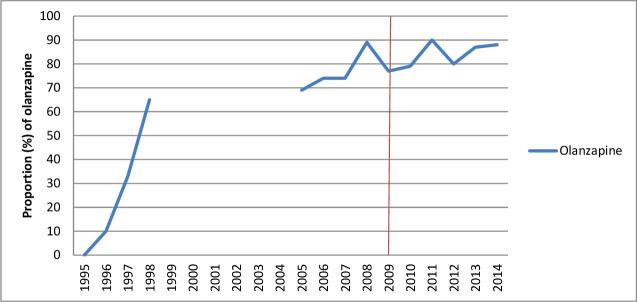
Guidelines for antipsychotic use in first-episode psychosis (FEP) recommend that medication be chosen initially on the basis of side effect profile with doses at the lower end of the range. Our objective was to describe the pattern of antipsychotic use in FEP over a period of 21 years in the context of changing clinical guidelines and the development of specialist early intervention in psychosis (EIP) services.
SETTING
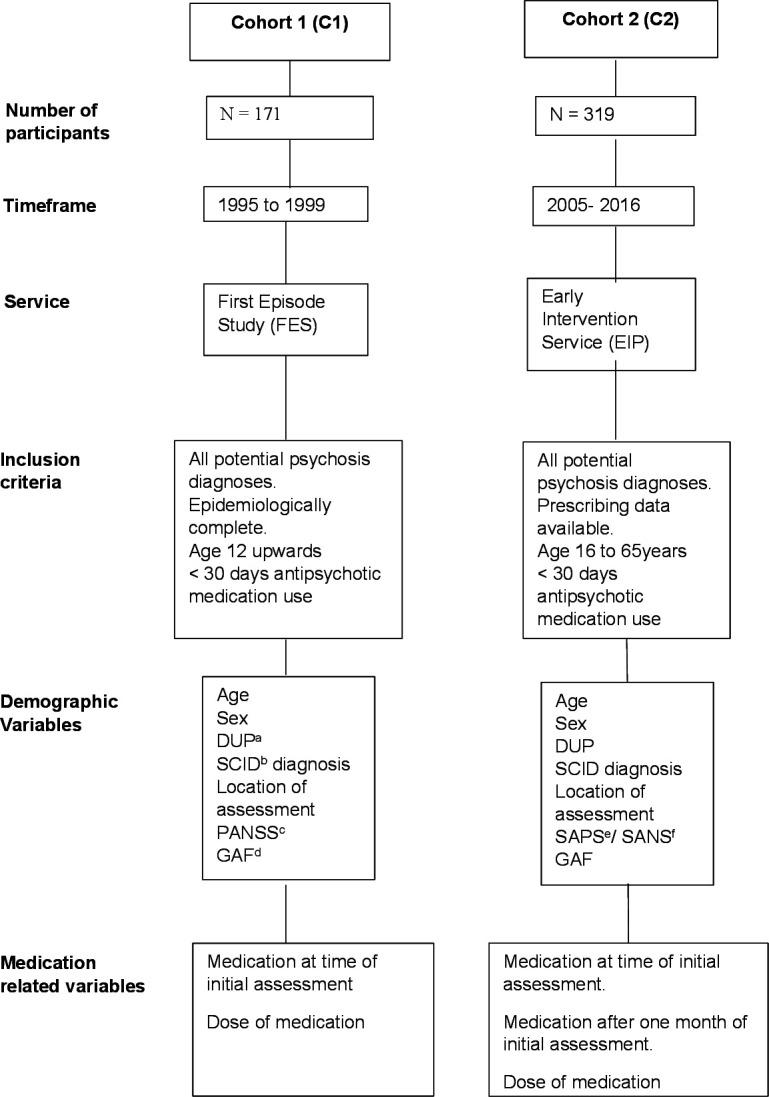
A community-based mental health service in South County Dublin (population 187 000) and a large private hospital.
PARTICIPANTS
Participants included 465 patients with FEP (146 from an epidemiological study (1995-1999) and 319 from a specialist EIP service (2005-2016)). Treatment with antipsychotic medication did not exceed 30 days at study entry.
OUTCOME MEASURES
This is a descriptive study of prescribing practices in the context of service development and changing guidelines.
RESULTS
First-generation antipsychotics were prescribed for 65% of the early cohort compared with 4.3% of the EIP cohort. Olanzapine was initially prescribed for 79.7% of EIP patients. Initial doses of medication were frequently low (≤50% British National Formulary (BNF) maximum) in both cohorts (71% and 78.6%). The demographic and clinical factors investigated did not influence the initial choice of antipsychotic medication significantly. Univariate logistic regression analysis suggested inpatient treatment setting was associated with a higher initial dose (>50% BNF maximum) of antipsychotic medication. Increasing dose requirements over the first month of engagement with an EIP service was associated with poorer global functioning at baseline, greater positive symptoms at baseline and the inpatient treatment setting. However, these associations were not seen in the multivariable model.
CONCLUSIONS
Second-generation antipsychotic prescribing predominates, but guidelines are often overlooked when choosing olanzapine notwithstanding lower initial dosages. EIP services should include proactive support for optimising medicines in line with evidence-based guidelines.
目的
首发精神病(FEP)抗精神病药物使用指南建议,初始用药应根据副作用情况选择,剂量采用较低范围。我们的目的是在临床指南不断变化以及精神病早期干预(EIP)专科服务发展的背景下,描述21年间FEP患者抗精神病药物的使用模式。
设置
都柏林南部县(人口18.7万)的社区心理健康服务机构和一家大型私立医院。
参与者
参与者包括465例FEP患者(146例来自一项流行病学研究(1995 - 1999年),319例来自专科EIP服务(2005 - 2016年))。研究开始时,抗精神病药物治疗时间不超过30天。
观察指标
这是一项在服务发展和指南变化背景下对处方实践的描述性研究。
结果
第一代抗精神病药物在早期队列中的处方率为65%,而在EIP队列中为4.3%。奥氮平最初在79.7%的EIP患者中被处方。两个队列中药物的初始剂量通常较低(≤英国国家处方集(BNF)最大剂量的50%)(分别为71%和78.6%)。所调查的人口统计学和临床因素对抗精神病药物的初始选择没有显著影响。单因素逻辑回归分析表明,住院治疗环境与抗精神病药物较高的初始剂量(>BNF最大剂量的50%)相关。在参与EIP服务的第一个月内剂量需求增加与基线时较差的整体功能、基线时更明显的阳性症状以及住院治疗环境相关。然而,在多变量模型中未发现这些关联。
结论
第二代抗精神病药物处方占主导,但尽管初始剂量较低,在选择奥氮平时往往忽视指南。EIP服务应包括积极支持根据循证指南优化用药。
 Zotero 插件