
抗菌药物管理项目捆绑式举措对革兰氏阴性需氧菌菌血症患者管理中利用 Accelerate Pheno™ 系统的影响。
Impact of an Antimicrobial Stewardship Program-bundled initiative utilizing Accelerate Pheno™ system in the management of patients with aerobic Gram-negative bacilli bacteremia.
机构信息
Medicine Institute and Division of Infectious Diseases, Allegheny Health Network, Allegheny General Hospital, 320 East North Ave. East Wing Office Building, Suite 406, Pittsburgh, PA, 15212, USA.
Department of Pharmacy, Allegheny Health Network, Pittsburgh, PA, USA.
出版信息
Infection. 2021 Jun;49(3):511-519. doi: 10.1007/s15010-021-01581-1. Epub 2021 Feb 2.
PURPOSE
Gram-negative bacteria (GNB) are a leading cause of bloodstream infections (BSI) and management is complicated by antibiotic resistance. The Accelerate Pheno™ system (ACC) can provide rapid organism identification and antimicrobial susceptibility testing (AST).
METHODS
A retrospective, pre-intervention/post-intervention study was conducted to compare management of non-critically ill patients with GNB BSI before and after implementation of a bundled initiative. This bundled initiative included dissemination of a clinical decision algorithm, ACC testing on all GNB isolated from blood cultures, real-time communication of results to the Antimicrobial Stewardship Program (ASP), and prospective audit with feedback by the ASP. The pre-intervention period was January 2018 through December 2018, and the post-intervention period was May 2019 through February 2020.
RESULTS
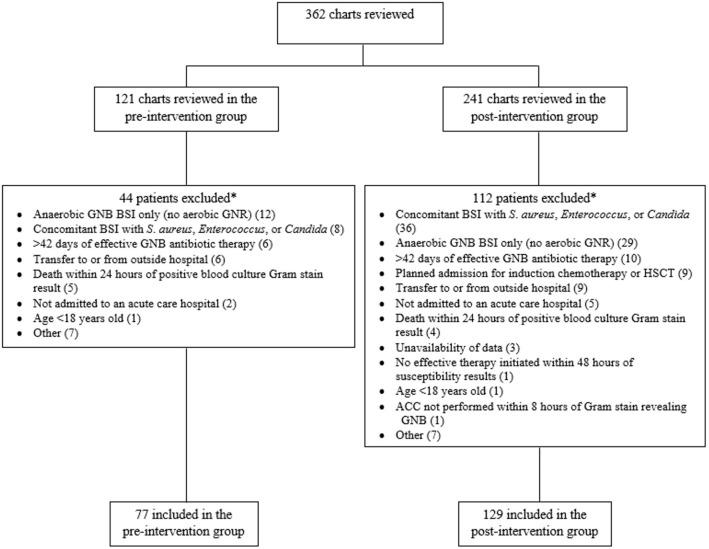
Seventy-seven and 129 patients were included in the pre-intervention and post-intervention cohorts, respectively. When compared with the pre-intervention group, the time from Gram stain to AST decreased from 46.1 to 6.9 h (p < 0.001), and the time to definitive therapy (TTDT) improved from 32.6 to 10.5 h (p < 0.001). Implementation led to shorter median total duration of antibiotic therapy (14.2 vs 9.5 days; p < 0.001) and mean hospital length of stay (7.9 vs 5.3 days; p = 0.047) without an increase in 30-day readmissions (22.1% vs 14%; p = 0.13).
CONCLUSION
Implementation of an ASP-bundled approach incorporating the ACC aimed at optimizing antibiotic therapy in the management GNB BSI in non-critically ill patients led to reduced TTDT, shorter duration of antibiotic therapy, and shorter hospital length of stay without adversely affecting readmission rates.
目的
革兰氏阴性菌(GNB)是血流感染(BSI)的主要原因,其管理因抗生素耐药性而变得复杂。Accelerate Pheno™ 系统(ACC)可以提供快速的生物体鉴定和抗菌药物敏感性测试(AST)。
方法
进行了一项回顾性的干预前/干预后研究,以比较在实施捆绑式方案前后对患有 GNB BSI 的非危重症患者的管理。该捆绑式方案包括传播临床决策算法、对所有从血培养中分离出的 GNB 进行 ACC 检测、实时将结果传达给抗菌药物管理计划(ASP),并由 ASP 进行前瞻性审核和反馈。干预前时期为 2018 年 1 月至 2018 年 12 月,干预后时期为 2019 年 5 月至 2020 年 2 月。
结果
干预前和干预后队列分别纳入了 77 例和 129 例患者。与干预前组相比,从革兰氏染色到 AST 的时间从 46.1 小时减少到 6.9 小时(p<0.001),而确定性治疗时间(TTDT)从 32.6 小时改善到 10.5 小时(p<0.001)。实施使抗生素治疗的总持续时间中位数(14.2 天与 9.5 天;p<0.001)和平均住院时间(7.9 天与 5.3 天;p=0.047)缩短,而 30 天再入院率没有增加(22.1%与 14%;p=0.13)。
结论
实施包含 ACC 的 ASP 捆绑式方案,旨在优化非危重症患者 GNB BSI 管理中的抗生素治疗,可缩短 TTDT、抗生素治疗持续时间和住院时间,而不会对再入院率产生不利影响。

 Zotero 插件