
健康足月出生婴儿在生命的头两年中纵向端粒长度与身体成分的关系。
Longitudinal telomere length and body composition in healthy term-born infants during the first two years of life.
机构信息
Department of Pediatrics, Subdivision of Endocrinology, Erasmus University Medical Center - Sophia Children's Hospital, Rotterdam, The Netherlands.
Department of Cardiovascular Sciences, University of Leicester, Leicester, United Kingdom.
出版信息
PLoS One. 2021 Feb 2;16(2):e0246400. doi: 10.1371/journal.pone.0246400. eCollection 2021.
OBJECTIVE
Leukocyte telomere length (LTL) is one of the markers of biological aging as shortening occurs over time. Shorter LTL has been associated with adiposity and a higher risk of cardiovascular diseases. The objective was to assess LTL and LTL shortening during the first 2 years of life in healthy, term-born infants and to associate LTL shortening with potential stressors and body composition.
STUDY DESIGN
In 145 healthy, term-born infants (85 boys), we measured LTL in blood, expressed as telomere to single-gene copy ratio (T/S ratio), at 3 months and 2 years by quantitative PCR technique. Fat mass (FM) was assessed longitudinally by PEAPOD, DXA, and abdominal FM by ultrasound.
RESULTS
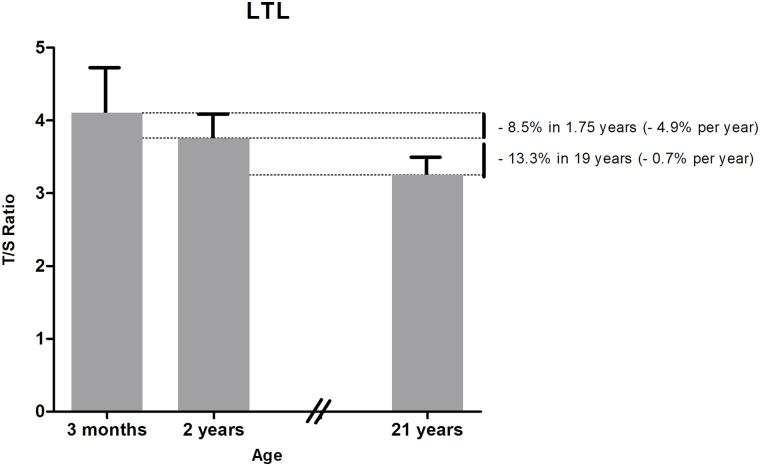
LTL decreased by 8.5% from 3 months to 2 years (T/S ratio 4.10 vs 3.75, p<0.001). LTL shortening from 3 months to 2 years associated with FM%(R = 0.254), FM index(R = 0.243) and visceral FM(R = 0.287) at 2 years. LTL shortening tended to associate with gain in FM% from 3 to 6 months (R = 0.155, p = 0.11), in the critical window for adiposity programming. There was a trend to a shorter LTL in boys at 2 years(p = 0.056). LTL shortening from 3 months to 2 years was not different between sexes.
CONCLUSION
We present longitudinal LTL values and show that LTL shortens considerably (8.5%) during the first 2 years of life. LTL shortening during first 2 years of life was associated with FM%, FMI and visceral FM at age 2 years, suggesting that adverse adiposity programming in early life could contribute to more LTL shortening.
目的
端粒酶长度(LTL)是生物衰老的标志之一,随着时间的推移会缩短。较短的 LTL 与肥胖和心血管疾病风险增加有关。本研究旨在评估健康足月出生婴儿生命最初 2 年内的 LTL 及其缩短情况,并探讨 LTL 缩短与潜在应激源和身体成分的关系。
研究设计
在 145 名健康足月出生的婴儿(85 名男婴)中,我们使用定量 PCR 技术在 3 个月和 2 岁时测量血液中的 LTL,以端粒与单基因拷贝比(T/S 比)表示。脂肪量(FM)通过 PEAPOD、DXA 和腹部超声进行纵向评估。
结果
LTL 从 3 个月到 2 岁下降了 8.5%(T/S 比从 4.10 降至 3.75,p<0.001)。从 3 个月到 2 岁的 LTL 缩短与 2 岁时的 FM%(R = 0.254)、FM 指数(R = 0.243)和内脏 FM(R = 0.287)相关。LTL 缩短与 3 至 6 个月时 FM%的增加有一定趋势(R = 0.155,p = 0.11),这是肥胖发生的关键时期。2 岁时男孩的 LTL 缩短趋势更明显(p = 0.056)。3 个月至 2 岁时的 LTL 缩短在性别间无差异。
结论
我们提供了纵向 LTL 值,并表明 LTL 在生命的头 2 年中显著缩短(8.5%)。生命最初 2 年内的 LTL 缩短与 2 岁时的 FM%、FMI 和内脏 FM 相关,表明生命早期不良的肥胖发生可能导致 LTL 进一步缩短。
 Zotero 插件