
青春期是犁鼻器介导小鼠社会性行为的关键时期。
Puberty is a Critical Period for Vomeronasal Organ Mediation of Socio-sexual Behavior in Mice.
作者信息
Cross Sarah K J, Martin Yellow H, Salia Stephanie, Gamba Iain, Major Christina A, Hassan Suhail, Parsons Katelyn A, Swift-Gallant Ashlyn
机构信息
Department of Psychology, Memorial University of Newfoundland, St. John's, NL, Canada.
出版信息
Front Behav Neurosci. 2021 Jan 22;14:606788. doi: 10.3389/fnbeh.2020.606788. eCollection 2020.
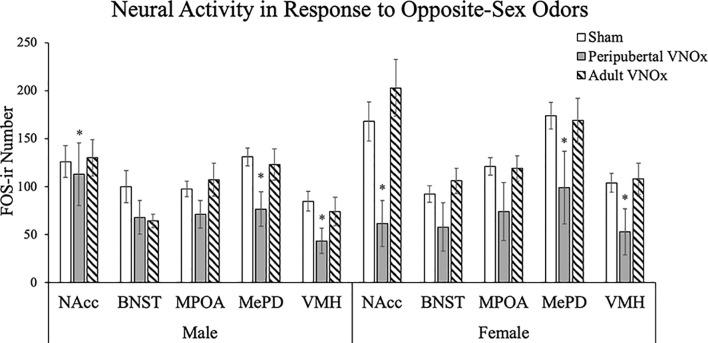
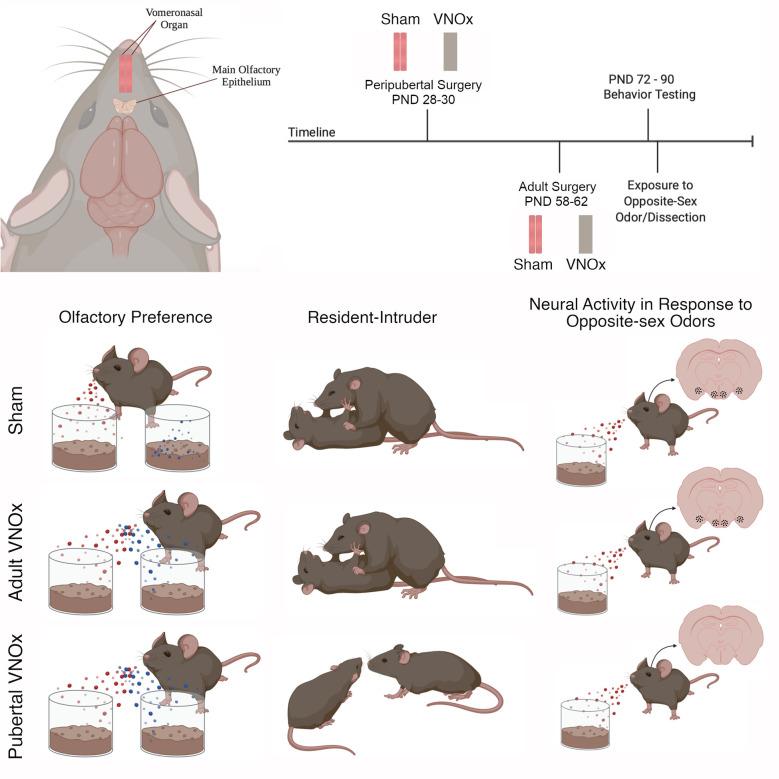
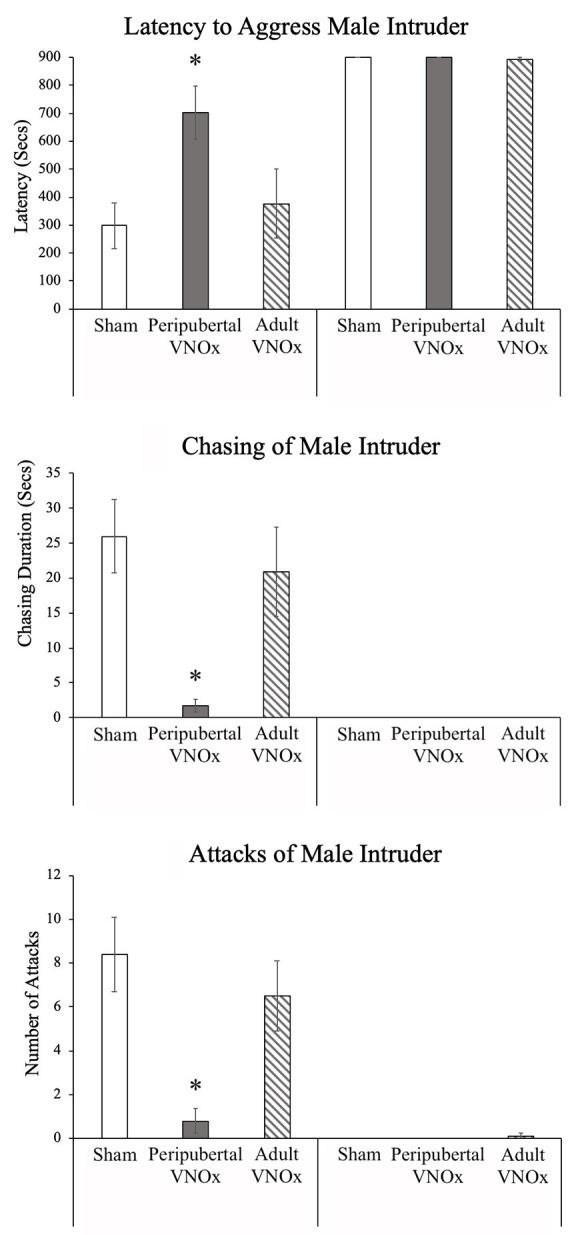
Genetic disruption of the vomeronasal organ (VNO), an organ responsible for pheromone processing, drastically alters socio-sexual behavior in mice. However, it is not known whether the VNO has a role during the pubertal organizational period when sex-typical socio-sexual behaviors emerge, or if disruption of the organ in adulthood is sufficient to alter socio-sexual behavior. To bypass the lifelong VNO disruption of genetic knockout models, we surgically ablated the VNO of male and female mice either during the peripubertal period [postnatal day (PND) 28-30] or adulthood (PND 58-60), with sham controls at both ages. We ruled out anosmia the buried food test and assessed sexual odor preferences by simultaneously exposing mice to same- and opposite-sex soiled-bedding. We then measured territorial aggression with the resident-intruder paradigm and assessed sexual behavior in response to an encounter with an estrus-induced female. Neural activity approximated by FOS-immunoreactivity along the VNO-accessory olfactory pathway was measured in response to opposite-sex odors. We found that peripubertal VNO ablation decreased sexual odor preferences and neural activity in response to opposite-sex odors, and drastically reduced territorial aggression in male mice. Conversely, adult VNO ablation resulted in subtle differences in sexual odor preferences compared with sham controls. Regardless of the VNO condition, mice displayed sex-typical copulatory behaviors. Together, these results suggest that puberty is a critical period in development whereby the VNO contributes to the sexual differentiation of behavior and neural response to conspecific odors.
犁鼻器(VNO)负责处理信息素,对其进行基因破坏会极大地改变小鼠的社会性行为。然而,尚不清楚犁鼻器在青春期组织期(此时出现性别典型的社会性行为)是否发挥作用,或者成年期对该器官的破坏是否足以改变社会性行为。为了避开基因敲除模型中犁鼻器的终身破坏,我们在青春期前后(出生后第28 - 30天)或成年期(出生后第58 - 60天)对雄性和雌性小鼠进行手术切除犁鼻器,并在两个年龄段设置假手术对照组。我们通过掩埋食物测试排除嗅觉丧失,并通过同时让小鼠接触同性和异性的脏垫料来评估性气味偏好。然后,我们用定居者 - 入侵者范式测量领地攻击性,并评估与发情诱导的雌性相遇时的性行为。测量了沿犁鼻器 - 副嗅球通路的FOS免疫反应性所近似的神经活动,以响应异性气味。我们发现青春期前后切除犁鼻器会降低对异性气味的性气味偏好和神经活动,并大幅降低雄性小鼠的领地攻击性。相反,与假手术对照组相比,成年期切除犁鼻器导致性气味偏好出现细微差异。无论犁鼻器状况如何,小鼠都表现出性别典型的交配行为。总之,这些结果表明青春期是发育的关键时期,在此期间犁鼻器有助于行为的性分化以及对同种气味的神经反应。


 Zotero 插件