
免疫检查点抑制剂在不同转移情况的晚期非小细胞肺癌患者中的疗效。
Efficacy of immune-checkpoint inhibitors in advanced non-small cell lung cancer patients with different metastases.
作者信息
Qiao Meng, Zhou Fei, Hou Likun, Li Xuefei, Zhao Chao, Jiang Tao, Gao Guanghui, Su Chunxia, Wu Chunyan, Ren Shengxiang, Zhou Caicun
机构信息
Department of Medical Oncology, Shanghai Pulmonary Hospital, Tongji University School of Medicine, Shanghai, China.
Department of Pathology, Shanghai Pulmonary Hospital, Tongji University School of Medicine, Shanghai, China.
出版信息
Ann Transl Med. 2021 Jan;9(1):34. doi: 10.21037/atm-20-1471.
BACKGROUND
To investigate the significance of metastatic sites and their numbers to the efficacy of immune checkpoint inhibitors (ICIs) in patients with advanced non-small cell lung cancer (NSCLC).
METHODS
A total of 232 patients who received ICI monotherapy or ICI-based combination therapy were retrospectively identified from January 2016 to February 2019. Six metastatic sites (brain, liver, bone, adrenal gland, contralateral lung, pleura) were included to analyze their significance to ICI efficacy. To explore the association between liver metastasis (LM) and tumor T cell infiltration, 46 patients with available tumor specimens were tested for PD-L1 expression, CD8+ tumor infiltrating lymphocytes (TILs) density. Overall survival (OS) and progression-free survival (PFS) were estimated by Kaplan-Meier curves.
RESULTS
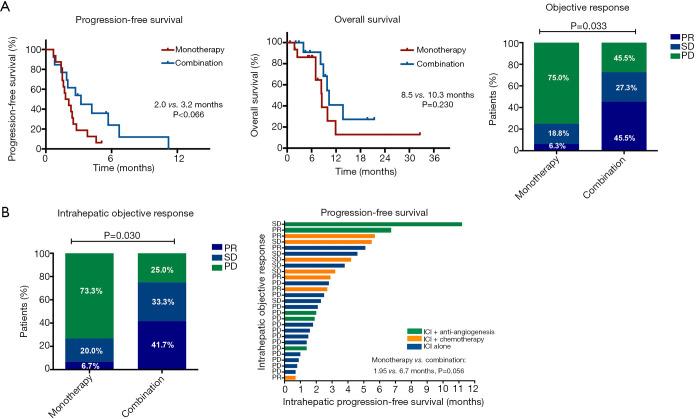
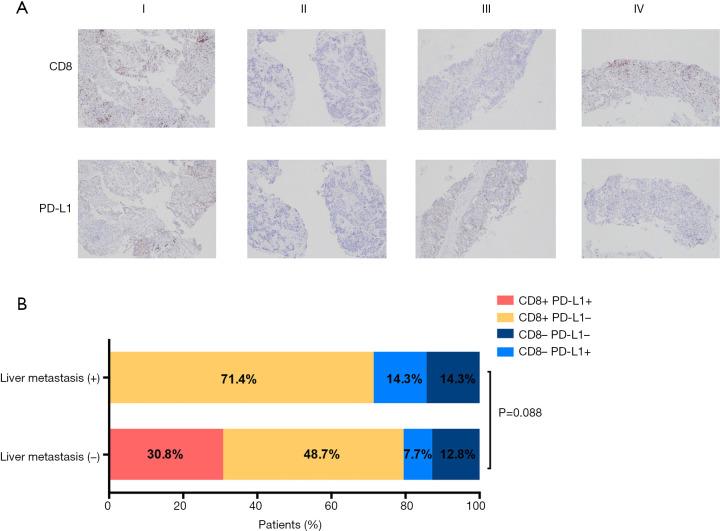
More metastatic organs involved were associated with significantly worse PFS (0-1 organ: 5.7 months, 2-3 organs: 3.5 months, ≥4 organs: 2.7 months, P<0.001) and lower ORR (36% 29.8% 18.2%, P<0.001). Patients with brain metastasis (BM) had shorter PFS and OS than those without (P=0.002, P=0.021; respectively). Notably, patients with LM had the shortest PFS (2.3 months, P=0.005) and numerically shortest OS (9.8 months, P=0.238) compared with those with other organ metastases. Multivariate analysis revealed that LM was independently associated with inferior PFS (P<0.001). Immunostaining showed that patients with LM tended to have lower proportions of PD-L1+CD8+TIL+ tumors compared with those without LM (0% 30.8%, P=0.088). Interestingly, ICI-based combination therapy could effectively control LM with improved intrahepatic PFS (P=0.056) and ORR (41.7% 6.7%, P=0.030).
CONCLUSIONS
More metastatic organs involved were associated with poorer response to ICIs. LM was a negative predictive factor for patients treated with ICI monotherapy and the combination strategy might effectively control LM.
背景
探讨转移部位及其数量对晚期非小细胞肺癌(NSCLC)患者免疫检查点抑制剂(ICI)疗效的意义。
方法
回顾性纳入2016年1月至2019年2月期间接受ICI单药治疗或基于ICI的联合治疗的232例患者。纳入六个转移部位(脑、肝、骨、肾上腺、对侧肺、胸膜)以分析它们对ICI疗效的意义。为探究肝转移(LM)与肿瘤T细胞浸润之间的关联,对46例有可用肿瘤标本的患者检测了PD-L1表达、CD8 +肿瘤浸润淋巴细胞(TILs)密度。采用Kaplan-Meier曲线估计总生存期(OS)和无进展生存期(PFS)。
结果
转移器官越多,PFS越差(0 - 1个器官:5.7个月,2 - 3个器官:3.5个月,≥4个器官:2.7个月,P<0.001),客观缓解率(ORR)越低(36%、29.8%、18.2%,P<0.001)。有脑转移(BM)的患者PFS和OS均短于无脑转移者(分别为P = 0.002,P = 0.021)。值得注意的是,与其他器官转移患者相比,LM患者的PFS最短(2.3个月,P = 0.005),OS在数值上最短(9.8个月,P = 0.238)。多因素分析显示,LM与较差的PFS独立相关(P<0.001)。免疫组化显示,与无LM的患者相比,有LM的患者PD-L1 + CD8 + TIL +肿瘤的比例往往较低(0%对30.8%,P = 0.


 Zotero 插件