
冬凌草甲素通过调节 STAT3 信号通路缓解胶原诱导性关节炎并抑制 Th17 细胞分化。
Alantolactone alleviates collagen-induced arthritis and inhibits Th17 cell differentiation through modulation of STAT3 signalling.
机构信息
Department of Surgery, Division of Urology, Tung's Taichung MetroHarbor Hospital, Taichung, Taiwan, ROC.
Program in Translational Medicine, National Chung Hsing University, Taichung, Taiwan, ROC.
出版信息
Pharm Biol. 2021 Dec;59(1):134-145. doi: 10.1080/13880209.2021.1876102.
CONTEXT
Alantolactone, the bioactive component in L. (Asteraceae), exhibits multiple biological effects.
OBJECTIVE
We aimed to determine the anti-inflammatory effect of alantolactone in a collagen-induced arthritis (CIA) mouse model and its immunomodulatory effects on Th17 differentiation.
MATERIALS AND METHODS
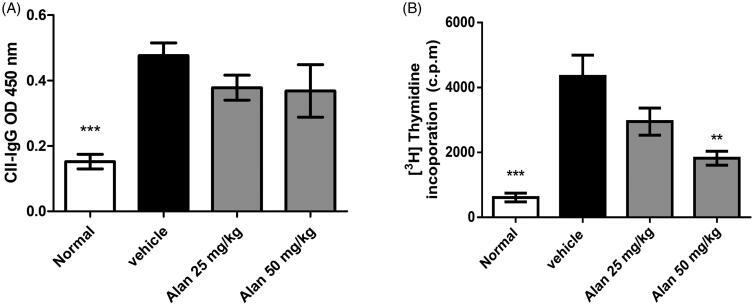
A CIA mouse model was established with DBA/1 mice randomly divided into four groups ( = 6): healthy, vehicle and two alantolactone-treated groups (25 or 50 mg/kg), followed by oral administration of alantolactone to mice for 21 consecutive days after arthritis onset. The severity of CIA was evaluated by an arthritic scoring system and histopathological examination. Levels of cytokines and anti-CII antibodies as well as percentages of splenic Th17 and Th17 differentiation with or without alantolactone treatments (0.62, 1.2 or 2.5 μM) were detected with ELISA and flow cytometry, respectively. Western blot analysis was used to evaluate intracellular signalling in alantolactone-treated spleen cells.
RESULTS
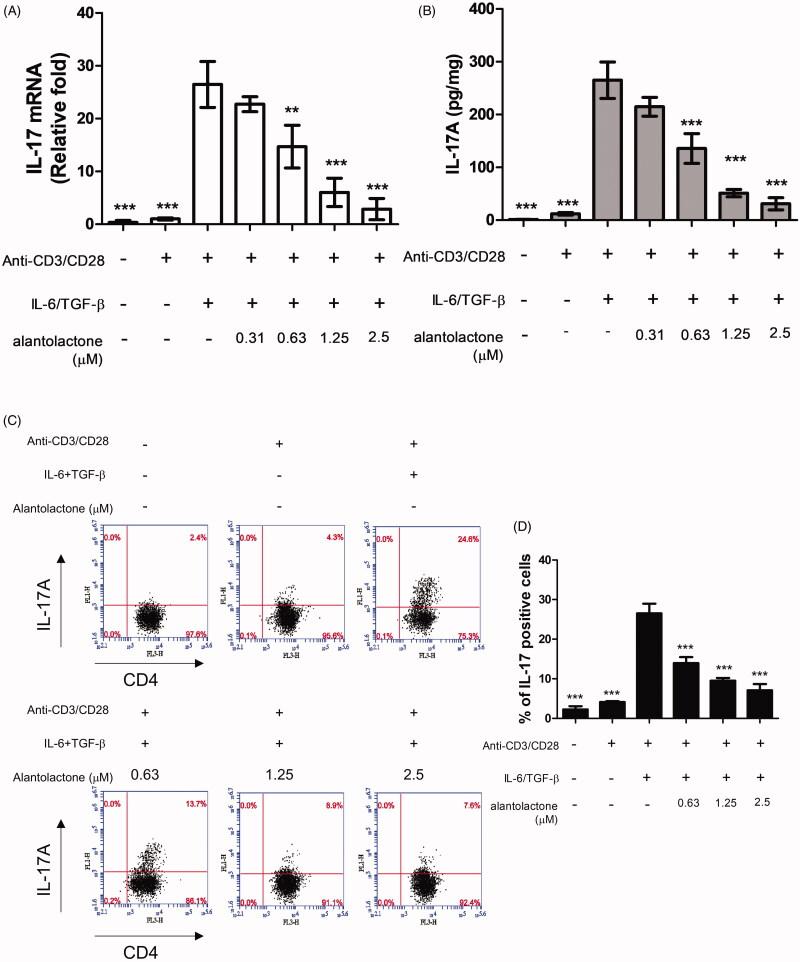
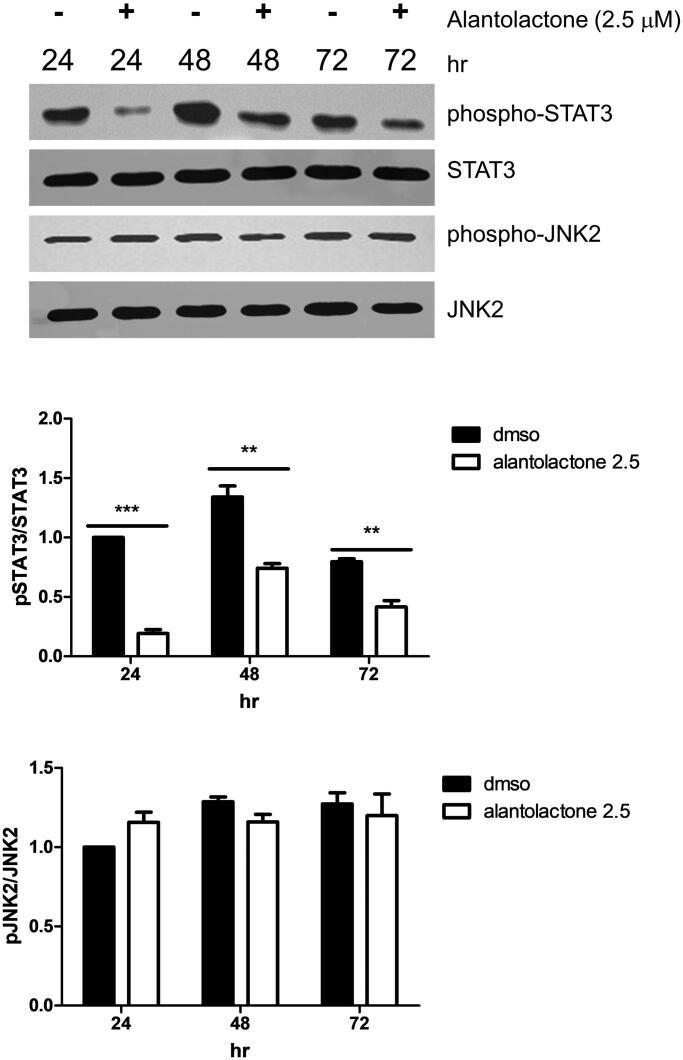
In CIA mice, alantolactone at 50 mg/kg attenuated RA symptoms, including high arthritis scores, infiltrating inflammatory cells, synovial hyperplasia, bone erosion and levels of the proinflammatory cytokines TNF-α, IL-6 and IL-17A, but not IL-10 in paw tissues. Alantolactone also reduced the number of splenic Th17 cells and the capability of naïve CD4 T cells to differentiate into the Th17 subset by downregulating STAT3/RORγt signalling by as early as 24 h of treatment.
DISCUSSION AND CONCLUSIONS
Alantolactone possesses an anti-inflammatory effect that suppresses murine CIA by inhibiting Th17 cell differentiation, suggesting alantolactone is an adjunctive therapeutic candidate to treat rheumatoid arthritis.
context: 土木香内酯是菊科土木香属( Asteraceae )植物的生物活性成分,具有多种生物学效应。
objective: 本研究旨在探讨土木香内酯在胶原诱导性关节炎( CIA )小鼠模型中的抗炎作用及其对 Th17 分化的免疫调节作用。
materials and methods: 将 DBA/1 小鼠建立 CIA 模型,随机分为四组(每组 6 只):健康对照组、模型对照组、土木香内酯低剂量( 25mg/kg )组和土木香内酯高剂量( 50mg/kg )组。在关节炎发病后,连续 21 天通过灌胃给予小鼠土木香内酯。采用关节炎评分系统和组织病理学检查评估 CIA 的严重程度。通过酶联免疫吸附试验( ELISA )和流式细胞术分别检测细胞因子和抗 CII 抗体水平以及脾 Th17 细胞和 Th17 分化细胞的比例。采用 Western blot 分析评估土木香内酯处理的脾细胞中的细胞内信号转导。
results: 在 CIA 小鼠中,土木香内酯( 50mg/kg )可减轻 RA 症状,包括关节炎评分升高、浸润性炎症细胞、滑膜增生、骨侵蚀以及 paw 组织中促炎细胞因子 TNF-α、IL-6 和 IL-17A 的水平,但对 IL-10 无影响。土木香内酯还通过下调 STAT3/RORγt 信号通路,降低脾 Th17 细胞数量和初始 CD4 T 细胞向 Th17 细胞分化的能力,早在治疗 24 小时即可发挥作用。
discussion and conclusions: 土木香内酯具有抗炎作用,可抑制 Th17 细胞分化,从而抑制 CIA 小鼠的炎症反应,提示土木香内酯可能是治疗类风湿关节炎的辅助治疗候选药物。





 Zotero 插件