
小分子与 SARS-CoV-2 木瓜蛋白酶样蛋白酶的相互作用:使用酶抑制测定法进行的体外验证和体外验证蛋白酶活性抑制的计算研究。
Interaction of small molecules with the SARS-CoV-2 papain-like protease: In silico studies and in vitro validation of protease activity inhibition using an enzymatic inhibition assay.
机构信息
Epigenomic Medicine, Department of Diabetes, Central Clinical School, Monash University, Melbourne, VIC, 3004, Australia; School of Science, College of Science, Engineering & Health, RMIT University, VIC, 3001, Australia.
Epigenomic Medicine, Department of Diabetes, Central Clinical School, Monash University, Melbourne, VIC, 3004, Australia.
出版信息
J Mol Graph Model. 2021 May;104:107851. doi: 10.1016/j.jmgm.2021.107851. Epub 2021 Jan 26.
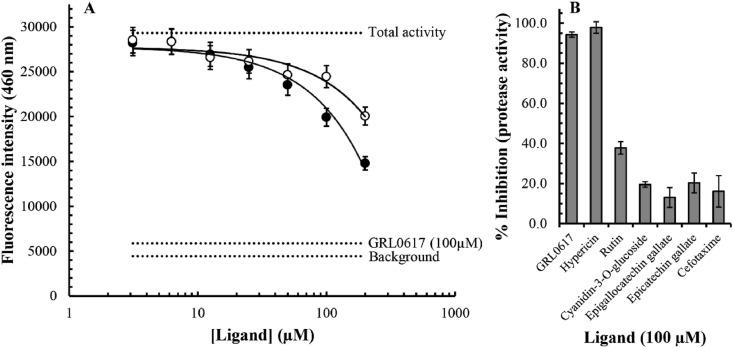
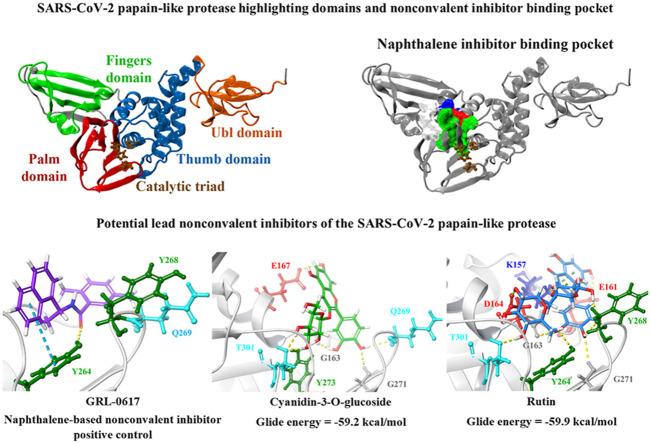
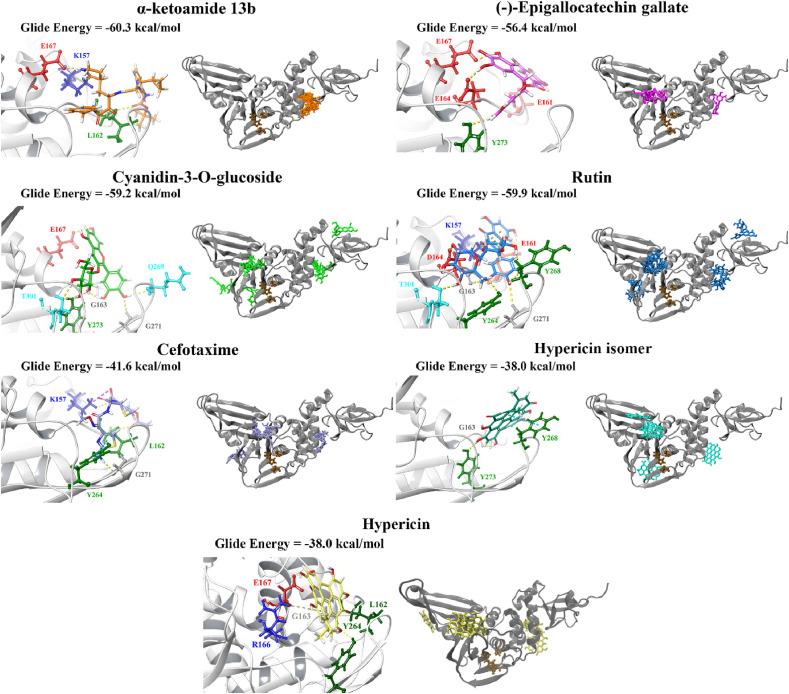
The SARS-CoV-2 virus is causing COVID-19, an ongoing pandemic, with extraordinary global health, social, and political implications. Currently, extensive research and development efforts are aimed at producing a safe and effective vaccine. In the interim, small molecules are being widely investigated for antiviral effects. With respect to viral replication, the papain-like (PL) and main proteases (M), are critical for processing viral replicase polypeptides. Further, the PL possesses deubiquitinating activity affecting key signalling pathways, including inhibition of interferon and innate immune antagonism. Therefore, inhibition of PL activity with small molecules is an important research direction. Our aim was to focus on identification of potential inhibitors of the protease activity of SARS-CoV-2 PL. We investigated 300 small compounds derived predominantly from our OliveNet™ library (222 phenolics) and supplemented with synthetic and dietary compounds with reported antiviral activities. An initial docking screen, using the potent and selective noncovalent PL inhibitor, GRL-0617 as a control, enabled a selection of 30 compounds for further analyses. From further in silico analyses, including docking to scenes derived from a publicly available molecular dynamics simulation trajectory (100 μs PDB 6WX4; DESRES-ANTON-11441075), we identified lead compounds for further in vitro evaluation using an enzymatic inhibition assay measuring SARS-CoV-2 PL protease activity. Our findings indicate that hypericin possessed inhibition activity, and both rutin and cyanidin-3-O-glucoside resulted in a concentration-dependent inhibition of the PL, with activity in the micromolar range. Overall, hypericin, rutin, and cyanidin-3-O-glucoside can be considered lead compounds requiring further characterisation for potential antiviral effects in appropriate model systems.
SARS-CoV-2 病毒引起的 COVID-19 大流行,对全球健康、社会和政治具有特殊影响。目前,广泛的研究和开发工作旨在生产安全有效的疫苗。在此期间,小分子正在广泛研究其抗病毒作用。就病毒复制而言,木瓜样(PL)和主要蛋白酶(M)对于加工病毒复制酶多肽至关重要。此外,PL 具有去泛素化活性,影响关键信号通路,包括干扰素抑制和先天免疫拮抗。因此,用小分子抑制 PL 活性是一个重要的研究方向。我们的目的是关注鉴定 SARS-CoV-2 PL 蛋白酶活性的潜在抑制剂。我们研究了 300 种主要源自我们的 OliveNet™ 文库(222 种酚类)的小分子化合物,并补充了具有报道的抗病毒活性的合成和饮食化合物。使用强效和选择性的非共价 PL 抑制剂 GRL-0617 作为对照进行初步对接筛选,选择了 30 种化合物进行进一步分析。通过进一步的计算机模拟分析,包括对接从公开可用的分子动力学模拟轨迹(100μs PDB 6WX4;DESRES-ANTON-11441075)中得出的场景,我们确定了用于进一步使用酶抑制测定法测量 SARS-CoV-2 PL 蛋白酶活性的体外评估的先导化合物。我们的研究结果表明,金丝桃素具有抑制活性,芦丁和矢车菊素-3-O-葡萄糖苷均导致 PL 浓度依赖性抑制,其活性处于微摩尔范围内。总体而言,金丝桃素、芦丁和矢车菊素-3-O-葡萄糖苷可被视为需要进一步表征以在适当模型系统中评估其潜在抗病毒作用的先导化合物。



 Zotero 插件