
胆管细胞释放高迁移率族蛋白 B1 调控胆道闭锁的发病机制,并与受累婴儿数量的增加相关。
High Mobility Group Box 1 Release by Cholangiocytes Governs Biliary Atresia Pathogenesis and Correlates With Increases in Afflicted Infants.
机构信息
Department of Pediatric and Thoracic SurgeryCincinnati Children's Hospital Medical CenterCincinnatiOH.
Translational Liver ResearchDepartment of Medical Cell BiophysicsTechnical Medical CentreFaculty of Science and TechnologyUniversity of TwenteEnschedeThe Netherlands.
出版信息
Hepatology. 2021 Aug;74(2):864-878. doi: 10.1002/hep.31745.
BACKGROUND AND AIMS
Biliary atresia (BA) is a devastating cholangiopathy of infancy. Upon diagnosis, surgical reconstruction by Kasai hepatoportoenterostomy (HPE) restores biliary drainage in a subset of patients, but most patients develop fibrosis and progress to end-stage liver disease requiring liver transplantation for survival. In the murine model of BA, rhesus rotavirus (RRV) infection of newborn pups results in a cholangiopathy paralleling that of human BA. High-mobility group box 1 (HMGB1) is an important member of the danger-associated molecular patterns capable of mediating inflammation during infection-associated responses. In this study, we investigated the role of HMGB1 in BA pathogenesis.
APPROACH AND RESULTS
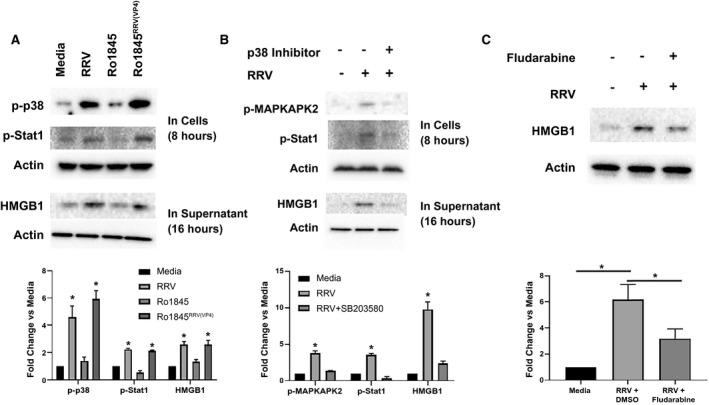
In cholangiocytes, RRV induced the expression and release of HMGB1 through the p38 mitogen-activated protein kinase signaling pathway, and inhibition of p38 blocked HMGB1 release. Treatment of cholangiocytes with ethyl pyruvate suppressed the release of HMGB1. Administration of glycyrrhizin in vivo decreased symptoms and increased survival in the murine model of BA. HMGB1 levels were measured in serum obtained from infants with BA enrolled in the PROBE and START studies conducted by the Childhood Liver Disease Research Network. High HMGB1 levels were found in a subset of patients at the time of HPE. These patients had higher bilirubin levels 3 months post-HPE and a lower survival of their native liver at 2 years.
CONCLUSIONS
These results suggest that HMGB1 plays a role in virus induced BA pathogenesis and could be a target for therapeutic interventions in a subset of patients with BA and high HMGB1.
背景与目的
先天性胆道闭锁(BA)是一种婴儿期毁灭性的胆管病。在诊断时,通过 Kasai 肝门肠吻合术(HPE)进行手术重建可使部分患者恢复胆汁引流,但大多数患者会发展为纤维化,并进展为终末期肝病,需要进行肝移植才能存活。在 BA 的鼠模型中,恒河猴轮状病毒(RRV)感染新生幼鼠会导致类似于人类 BA 的胆管病。高迁移率族蛋白 B1(HMGB1)是危险相关分子模式的重要成员,能够在感染相关反应中介导炎症。在本研究中,我们研究了 HMGB1 在 BA 发病机制中的作用。
方法和结果
在胆管细胞中,RRV 通过 p38 丝裂原活化蛋白激酶信号通路诱导 HMGB1 的表达和释放,而 p38 的抑制作用可阻断 HMGB1 的释放。用乙基丙酮酸处理胆管细胞可抑制 HMGB1 的释放。体内给予甘草酸可减轻 BA 鼠模型的症状并提高存活率。HMGB1 水平在儿童肝脏疾病研究网络进行的 PROBE 和 START 研究中纳入的 BA 婴儿的血清中进行了测量。在进行 HPE 时,发现一部分患者的 HMGB1 水平较高。这些患者在 HPE 后 3 个月胆红素水平较高,2 年时其原肝存活率较低。
结论
这些结果表明,HMGB1 在病毒诱导的 BA 发病机制中起作用,并且可能成为 BA 患者中 HMGB1 水平较高的亚组的治疗干预靶点。




 Zotero 插件