
碳水化合物限制饮食:青少年严重肥胖短期管理的成功策略——一项观察性研究。
Carbohydrate-Restricted Diet: A Successful Strategy for Short-Term Management in Youth with Severe Obesity-An Observational Study.
机构信息
Department of Pediatrics, Marshall University School of Medicine, Huntington, West Virginia, USA.
Division of Pediatric Critical Care, Helen DeVos Children's Hospital, Grand Rapids, Michigan, USA.
出版信息
Metab Syndr Relat Disord. 2021 Jun;19(5):281-287. doi: 10.1089/met.2020.0078. Epub 2021 Feb 9.
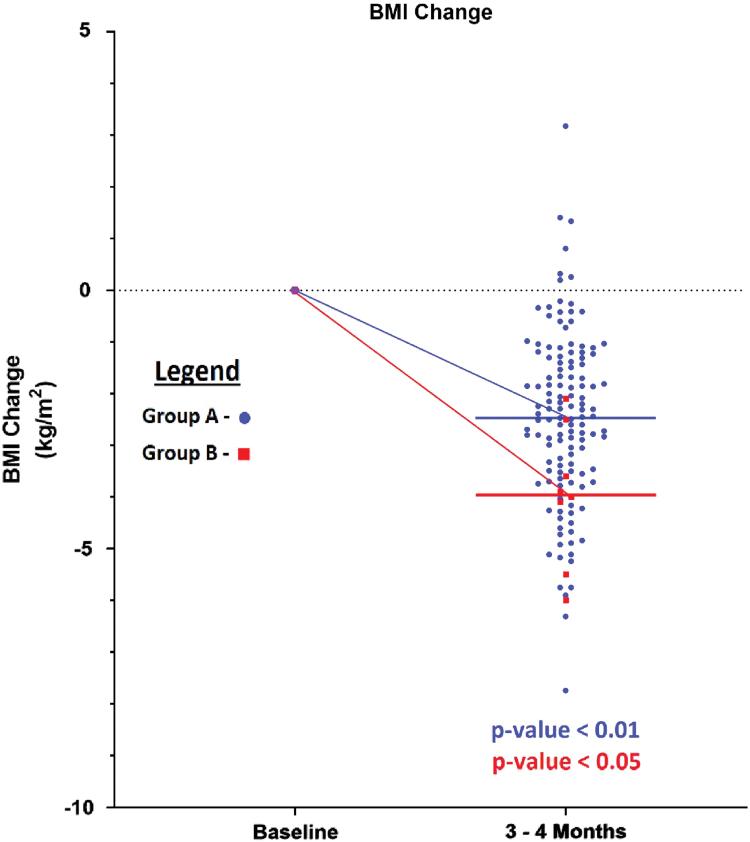
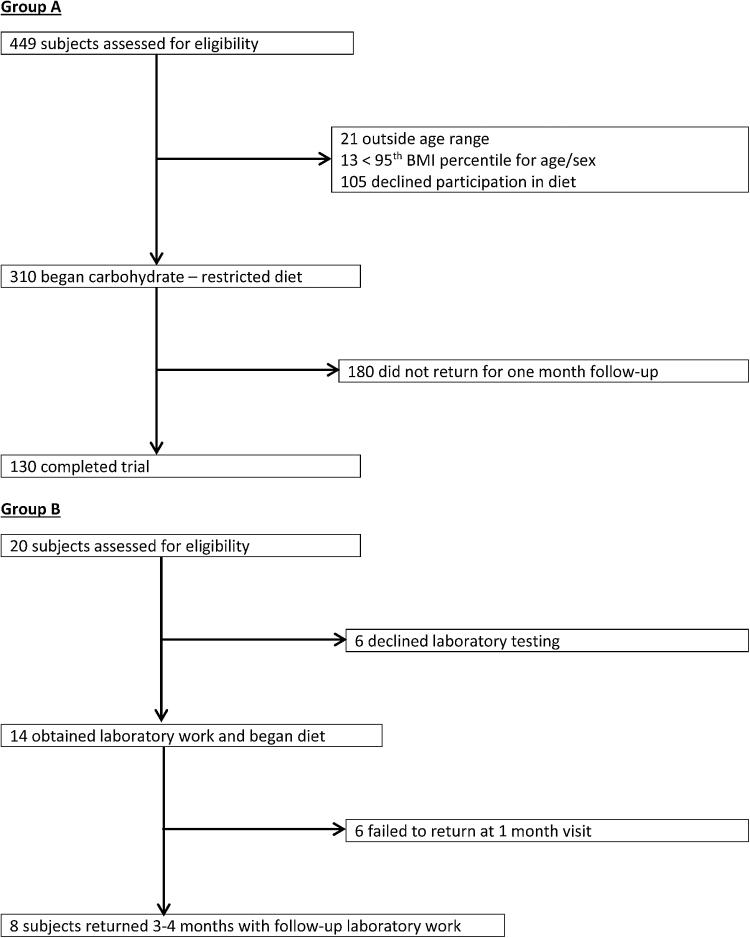
Obesity affects ∼20% of children in the United States and reports of successful dietary treatment are lacking. This study aimed to determine the change in body weight in severely obese youth after carbohydrate-restricted dietary intervention. This single-center study of a carbohydrate-restricted diet (≤30 grams per day), with unlimited calories, fat, and protein for 3-4 months, examined two groups of severely obese youth of ages 5-18 years: Group A, retrospectively reviewed charts of severely obese youth referred to the Pediatric Obesity Clinic at Hoops Family Children's Hospital and the Ambulatory Division of Marshall Pediatrics, Marshall University School of Medicine, in Huntington, WV, between July 1, 2014 and June 30, 2017 ( = 130), and Group B, prospective participants, referred between July 1, 2018 and December 31, 2018, followed with laboratory studies pre- and postdietary intervention ( = 8). In Group A, 310 participants began the diet, 130 (42%) returned after 3-4 months. Group B had 14 enrollees who began the diet, and 8 followed up at 3-4 months (57%). Girls compared with boys were more likely to complete the diet ( = 0.02). Participants <12 years age were almost twice as likely to complete the diet compared with those 12-18 years (64% vs. 36%, < 0.01); however, the older group subjects who completed the diet had the same percentage of weight loss compared with those <12 years (6.9% vs. 6.9%). Group A had reductions in weight of 5.1 kg ( < 0.001), body mass index (BMI) 2.5 kg/m ( < 0.001), and percentage weight loss 6.9% ( < 0.001). Group B had reductions in weight 9.6 kg ( < 0.01), BMI 4 kg/m ( < 0.01), and percentage weight loss 9% ( < 0.01). In addition, participants had significant reductions of fasting serum insulin ( < 0.01), triglycerides ( < 0.01), and 20-hydroxyeicosatetraenoic acid ( < 0.01). This study demonstrated a carbohydrate-restricted diet, utilized short term, effectively reduced weight in a large percentage of severely obese youth, and can be replicated in a busy primary care office.
肥胖影响了美国约 20%的儿童,但目前缺乏成功的饮食治疗报告。本研究旨在确定严格限制碳水化合物饮食(每天≤30 克)对 5-18 岁重度肥胖青少年体重的影响。该研究为单中心研究,限制碳水化合物饮食(每天≤30 克),不限卡路里、脂肪和蛋白质,持续 3-4 个月,共纳入两组年龄在 5-18 岁的重度肥胖青少年:A 组,回顾性分析 2014 年 7 月 1 日至 2017 年 6 月 30 日期间在西弗吉尼亚州亨廷顿胡普斯家庭儿童医院儿科肥胖诊所和马歇尔大学医学院马歇尔儿科学门诊就诊的重度肥胖青少年的病历(n=130);B 组,前瞻性参与者,于 2018 年 7 月 1 日至 2018 年 12 月 31 日就诊,在饮食干预前后进行实验室研究(n=8)。A 组有 310 名参与者开始饮食,130 名(42%)在 3-4 个月后返回。B 组有 14 名参与者开始饮食,8 名在 3-4 个月后进行了随访(57%)。与男孩相比,女孩更有可能完成饮食(P=0.02)。12 岁以下的参与者完成饮食的可能性几乎是 12-18 岁参与者的两倍(64%比 36%,P<0.01);然而,完成饮食的年龄较大组参与者的体重减轻百分比与 12 岁以下组相同(6.9%比 6.9%)。A 组体重减轻 5.1kg(P<0.001),体重指数(BMI)降低 2.5kg/m(P<0.001),体重减轻百分比为 6.9%(P<0.001)。B 组体重减轻 9.6kg(P<0.01),BMI 降低 4kg/m(P<0.01),体重减轻百分比为 9%(P<0.01)。此外,参与者的空腹血清胰岛素(P<0.01)、甘油三酯(P<0.01)和 20-羟二十碳四烯酸(P<0.01)显著降低。本研究表明,短期使用严格限制碳水化合物的饮食可有效降低大部分重度肥胖青少年的体重,并且可以在繁忙的初级保健办公室中复制。
 Zotero 插件