
照顾者压力与糖尿病照顾者自我护理之间的关系。
Association Between Caregiver Strain and Self-Care Among Caregivers With Diabetes.
机构信息
New York Presbyterian Hospital/Weill Cornell Medicine, New York.
Division of General Internal Medicine, Department of Medicine, Weill Cornell Medicine, New York, New York.
出版信息
JAMA Netw Open. 2021 Feb 1;4(2):e2036676. doi: 10.1001/jamanetworkopen.2020.36676.
IMPORTANCE
Caregiver strain has been shown to be associated with adverse effects on caregivers' health, particularly among those with cardiovascular disease. Less is known about the association of caregiver strain with health behaviors among caregivers with diabetes, a disease that requires a high degree of self-care.
OBJECTIVE
To examine the association between caregiver strain and diabetes self-care among caregivers with diabetes.
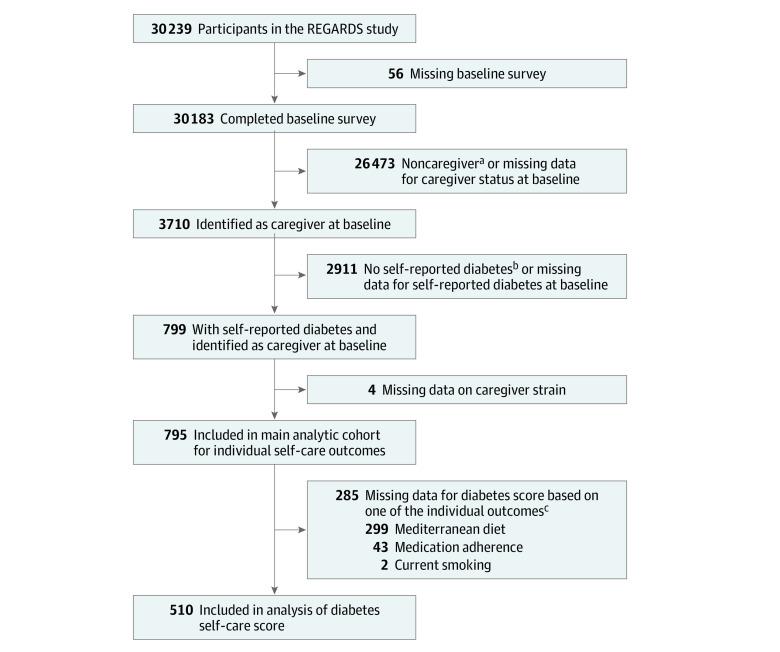
DESIGN, SETTING, AND PARTICIPANTS: This cohort study was conducted between July 13, 2018, and June 25, 2020, using data on 795 US caregivers aged 45 years or older with self-reported diabetes from the Reasons for Geographic and Racial Differences in Stroke (REGARDS) study, which comprised 30 239 Black and White adults 45 years or older throughout the US enrolled from January 2003 to October 2007.
EXPOSURES
Caregiver strain, assessed by self-report in response to the question, "How much of a mental or emotional strain is it to provide this care?" Response options were no strain, some strain, or a lot of (high) strain.
MAIN OUTCOMES AND MEASURES
Diabetes self-care, which was assessed across 4 domains (Mediterranean diet adherence, physical activity, smoking status, and medication adherence), and a composite self-care score summing performance across these domains. The association between caregiver strain and diabetes self-care was examined with multivariable Poisson regression adjusting for demographic, clinical, physical and mental functioning, and caregiving covariates.
RESULTS
Among the 795 caregivers with diabetes included in the study, the mean (SD) age was 63.7 (8.6) years, 469 (59.0%) were women, and 452 (56.9%) were Black individuals. Overall, 146 caregivers (18.4%) reported high caregiver strain. In unadjusted models, high caregiver strain was associated with less physical activity (prevalence ratio [PR], 0.66; 95% CI, 0.45-0.97), low medication adherence (PR, 0.80; 95% CI, 0.68-0.94), and worse self-care (PR, 0.65; 95% CI, 0.44-0.98). In adjusted models, the association between some and high caregiving strain with low medication adherence remained significant (adjusted PR: some strain, 0.88 [95% CI, 0.78-0.99]; high strain, 0.83 [95% CI, 0.69-0.99]).
CONCLUSIONS AND RELEVANCE
In this cohort study of US adult caregivers with diabetes, a high level of strain was associated with low medication adherence. Increased awareness of the prevalence of caregiver strain and potential ramifications on caregivers' self-care appears to be warranted among health care professionals and caregivers.
重要性
已证明照顾者的压力与照顾者的健康产生负面影响有关,尤其是在那些患有心血管疾病的人中。对于糖尿病患者照顾者的压力与健康行为之间的关联,了解较少,因为这种疾病需要高度的自我护理。
目的
研究照顾者的压力与糖尿病患者照顾者的糖尿病自我护理之间的关系。
设计、地点和参与者:这项队列研究于 2018 年 7 月 13 日至 2020 年 6 月 25 日进行,使用来自 Reasons for Geographic and Racial Differences in Stroke(REGARDS)研究的数据,该研究是在美国进行的,纳入了 795 名年龄在 45 岁或以上的美国照顾者,他们自我报告患有糖尿病,这些照顾者来自 30239 名年龄在 45 岁或以上的黑人和白人成年人,这些成年人来自美国各地,于 2003 年 1 月至 2007 年 10 月期间登记。
暴露因素
通过自我报告来评估照顾者的压力,问题是:“提供这种照顾会给你带来多大的精神或情感压力?”回答选项是没有压力、有一些压力或有很大压力(高)。
主要结果和测量
糖尿病自我护理,通过四个方面(地中海饮食的遵守情况、身体活动、吸烟状况和药物依从性)进行评估,以及通过这些方面综合表现的自我护理综合评分。使用多变量泊松回归来调整人口统计学、临床、身体和精神功能以及照顾者相关的协变量,来检验照顾者的压力与糖尿病自我护理之间的关系。
结果
在这项包括 795 名患有糖尿病的照顾者的研究中,平均(标准差)年龄为 63.7(8.6)岁,469 名(59.0%)为女性,452 名(56.9%)为黑人。总体而言,146 名照顾者(18.4%)报告了较高的照顾者压力。在未调整的模型中,高照顾者压力与较低的身体活动(患病率比 [PR],0.66;95%CI,0.45-0.97)、较低的药物依从性(PR,0.80;95%CI,0.68-0.94)和较差的自我护理(PR,0.65;95%CI,0.44-0.98)相关。在调整后的模型中,一些和高照顾压力与较低的药物依从性之间的关联仍然显著(调整后的 PR:一些压力,0.88[95%CI,0.78-0.99];高压力,0.83[95%CI,0.69-0.99])。
结论和相关性
在这项针对美国成年糖尿病患者照顾者的队列研究中,高水平的压力与较低的药物依从性有关。卫生保健专业人员和照顾者似乎需要进一步提高对照顾者压力的普遍性及其对照顾者自我护理的潜在影响的认识。
 Zotero 插件