
革兰氏阴性菌血流感染快速表型药敏平台联合抗菌药物管理干预的实施:是否物有所值?
Implementation of a Rapid Phenotypic Susceptibility Platform for Gram-Negative Bloodstream Infections With Paired Antimicrobial Stewardship Intervention: Is the Juice Worth the Squeeze?
机构信息
Division of Infectious Diseases and International Health, Department of Medicine, University of Virginia Health. Charlottesville, Virginia, USA.
Department of Pharmacy Services, New York-Presbyterian Brooklyn Methodist Hospital, Brooklyn, New York, USA.
出版信息
Clin Infect Dis. 2021 Sep 7;73(5):783-792. doi: 10.1093/cid/ciab126.
BACKGROUND
Implementation of the Accelerate PhenoTM Gram-negative platform (RDT) paired with antimicrobial stewardship program (ASP) intervention projects to improve time to institutional-preferred antimicrobial therapy (IPT) for Gram-negative bacilli (GNB) bloodstream infections (BSIs). However, few data describe the impact of discrepant RDT results from standard of care (SOC) methods on antimicrobial prescribing.
METHODS
A single-center, pre-/post-intervention study of consecutive, nonduplicate blood cultures for adult inpatients with GNB BSI following combined RDT + ASP intervention was performed. The primary outcome was time to IPT. An a priori definition of IPT was utilized to limit bias and to allow for an assessment of the impact of discrepant RDT results with the SOC reference standard.
RESULTS
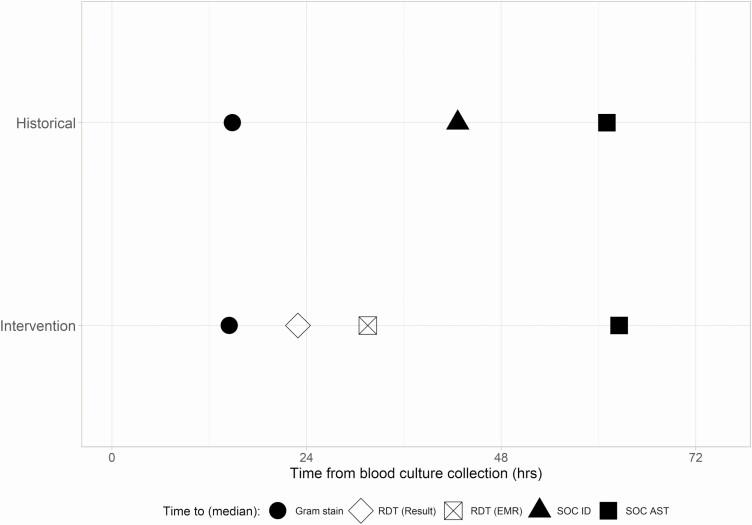
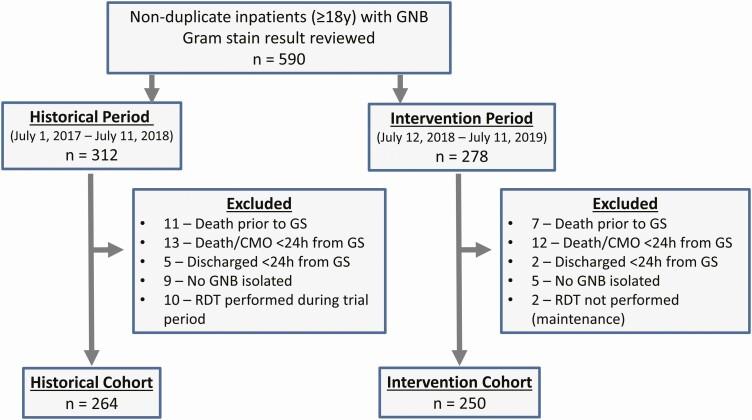
Five hundred fourteen patients (PRE 264; POST 250) were included. Median time to antimicrobial susceptibility testing (AST) results decreased 29.4 hours (P < .001) post-intervention, and median time to IPT was reduced by 21.2 hours (P < .001). Utilization (days of therapy [DOTs]/1000 days present) of broad-spectrum agents decreased (PRE 655.2 vs POST 585.8; P = .043) and narrow-spectrum beta-lactams increased (69.1 vs 141.7; P < .001). Discrepant results occurred in 69/250 (28%) post-intervention episodes, resulting in incorrect ASP recommendations in 10/69 (14%). No differences in clinical outcomes were observed.
CONCLUSIONS
While implementation of a phenotypic RDT + ASP can improve time to IPT, close coordination with Clinical Microbiology and continued ASP follow up are needed to optimize therapy. Although uncommon, the potential for erroneous ASP recommendations to de-escalate to inactive therapy following RDT results warrants further investigation.
背景
实施加速 PhenoTM 革兰氏阴性平台(RDT)与抗菌药物管理计划(ASP)干预项目,以改善革兰氏阴性菌(GNB)血流感染(BSI)患者的机构首选抗菌治疗(IPT)时间。然而,很少有数据描述与标准护理(SOC)方法不一致的 RDT 结果对抗菌药物处方的影响。
方法
对接受 RDT+ASP 联合干预的成人住院患者 GNB BSI 连续非重复血培养进行了单中心、干预前后研究。主要结局是 IPT 时间。采用预先定义的 IPT 定义来限制偏倚,并评估与 SOC 参考标准不一致的 RDT 结果的影响。
结果
共纳入 514 例患者(干预前 264 例,干预后 250 例)。干预后抗菌药物敏感性试验(AST)结果的中位时间缩短了 29.4 小时(P<0.001),IPT 的中位时间缩短了 21.2 小时(P<0.001)。广谱药物的使用(治疗天数/1000 天存在)减少(干预前 655.2 天 vs 干预后 585.8 天;P=0.043),而窄谱β-内酰胺类药物增加(69.1 天 vs 141.7 天;P<0.001)。干预后 250 例中出现 69 例(28%)不一致结果,导致 ASP 建议错误的 10 例(14%)。未观察到临床结局的差异。
结论
虽然实施表型 RDT+ASP 可以缩短 IPT 时间,但需要与临床微生物学密切协调,并持续进行 ASP 随访,以优化治疗。尽管不常见,但 RDT 结果后 ASP 建议错误降级为不活跃治疗的潜在风险需要进一步研究。

 Zotero 插件