
大面积严重烧伤患儿烧伤创面清创时的虚拟现实镇痛
Virtual Reality Analgesia for Children With Large Severe Burn Wounds During Burn Wound Debridement.
作者信息
Hoffman Hunter G, Patterson David R, Rodriguez Robert A, Peña Raquel, Beck Wanda, Meyer Walter J
机构信息
Department of Mechanical Engineering, College of Engineering, University of Washington, Seattle, WA, United States.
Department of Psychology, University of Washington, Washington, ME, United States.
出版信息
Front Virtual Real. 2020 Dec;1. doi: 10.3389/frvir.2020.602299. Epub 2020 Dec 10.
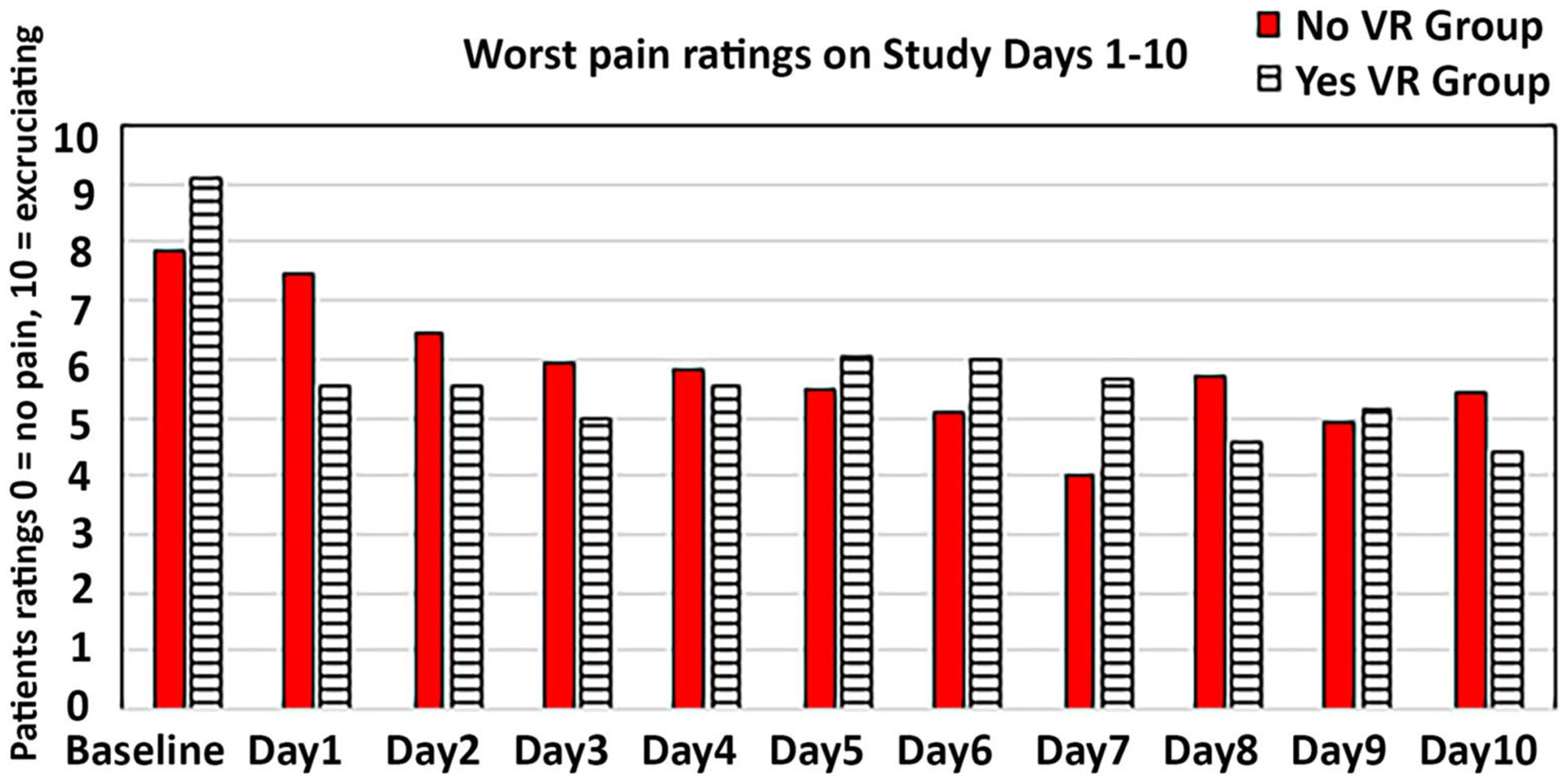
The objective of this study was to compare the effect of adjunctive virtual reality vs. standard analgesic pain medications during burn wound cleaning/debridement. Participants were predominantly Hispanic children aged 6-17 years of age, with large severe burn injuries (TBSA = 44%) reporting moderate or higher baseline pain during burn wound care. Using a randomized between-groups design, participants were randomly assigned to one of two groups, (a) the Control Group = pain medications only or (b) the VR Group = pain medications + virtual reality. A total of 50 children (88% Hispanic) with large severe burns (mean TBSA > 10%) received severe burn wound cleaning sessions. For the primary outcome measure of worst pain (intensity) on Study Day 1, using a between groups ANOVA, burn injured children in the group that received virtual reality during wound care showed significantly less pain intensity than the No VR control group, [mean worst pain ratings for the No VR group = 7.46 (SD = 2.93) vs. 5.54 (SD = 3.56), = 4.29, <0.05, MSE = 46.00]. Similarly, one of the secondary pain measures, "lowest pain during wound care" was significantly lower in the VR group, No VR = 4.29 (SD = 3.75) vs. 1.68 (2.04) for the VR group, () = 9.29, < 0.005, MSE = 83.52 for Study Day 1. The other secondary pain measures showed the predicted pattern on Study Day 1, but were non-significant. Regarding whether VR reduced pain beyond Study Day 1, absolute change in pain intensity (analgesia = baseline pain minus the mean of the worst pain scores on Study days 1-10) was significantly greater for the VR group, = 4.88, 0.05, MSE = 34.26, partial eta squared = 0.09, but contrary to predictions, absolute change scores were non-significant for all secondary measures.
本研究的目的是比较在烧伤创面清洁/清创过程中,辅助使用虚拟现实技术与标准镇痛药物的效果。参与者主要是6至17岁的西班牙裔儿童,他们遭受大面积严重烧伤(总体表面积=TBSA=44%),在烧伤创面护理期间报告有中度或更高的基线疼痛。采用随机分组设计,参与者被随机分配到两组之一:(a)对照组=仅使用镇痛药物;(b)虚拟现实组=镇痛药物+虚拟现实技术。共有50名大面积严重烧伤(平均TBSA>10%)的儿童(88%为西班牙裔)接受了严重烧伤创面清洁治疗。对于研究第1天最严重疼痛(强度)的主要结局指标,使用组间方差分析,在创面护理期间接受虚拟现实技术的组中的烧伤儿童的疼痛强度明显低于无虚拟现实技术的对照组,[无虚拟现实技术组的平均最严重疼痛评分=7.46(标准差=2.93),而虚拟现实组为5.54(标准差=3.56),F=4.29,P<0.05,均方误差MSE=46.00]。同样,次要疼痛指标之一“创面护理期间最低疼痛”在虚拟现实组中明显更低,无虚拟现实技术组为4.29(标准差=3.75),而虚拟现实组为1.68(2.04),t(48)=9.29,P<0.005,研究第1天的均方误差MSE=83.52。其他次要疼痛指标在研究第1天呈现出预期的模式,但无统计学意义。关于虚拟现实技术在研究第1天之后是否能减轻疼痛,虚拟现实组疼痛强度的绝对变化(镇痛效果=基线疼痛减去研究第1至10天最严重疼痛评分的平均值)明显更大,F=4.88,P<0.05,均方误差MSE=34.26,偏 eta 平方=0.09,但与预测相反,所有次要指标的绝对变化评分均无统计学意义。

 Zotero 插件