
促进健康的人工智能:伦理文献的范围综述
Artificial intelligence for good health: a scoping review of the ethics literature.
作者信息
Murphy Kathleen, Di Ruggiero Erica, Upshur Ross, Willison Donald J, Malhotra Neha, Cai Jia Ce, Malhotra Nakul, Lui Vincci, Gibson Jennifer
机构信息
Joint Centre for Bioethics, Dalla Lana School of Public Health, University of Toronto, 155 College Street, Suite 754, Toronto, ON, M5T 1P8, Canada.
Office of Global Health Education and Training, Dalla Lana School of Public Health, University of Toronto, 155 College Street, Room 408, Toronto, ON, M5T 3M7, Canada.
出版信息
BMC Med Ethics. 2021 Feb 15;22(1):14. doi: 10.1186/s12910-021-00577-8.
BACKGROUND
Artificial intelligence (AI) has been described as the "fourth industrial revolution" with transformative and global implications, including in healthcare, public health, and global health. AI approaches hold promise for improving health systems worldwide, as well as individual and population health outcomes. While AI may have potential for advancing health equity within and between countries, we must consider the ethical implications of its deployment in order to mitigate its potential harms, particularly for the most vulnerable. This scoping review addresses the following question: What ethical issues have been identified in relation to AI in the field of health, including from a global health perspective?
METHODS
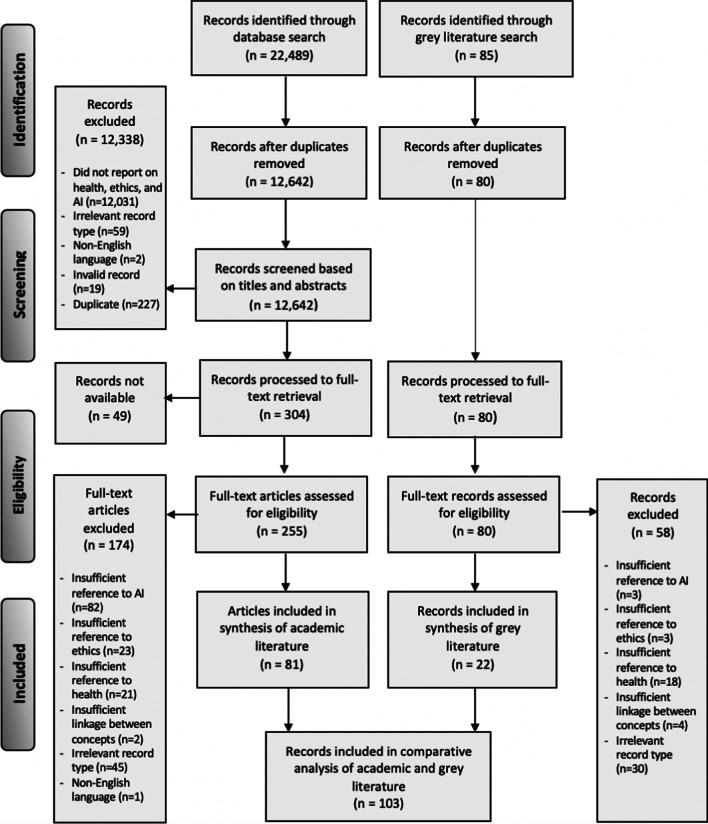
Eight electronic databases were searched for peer reviewed and grey literature published before April 2018 using the concepts of health, ethics, and AI, and their related terms. Records were independently screened by two reviewers and were included if they reported on AI in relation to health and ethics and were written in the English language. Data was charted on a piloted data charting form, and a descriptive and thematic analysis was performed.
RESULTS
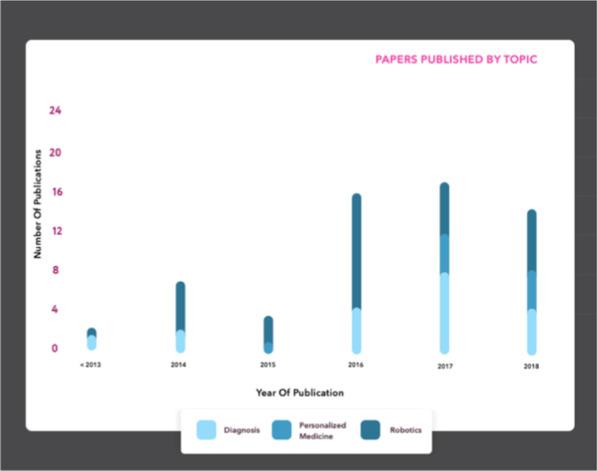
Upon reviewing 12,722 articles, 103 met the predetermined inclusion criteria. The literature was primarily focused on the ethics of AI in health care, particularly on carer robots, diagnostics, and precision medicine, but was largely silent on ethics of AI in public and population health. The literature highlighted a number of common ethical concerns related to privacy, trust, accountability and responsibility, and bias. Largely missing from the literature was the ethics of AI in global health, particularly in the context of low- and middle-income countries (LMICs).
CONCLUSIONS
The ethical issues surrounding AI in the field of health are both vast and complex. While AI holds the potential to improve health and health systems, our analysis suggests that its introduction should be approached with cautious optimism. The dearth of literature on the ethics of AI within LMICs, as well as in public health, also points to a critical need for further research into the ethical implications of AI within both global and public health, to ensure that its development and implementation is ethical for everyone, everywhere.
背景
人工智能(AI)被描述为“第四次工业革命”,具有变革性和全球影响,包括在医疗保健、公共卫生和全球卫生领域。人工智能方法有望改善全球卫生系统以及个人和人群的健康结果。虽然人工智能可能有潜力在国家内部和国家之间促进健康公平,但我们必须考虑其部署的伦理影响,以减轻其潜在危害,特别是对最脆弱人群的危害。本范围审查解决以下问题:在健康领域,包括从全球卫生角度,与人工智能相关的伦理问题有哪些?
方法
使用健康、伦理和人工智能及其相关术语的概念,在八个电子数据库中搜索2018年4月之前发表的同行评审和灰色文献。记录由两名评审员独立筛选,如果报告了与健康和伦理相关的人工智能且用英语撰写,则予以纳入。数据按照试点数据图表形式进行整理,并进行描述性和主题分析。
结果
在审查12722篇文章后,103篇符合预定的纳入标准。文献主要关注医疗保健中人工智能的伦理问题,特别是护理机器人、诊断和精准医学,但在很大程度上对公共卫生和人群健康中人工智能的伦理问题未作讨论。文献强调了一些与隐私、信任、问责和责任以及偏见相关的常见伦理问题。文献中很大程度上缺失的是全球卫生中人工智能的伦理问题,特别是在低收入和中等收入国家(LMICs)的背景下。
结论
健康领域围绕人工智能的伦理问题既广泛又复杂。虽然人工智能有改善健康和卫生系统的潜力,但我们的分析表明,应以谨慎乐观的态度引入它。低收入和中等收入国家以及公共卫生领域关于人工智能伦理的文献匮乏,也表明迫切需要进一步研究人工智能在全球卫生和公共卫生中的伦理影响,以确保其在任何地方对每个人的发展和实施都是符合伦理的。

 Zotero 插件