
用于治疗细胞内细菌感染的抗菌肽和细胞穿透肽
Antimicrobial Peptides and Cell-Penetrating Peptides for Treating Intracellular Bacterial Infections.
作者信息
Buccini Danieli F, Cardoso Marlon H, Franco Octavio L
机构信息
S-inova Biotech, Programa de Pós-Graduação em Biotecnologia, Universidade Católica Dom Bosco, Campo Grande, Brazil.
Centro de Análises Proteômicas e Bioquímicas, Pós-Graduação em Ciências Genômicas e Biotecnologia, Universidade Católica de Brasília, Brasília, Brazil.
出版信息
Front Cell Infect Microbiol. 2021 Feb 5;10:612931. doi: 10.3389/fcimb.2020.612931. eCollection 2020.
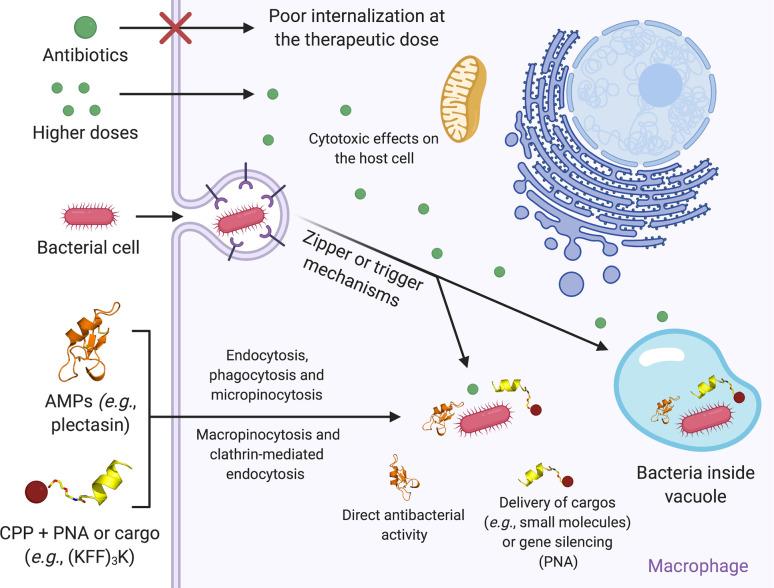
Bacterial infections caused by intracellular pathogens are difficult to control. Conventional antibiotic therapies are often ineffective, as high doses are needed to increase the number of antibiotics that will cross the host cell membrane to act on the intracellular bacterium. Moreover, higher doses of antibiotics may lead to elevated severe toxic effects against host cells. In this context, antimicrobial peptides (AMPs) and cell-penetrating peptides (CPPs) have shown great potential to treat such infections by acting directly on the intracellular pathogenic bacterium or performing the delivery of cargos with antibacterial activities. Therefore, in this mini-review, we cover the main AMPs and CPPs described to date, aiming at intracellular bacterial infection treatment. Moreover, we discuss some of the proposed mechanisms of action for these peptide classes and their conjugation with other antimicrobials.
由细胞内病原体引起的细菌感染难以控制。传统的抗生素疗法往往无效,因为需要高剂量才能增加穿过宿主细胞膜作用于细胞内细菌的抗生素数量。此外,更高剂量的抗生素可能会导致对宿主细胞的严重毒性作用增加。在这种情况下,抗菌肽(AMPs)和细胞穿透肽(CPPs)通过直接作用于细胞内致病细菌或进行具有抗菌活性的货物递送,在治疗此类感染方面显示出巨大潜力。因此,在本综述中,我们涵盖了迄今为止描述的主要抗菌肽和细胞穿透肽,旨在治疗细胞内细菌感染。此外,我们讨论了这些肽类的一些作用机制及其与其他抗菌剂的共轭。
 Zotero 插件