
肌动蛋白细胞骨架重组在免疫突触极化分泌运输中的作用
Role of Actin Cytoskeleton Reorganization in Polarized Secretory Traffic at the Immunological Synapse.
作者信息
Calvo Victor, Izquierdo Manuel
机构信息
Departamento de Bioquímica, Facultad de Medicina, Instituto de Investigaciones Biomédicas Alberto Sols, Consejo Superior de Investigaciones Científicas - Universidad Autónoma de Madrid (CSIC-UAM), Madrid, Spain.
Instituto de Investigaciones Biomédicas Alberto Sols, Consejo Superior de Investigaciones Científicas - Universidad Autónoma de Madrid, Madrid, Spain.
出版信息
Front Cell Dev Biol. 2021 Feb 4;9:629097. doi: 10.3389/fcell.2021.629097. eCollection 2021.
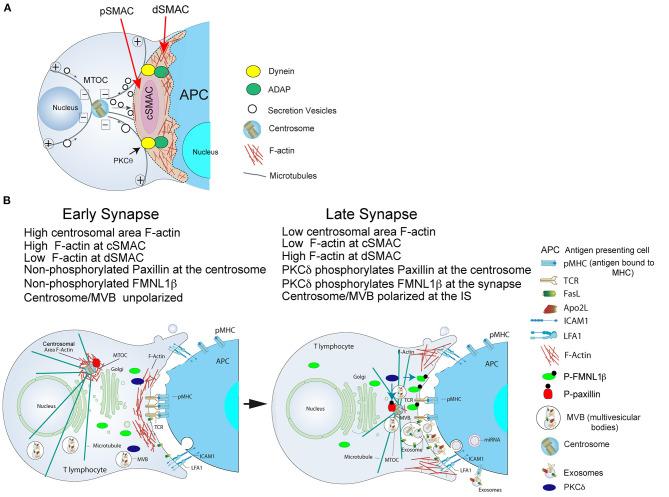
T cell receptor (TCR) and B cell receptor (BCR) stimulation by antigen presented on an antigen-presenting cell (APC) induces the formation of the immune synapse (IS), the convergence of secretory vesicles from T and B lymphocytes toward the centrosome, and the polarization of the centrosome to the immune synapse. Immune synapse formation is associated with an initial increase in cortical F-actin at the synapse, followed by a decrease in F-actin density at the central region of the immune synapse, which contains the secretory domain. These reversible, actin cytoskeleton reorganization processes occur during lytic granule degranulation in cytotoxic T lymphocytes (CTL) and cytokine-containing vesicle secretion in T-helper (Th) lymphocytes. Recent evidences obtained in T and B lymphocytes forming synapses show that F-actin reorganization also occurs at the centrosomal area. F-actin reduction at the centrosomal area appears to be involved in centrosome polarization. In this review we deal with the biological significance of both cortical and centrosomal area F-actin reorganization and some of the derived biological consequences.
抗原呈递细胞(APC)呈递的抗原对T细胞受体(TCR)和B细胞受体(BCR)的刺激会诱导免疫突触(IS)的形成、T和B淋巴细胞分泌囊泡向中心体的汇聚以及中心体向免疫突触的极化。免疫突触的形成与突触处皮质F-肌动蛋白的最初增加有关,随后免疫突触中心区域(包含分泌结构域)的F-肌动蛋白密度降低。这些可逆的肌动蛋白细胞骨架重组过程发生在细胞毒性T淋巴细胞(CTL)的溶细胞颗粒脱颗粒以及辅助性T(Th)淋巴细胞含细胞因子囊泡分泌过程中。在形成突触的T和B淋巴细胞中获得的最新证据表明,F-肌动蛋白重组也发生在中心体区域。中心体区域的F-肌动蛋白减少似乎与中心体极化有关。在这篇综述中,我们探讨了皮质和中心体区域F-肌动蛋白重组的生物学意义以及一些由此产生的生物学后果。
 Zotero 插件