
生物质燃料使用与中国老年人群认知障碍风险的关联:一项基于人群的队列研究。
Association between biomass fuel use and the risk of cognitive impairment among older populations in China: a population-based cohort study.
机构信息
Department of Epidemiology and Biostatistics, School of Public Health, Peking University, No.38, Xueyuan Road, Haidian District, Beijing, 100191, China.
Research Center of Clinical Epidemiology, Peking University Third Hospital, No.49 Huayuan North Road, Haidian District, Beijing, 100083, China.
出版信息
Environ Health. 2021 Feb 24;20(1):21. doi: 10.1186/s12940-021-00706-1.
BACKGROUND
Cohort studies on the impact of biomass fuel use for cooking on cognitive impairment among older population are still lacking in China and elsewhere. The aim of this study was to examine whether biomass fuel use for cooking is associated with cognitive impairment in Chinese adults aged 65 years or older.
METHODS
The prospective population-based cohort study of the Chinese Longitudinal Healthy Longevity Survey (CLHLS) included participants aged 65 years or older in 2014 who were followed-up until 2018 in 23 provinces in China. The Mini-Mental State Examination (MMSE) was used to assess cognitive function, and cognitive impairment was defined as total MMSE scores less than 18. The association between biomass fuel use and cognitive impairment was evaluated using the Cox proportional hazards model.
RESULTS
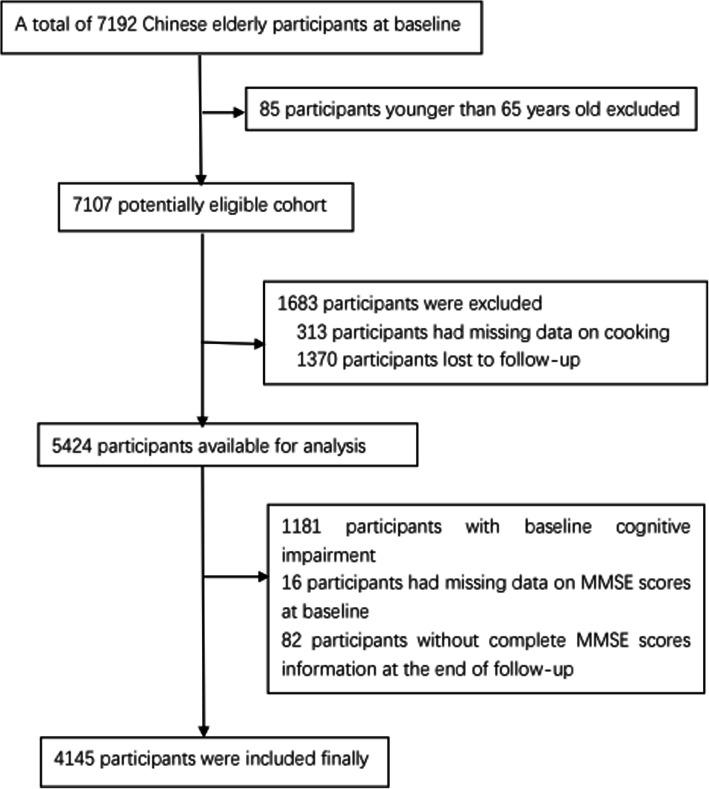
Of the 4145 participants included at baseline, participants who reported that they used biomass fuel for cooking (40.43%; IR: 3.11 versus 2.77 per 100 person-years; aHR: 1.27, 95% CI: 1.02-1.58) had a higher risk of cognitive impairment compared with participants who used clean fuels (53.75%). A stratified analyses showed greater effect estimates of cognitive impairment in the older people that lived in the rural areas (aHR: 1.444, 95% CI: 1.08-3.90) and never smoked (aHR: 1.33, 95% CI: 1.04-1.71).
CONCLUSIONS
These findings demonstrated that biomass fuel used for cooking was associated with cognitive impairment, as defined by MMSE, in a population-based study of elderly in China. To prevent cognitive impairment, the structure of cooking fuels requires improvements.
背景
关于生物质燃料用于烹饪对老年人群认知障碍影响的队列研究在中国和其他地方仍然缺乏。本研究旨在探讨烹饪用生物质燃料的使用是否与中国 65 岁及以上成年人的认知障碍有关。
方法
中国长寿纵向研究(CLHLS)的前瞻性人群队列研究纳入了 2014 年年龄在 65 岁及以上的参与者,在 23 个省份进行了随访,直到 2018 年。使用简易精神状态检查(MMSE)评估认知功能,认知障碍定义为 MMSE 总分低于 18 分。使用 Cox 比例风险模型评估生物质燃料使用与认知障碍之间的关系。
结果
在基线时纳入的 4145 名参与者中,报告使用生物质燃料烹饪的参与者(40.43%;IR:3.11 比每 100 人年 2.77;aHR:1.27,95%CI:1.02-1.58)认知障碍的风险高于使用清洁燃料的参与者(53.75%)。分层分析显示,在农村地区居住的老年人(aHR:1.444,95%CI:1.08-3.90)和从不吸烟的老年人(aHR:1.33,95%CI:1.04-1.71)认知障碍的估计值更大。
结论
这些发现表明,在中国的一项基于人群的老年人研究中,烹饪用生物质燃料与 MMSE 定义的认知障碍有关。为了预防认知障碍,需要改善烹饪燃料的结构。
 Zotero 插件