
静止内皮:调节器官特异性内皮正常状态的信号通路
The quiescent endothelium: signalling pathways regulating organ-specific endothelial normalcy.
作者信息
Ricard Nicolas, Bailly Sabine, Guignabert Christophe, Simons Michael
机构信息
Yale Cardiovascular Research Center, Department of Internal Medicine, Yale University School of Medicine, New Haven, CT, USA.
Université Grenoble Alpes, INSERM, CEA, BIG-Biologie du Cancer et de l'Infection, Grenoble, France.
出版信息
Nat Rev Cardiol. 2021 Aug;18(8):565-580. doi: 10.1038/s41569-021-00517-4. Epub 2021 Feb 24.
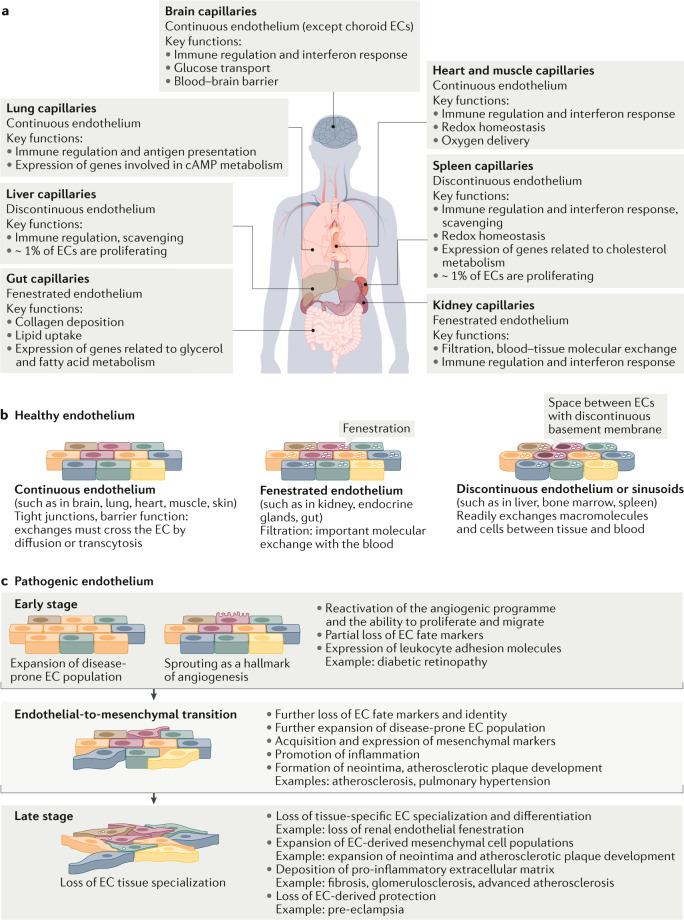
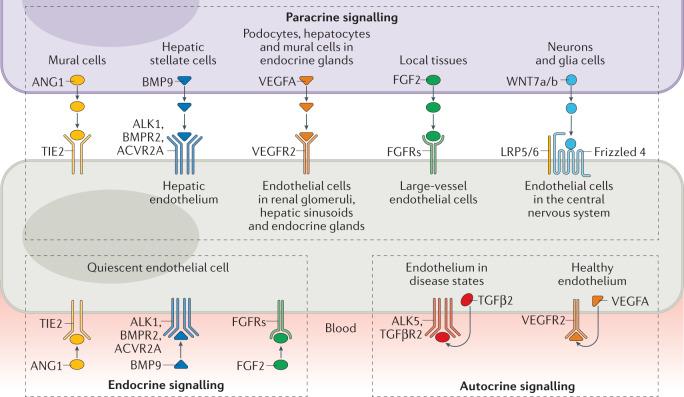
Endothelial cells are at the interface between circulating blood and tissues. This position confers on them a crucial role in controlling oxygen and nutrient exchange and cellular trafficking between blood and the perfused organs. The endothelium adopts a structure that is specific to the needs and function of each tissue and organ and is subject to tissue-specific signalling input. In adults, endothelial cells are quiescent, meaning that they are not proliferating. Quiescence was considered to be a state in which endothelial cells are not stimulated but are instead slumbering and awaiting activating signals. However, new evidence shows that quiescent endothelium is fully awake, that it constantly receives and initiates functionally important signalling inputs and that this state is actively regulated. Signalling pathways involved in the maintenance of functionally quiescent endothelia are starting to be identified and are a combination of endocrine, autocrine, paracrine and mechanical inputs. The paracrine pathways confer a microenvironment on the endothelial cells that is specific to the perfused organs and tissues. In this Review, we present the current knowledge of organ-specific signalling pathways involved in the maintenance of endothelial quiescence and the pathologies associated with their disruption. Linking organ-specific pathways and human vascular pathologies will pave the way towards the development of innovative preventive strategies and the identification of new therapeutic targets.
内皮细胞处于循环血液与组织的界面。这一位置使其在控制血液与灌注器官之间的氧气和营养物质交换以及细胞运输方面发挥着关键作用。内皮会采用一种特定于每个组织和器官需求及功能的结构,并受到组织特异性信号输入的影响。在成年人中,内皮细胞处于静止状态,这意味着它们不会增殖。静止状态曾被认为是内皮细胞未受刺激、而是处于沉睡并等待激活信号的一种状态。然而,新证据表明,静止的内皮细胞是完全活跃的,它不断接收并启动功能上重要的信号输入,且这种状态受到积极调控。参与维持功能静止内皮的信号通路正开始被识别,它们是内分泌、自分泌、旁分泌和机械输入的组合。旁分泌通路赋予内皮细胞一个特定于灌注器官和组织的微环境。在本综述中,我们阐述了目前关于参与维持内皮静止的器官特异性信号通路以及与其破坏相关的病理学的知识。将器官特异性通路与人类血管病理学联系起来将为创新预防策略的开发和新治疗靶点的识别铺平道路。

 Zotero 插件