
近端和远端结直肠癌的遗传结构部分不同。
Genetic architectures of proximal and distal colorectal cancer are partly distinct.
机构信息
Public Health Sciences Division, Fred Hutchinson Cancer Research Center, Seattle, Washington, USA.
Division of Human Genetics, Department of Internal Medicine, The Ohio State University Comprehensive Cancer Center, Columbus, Ohio, USA.
出版信息
Gut. 2021 Jul;70(7):1325-1334. doi: 10.1136/gutjnl-2020-321534. Epub 2021 Feb 25.
OBJECTIVE
An understanding of the etiologic heterogeneity of colorectal cancer (CRC) is critical for improving precision prevention, including individualized screening recommendations and the discovery of novel drug targets and repurposable drug candidates for chemoprevention. Known differences in molecular characteristics and environmental risk factors among tumors arising in different locations of the colorectum suggest partly distinct mechanisms of carcinogenesis. The extent to which the contribution of inherited genetic risk factors for CRC differs by anatomical subsite of the primary tumor has not been examined.
DESIGN
To identify new anatomical subsite-specific risk loci, we performed genome-wide association study (GWAS) meta-analyses including data of 48 214 CRC cases and 64 159 controls of European ancestry. We characterised effect heterogeneity at CRC risk loci using multinomial modelling.
RESULTS
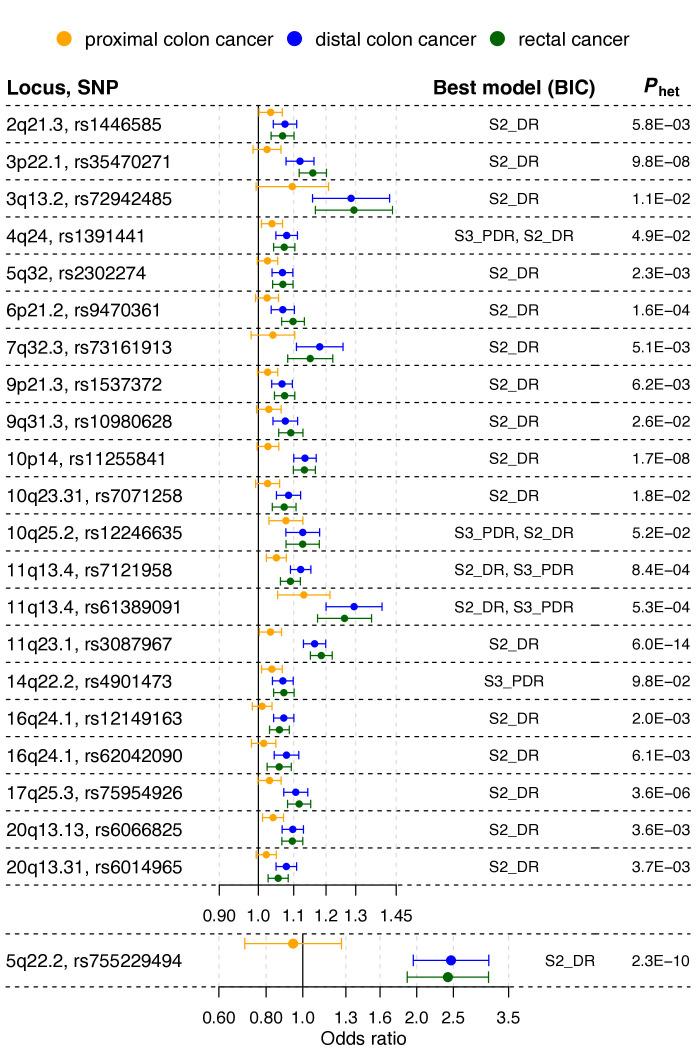
We identified 13 loci that reached genome-wide significance (p<5×10) and that were not reported by previous GWASs for overall CRC risk. Multiple lines of evidence support candidate genes at several of these loci. We detected substantial heterogeneity between anatomical subsites. Just over half (61) of 109 known and new risk variants showed no evidence for heterogeneity. In contrast, 22 variants showed association with distal CRC (including rectal cancer), but no evidence for association or an attenuated association with proximal CRC. For two loci, there was strong evidence for effects confined to proximal colon cancer.
CONCLUSION
Genetic architectures of proximal and distal CRC are partly distinct. Studies of risk factors and mechanisms of carcinogenesis, and precision prevention strategies should take into consideration the anatomical subsite of the tumour.
目的
了解结直肠癌(CRC)的病因异质性对于改善精准预防至关重要,包括个体化筛查建议以及发现新的药物靶点和用于化学预防的可重新利用的药物候选物。结直肠不同部位的肿瘤在分子特征和环境风险因素方面的已知差异表明其致癌发生机制部分不同。遗传易感性因素对原发性肿瘤不同解剖部位 CRC 的贡献程度尚未得到检验。
设计
为了确定新的解剖部位特异性风险位点,我们进行了全基因组关联研究(GWAS)荟萃分析,包括 48214 例 CRC 病例和 64159 例欧洲血统对照的数据。我们使用多项建模来描述 CRC 风险位点的效应异质性。
结果
我们确定了 13 个达到全基因组显著水平(p<5×10)且以前的 CRC 总体风险 GWAS 未报道的位点。这些位点中的多个候选基因得到了多种证据的支持。我们在解剖部位之间检测到了明显的异质性。在 109 个已知和新的风险变异中,只有超过一半(61 个)没有证据表明存在异质性。相比之下,22 个变异与远端 CRC(包括直肠癌)相关,但与近端 CRC 无关联或关联减弱。对于两个位点,有强有力的证据表明其作用仅限于近端结肠癌。
结论
近端和远端 CRC 的遗传结构部分不同。对致癌发生机制的危险因素和机制的研究以及精准预防策略应考虑肿瘤的解剖部位。

 Zotero 插件