
基于深度学习的准确性评估指导的蛋白质结构改进精修。
Improved protein structure refinement guided by deep learning based accuracy estimation.
机构信息
Department of Biochemistry and Institute for Protein Design, University of Washington, Washington, WA, USA.
Paul G. Allen School of Computer Science & Engineering, University of Washington, Washington, WA, USA.
出版信息
Nat Commun. 2021 Feb 26;12(1):1340. doi: 10.1038/s41467-021-21511-x.
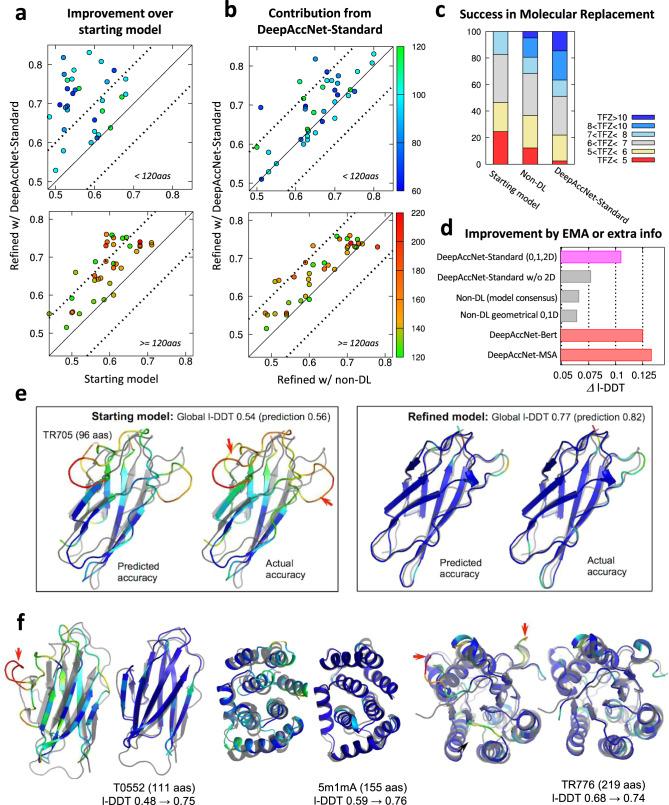
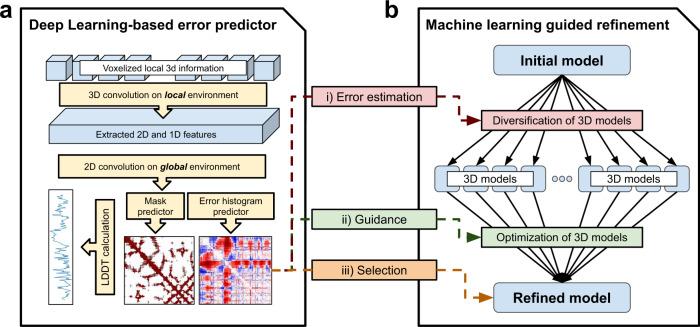
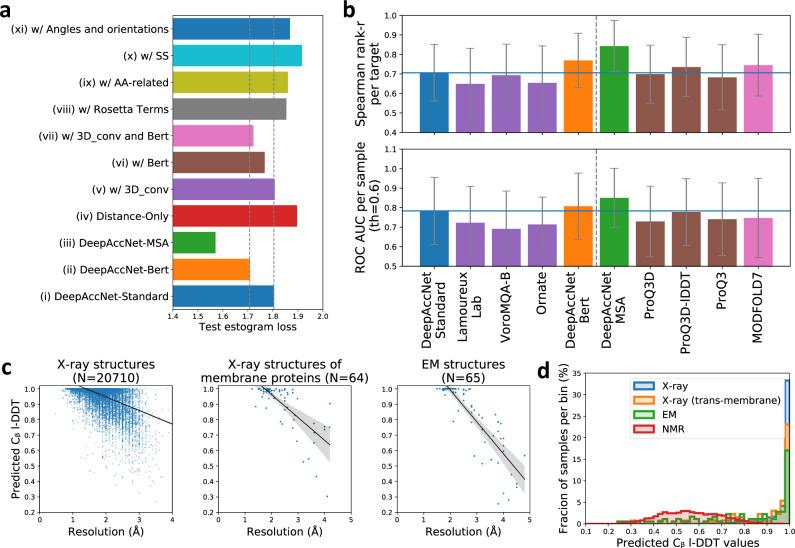
We develop a deep learning framework (DeepAccNet) that estimates per-residue accuracy and residue-residue distance signed error in protein models and uses these predictions to guide Rosetta protein structure refinement. The network uses 3D convolutions to evaluate local atomic environments followed by 2D convolutions to provide their global contexts and outperforms other methods that similarly predict the accuracy of protein structure models. Overall accuracy predictions for X-ray and cryoEM structures in the PDB correlate with their resolution, and the network should be broadly useful for assessing the accuracy of both predicted structure models and experimentally determined structures and identifying specific regions likely to be in error. Incorporation of the accuracy predictions at multiple stages in the Rosetta refinement protocol considerably increased the accuracy of the resulting protein structure models, illustrating how deep learning can improve search for global energy minima of biomolecules.
我们开发了一个深度学习框架(DeepAccNet),用于估计蛋白质模型中每个残基的准确性和残基间距离的有符号误差,并使用这些预测来指导 Rosetta 蛋白质结构精修。该网络使用 3D 卷积来评估局部原子环境,然后使用 2D 卷积来提供它们的全局上下文,并优于其他类似地预测蛋白质结构模型准确性的方法。在 PDB 中,X 射线和 cryoEM 结构的整体准确性预测与它们的分辨率相关,该网络应该广泛用于评估预测结构模型和实验确定结构的准确性,并识别可能存在错误的特定区域。在 Rosetta 精修协议的多个阶段中加入准确性预测,大大提高了最终蛋白质结构模型的准确性,说明了深度学习如何改进对生物分子全局能量最小值的搜索。

 Zotero 插件