
2019 年冠状病毒病疫情对台湾法定传染病的影响:数据库分析。
The impact of the coronavirus disease 2019 epidemic on notifiable infectious diseases in Taiwan: A database analysis.
机构信息
Department of Internal Medicine, Kaohsiung Veterans General Hospital, Tainan Branch, Tainan, Taiwan.
Department of Emergency Medicine, National Taiwan University Hospital, National Taiwan University College of Medicine, Taipei, Taiwan; Center for Quality Management, National Taiwan University Hospital, College of Medicine, National Taiwan University, Taipei, Taiwan.
出版信息
Travel Med Infect Dis. 2021 Mar-Apr;40:101997. doi: 10.1016/j.tmaid.2021.101997. Epub 2021 Feb 25.
INTRODUCTION
The impact of the COVID-19 pandemic on the incidence of notifiable infectious diseases (NIDs) in Taiwan remains unclear.
MATERIALS AND METHODS
The number of cases of NID (n = 42) between January and September 2019 and 2020 were obtained from the open database from Taiwan Centers for Disease Control.
RESULTS
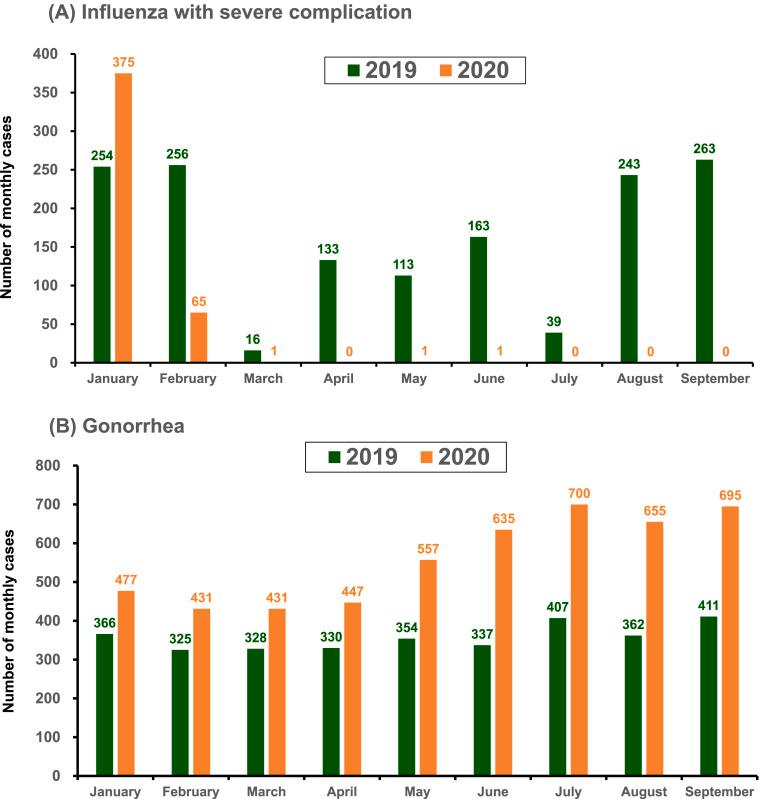
The number of NID cases was 21,895 between January and September 2020, which was lower than the number of cases during the same period in 2019 (n = 24,469), with a decline in incidence from 102.9 to 91.7 per 100,000 people in 2019 and 2020, respectively. Fourteen airborne/droplet, 11 fecal-oral, seven vector-borne, and four direct-contact transmitted NID had an overall reduction of 2700 (-28.1%), 156 (-23.0%), 557 (-54.8%), and 73 (-45.9%) cases, respectively, from 2019 to 2020. Similar trends were observed for the changes in incidence, which were 11.5 (-28.4%), 6.7 (-23.4%), 2.4 (-55.0%), and 0.3 (-46.2%) per 100,000 people for airborne/droplet, fecal-oral, vector-borne, and direct-contact transmitted NID, respectively. In addition, all the 38 imported NID showed a reduction of 632 (-73.5%) cases from 2019 to 2020. In contrast, 4 sexually transmitted diseases (STDs) showed an increase of 903 (+7.2%) cases from 2019 to 2020, which was attributed to the increase in gonorrhea (from 3220 to 5028). The overall incidence of STDs increased from 52.5 to 56.0 per 100,000 people, with a percentage change of +6.7%.
CONCLUSION
This study demonstrated a collateral benefit of COVID-19 prevention measures for various infectious diseases, except STDs, in Taiwan, during the COVID-19 epidemic.
引言:COVID-19 大流行对台湾法定传染病(Notifiable Infectious Diseases,NIDs)发病率的影响尚不清楚。
材料与方法:从台湾疾病管制署的开放数据库中获取 2019 年 1 月至 9 月和 2020 年同期 NID 病例数(n=42)。
结果:2020 年 1 月至 9 月 NID 病例数为 21895 例,低于 2019 年同期(n=24469 例),发病率分别从 2019 年的 102.9/100000 人下降至 2020 年的 91.7/100000 人。十四种空气飞沫传播、十一种粪口传播、七种媒介传播和四种直接接触传播的 NID 总病例数分别减少 2700 例(-28.1%)、156 例(-23.0%)、557 例(-54.8%)和 73 例(-45.9%)。从 2019 年到 2020 年,发病率也呈现出类似的变化趋势,空气飞沫传播、粪口传播、媒介传播和直接接触传播的 NID 发病率分别为 11.5/100000 人(-28.4%)、6.7/100000 人(-23.4%)、2.4/100000 人(-55.0%)和 0.3/100000 人(-46.2%)。此外,2019 年至 2020 年,所有 38 例输入性 NID 病例数减少 632 例(-73.5%)。相比之下,2019 年至 2020 年,四种性传播疾病(Sexually Transmitted Diseases,STDs)的病例数增加了 903 例(7.2%),这归因于淋病(从 3220 例增加到 5028 例)的增加。性传播疾病的总发病率从 52.5/100000 人增加到 56.0/100000 人,百分比变化为+6.7%。
结论:本研究表明,在 COVID-19 大流行期间,台湾除性传播疾病外,COVID-19 预防措施对各种传染病(包括法定传染病)具有间接保护作用。


 Zotero 插件