
当前对葡萄膜黑色素瘤的分子和临床认识(综述)。
Current molecular and clinical insights into uveal melanoma (Review).
机构信息
Department of Ophthalmology, University of Catania, I‑95123 Catania, Italy.
Department of Drug Sciences, Section of Biochemistry, University of Catania, I‑95125 Catania, Italy.
出版信息
Int J Oncol. 2021 Apr;58(4). doi: 10.3892/ijo.2021.5190. Epub 2021 Mar 2.
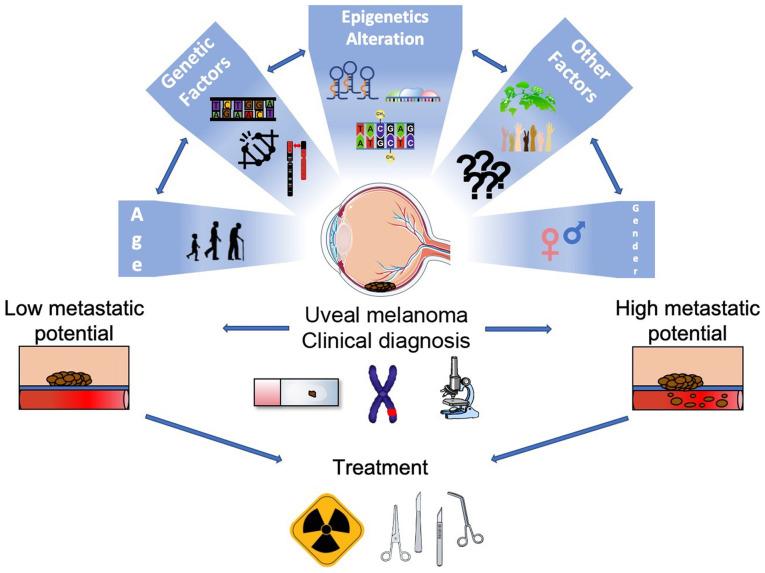
Uveal melanoma (UM) represents the most prominent primary eye cancer in adults. With an incidence of approximately 5 cases per million individuals annually in the United States, UM could be considered a relatively rare cancer. The 90‑95% of UM cases arise from the choroid. Diagnosis is based mainly on a clinical examination and ancillary tests, with ocular ultrasonography being of greatest value. Differential diagnosis can prove challenging in the case of indeterminate choroidal lesions and, sometimes, monitoring for documented growth may be the proper approach. Fine needle aspiration biopsy tends to be performed with a prognostic purpose, often in combination with radiotherapy. Gene expression profiling has allowed for the grading of UMs into two classes, which feature different metastatic risks. Patients with UM require a specialized multidisciplinary management. Primary tumor treatment can be either enucleation or globe preserving. Usually, enucleation is reserved for larger tumors, while radiotherapy is preferred for small/medium melanomas. The prognosis is unfavorable due to the high mortality rate and high tendency to metastasize. Following the development of metastatic disease, the mortality rate increases to 80% within one year, due to both the absence of an effective treatment and the aggressiveness of the condition. Novel molecular studies have allowed for a better understanding of the genetic and epigenetic mechanisms involved in UM biological activity, which differs compared to skin melanomas. The most commonly mutated genes are GNAQ, GNA11 and BAP1. Research in this field could help to identify effective diagnostic and prognostic biomarkers, as well as novel therapeutic targets.
葡萄膜黑色素瘤 (UM) 是成年人中最常见的原发性眼癌。在美国,每年每百万人中有约 5 例 UM,因此可以认为它是一种相对罕见的癌症。90-95%的 UM 病例源于脉络膜。诊断主要基于临床检查和辅助检查,其中眼部超声检查最为重要。在不确定的脉络膜病变的情况下,鉴别诊断可能具有挑战性,有时,对已记录的生长进行监测可能是适当的方法。细针抽吸活检通常是出于预后目的进行的,通常与放射治疗联合进行。基因表达谱分析允许将 UM 分为两类,这两类具有不同的转移风险。UM 患者需要专门的多学科管理。原发肿瘤的治疗可以是眼球摘除术或眼球保留术。通常,眼球摘除术保留用于较大的肿瘤,而放射治疗则更适用于小/中等大小的黑色素瘤。由于死亡率高且转移倾向高,预后不利。转移性疾病发展后,一年内死亡率增加到 80%,这既是因为缺乏有效治疗,也是因为病情具有侵袭性。新的分子研究使人们更好地了解了 UM 生物学活性所涉及的遗传和表观遗传机制,这与皮肤黑色素瘤不同。最常见的突变基因是 GNAQ、GNA11 和 BAP1。该领域的研究可能有助于确定有效的诊断和预后生物标志物以及新的治疗靶点。
 Zotero 插件