
“新发”脑动静脉畸形——发育假说及病例报告系统综述
'De Novo' Brain AVMs-Hypotheses for Development and a Systematic Review of Reported Cases.
作者信息
Florian Ioan Alexandru, Beni Lehel, Moisoiu Vlad, Timis Teodora Larisa, Florian Ioan Stefan, Balașa Adrian, Berindan-Neagoe Ioana
机构信息
Clinic of Neurosurgery, Cluj County Emergency Clinical Hospital, 400012 Cluj-Napoca, Romania.
Department of Neurosurgery, Iuliu Hatieganu University of Medicine and Pharmacy, 400012 Cluj-Napoca, Romania.
出版信息
Medicina (Kaunas). 2021 Feb 26;57(3):201. doi: 10.3390/medicina57030201.
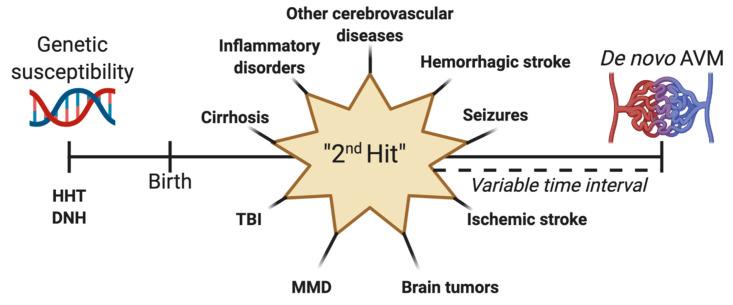
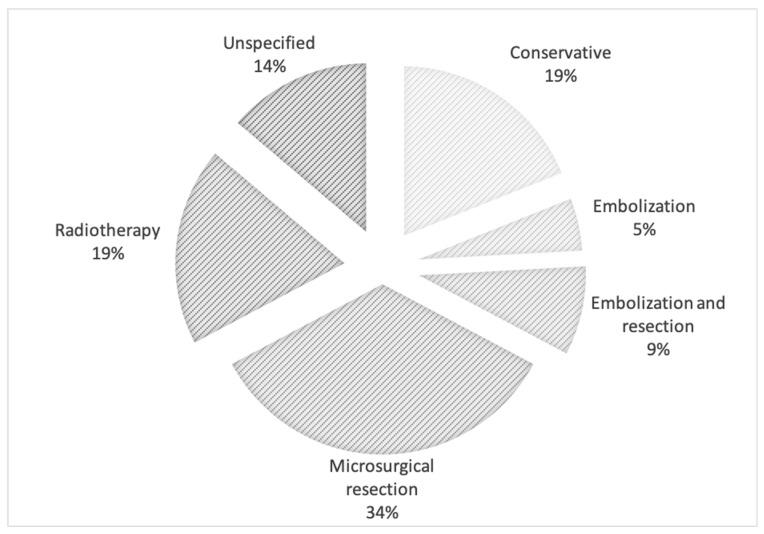
Brain arteriovenous malformations AVMs have been consistently regarded as congenital malformations of the cerebral vasculature. However, recent case reports describing "de novo AVMs" have sparked a growing debate on the nature of these lesions. We have performed a systematic review of the literature concerning de novo AVMs utilizing the PubMed and Google Academic databases. Termes used in the search were "AVM," "arteriovenous," "de novo," and "acquired," in all possible combinations. 53 articles including a total of 58 patients harboring allegedly acquired AVMs were identified by researching the literature. Of these, 32 were male (55.17%), and 25 were female (43.10%). Mean age at de novo AVM diagnosis was 27.833 years (standard deviation (SD) of 21.215 years and a 95% confidence interval (CI) of 22.3 to 33.3). Most de novo AVMs were managed via microsurgical resection (20 out of 58, 34.48%), followed by radiosurgery and conservative treatment for 11 patients (18.97%) each, endovascular embolization combined with resection for five patients (8.62%), and embolization alone for three (5.17%), the remaining eight cases (13.79%) having an unspecified therapy. Increasing evidence suggests that some of the AVMs discovered develop some time after birth. We are still a long way from finally elucidating their true nature, though there is reason to believe that they can also appear after birth. Thus, we reason that the de novo AVMs are the result of a 'second hit' of a variable type, such as a previous intracranial hemorrhage or vascular pathology. The congenital or acquired characteristic of AVMs may have a tremendous impact on prognosis, risk of hemorrhage, and short and long-term management.
脑动静脉畸形(AVM)一直被认为是脑血管的先天性畸形。然而,最近描述“新发AVM”的病例报告引发了关于这些病变性质的越来越多的争论。我们利用PubMed和谷歌学术数据库对有关新发AVM的文献进行了系统综述。搜索中使用的术语是“AVM”、“动静脉”、“新发”和“后天性”,采用所有可能的组合。通过文献检索,共识别出53篇文章,其中包括58例据称患有后天性AVM的患者。其中,男性32例(55.17%),女性25例(43.10%)。新发AVM诊断时的平均年龄为27.833岁(标准差(SD)为21.215岁,95%置信区间(CI)为22.3至33.3)。大多数新发AVM通过显微手术切除进行治疗(58例中有20例,34.48%),其次是放射外科治疗和保守治疗,各有11例患者(18.97%),5例患者采用血管内栓塞联合切除术(8.62%),3例患者仅采用栓塞治疗(5.17%),其余8例(13.79%)治疗方式未明确。越来越多的证据表明,一些发现的AVM是在出生后一段时间才出现的。尽管有理由相信它们也可能在出生后出现,但我们距离最终阐明它们的真实性质仍有很长的路要走。因此,我们推断新发AVM是由诸如先前颅内出血或血管病变等可变类型的“二次打击”导致的结果。AVM的先天性或后天性特征可能对预后、出血风险以及短期和长期治疗产生巨大影响。


 Zotero 插件