
患者体验医生共情的社会经济、种族和民族差异:系统评价和荟萃分析的结果。
Socioeconomic, racial and ethnic differences in patient experience of clinician empathy: Results of a systematic review and meta-analysis.
机构信息
Cooper University Health Care, Camden, New Jersey, United States of America.
Department of Emergency Medicine, Cooper Medical School of Rowan University, Camden, New Jersey, United States of America.
出版信息
PLoS One. 2021 Mar 3;16(3):e0247259. doi: 10.1371/journal.pone.0247259. eCollection 2021.
INTRODUCTION
Empathy is essential for high quality health care. Health care disparities may reflect a systemic lack of empathy for disadvantaged people; however, few data exist on disparities in patient experience of empathy during face-to-face health care encounters with individual clinicians. We systematically analyzed the literature to test if socioeconomic status (SES) and race/ethnicity disparities exist in patient-reported experience of clinician empathy.
METHODS
Using a published protocol, we searched Ovid MEDLINE, PubMed, CINAHL, EMBASE, CENTRAL and PsychINFO for studies using the Consultation and Relational Empathy (CARE) Measure, which to date is the most commonly used and well-validated methodology for measuring clinician empathy from the patient perspective. We included studies containing CARE Measure data stratified by SES and/or race/ethnicity. We contacted authors to request stratified data, when necessary. We performed quantitative meta-analyses using random effects models to test for empathy differences by SES and race/ethnicity.
RESULTS
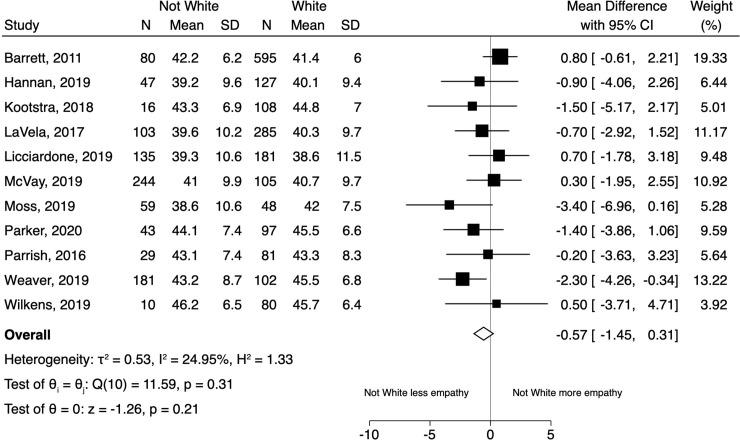
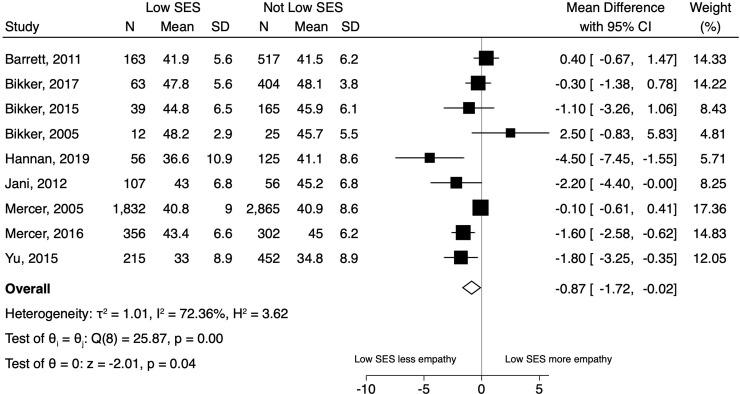
Eighteen studies (n = 9,708 patients) were included. We found that, compared to patients whose SES was not low, low SES patients experienced lower empathy from clinicians (mean difference = -0.87 [95% confidence interval -1.72 to -0.02]). Compared to white patients, empathy scores were numerically lower for patients of multiple race/ethnicity groups (Black/African American, Asian, Native American, and all non-whites combined) but none of these differences reached statistical significance.
CONCLUSION
These data suggest an empathy gap may exist for patients with low SES. More research is needed to further test for SES and race/ethnicity disparities in clinician empathy and help promote health care equity.
TRIAL REGISTRATION
Registration (PROSPERO): CRD42019142809.
简介
同理心对于高质量的医疗保健至关重要。医疗保健差异可能反映出系统缺乏对弱势群体的同理心;然而,关于个体临床医生面对面医疗保健接触中患者同理心体验的差异的数据很少。我们系统地分析了文献,以检验患者报告的临床医生同理心体验是否存在社会经济地位(SES)和种族/民族差异。
方法
使用已发表的方案,我们在 Ovid MEDLINE、PubMed、CINAHL、EMBASE、CENTRAL 和 PsychINFO 中搜索使用咨询和关系同理心(CARE)量表的研究,迄今为止,该量表是从患者角度衡量临床医生同理心最常用和最有效的方法。我们纳入了按 SES 和/或种族/民族分层的 CARE 量表数据的研究。必要时,我们联系作者请求分层数据。我们使用随机效应模型进行定量荟萃分析,以检验 SES 和种族/民族差异对同理心的影响。
结果
纳入了 18 项研究(n = 9708 名患者)。我们发现,与 SES 不低的患者相比,SES 较低的患者从临床医生那里获得的同理心较低(平均差异=-0.87[95%置信区间-1.72 至-0.02])。与白人患者相比,多种种族/民族群体(黑/非裔美国人、亚洲人、美洲原住民和所有非白人)的患者同理心评分数值较低,但这些差异均无统计学意义。
结论
这些数据表明,SES 较低的患者可能存在同理心差距。需要进一步研究以进一步检验临床医生同理心的 SES 和种族/民族差异,并帮助促进医疗保健公平。
试验注册
注册(PROSPERO):CRD42019142809。

 Zotero 插件