
精氨酸衍生物如何改变脂质膜的稳定性:解析侧链、主链和末端的作用。
How arginine derivatives alter the stability of lipid membranes: dissecting the roles of side chains, backbone and termini.
机构信息
Department of Chemistry, Institute of Physical Chemistry, Georg-August-Universität Göttingen, 37077, Göttingen, Germany.
Institute of Microbiology and Genetics, Georg-August-Universität Göttingen, 37077, Göttingen, Germany.
出版信息
Eur Biophys J. 2021 Mar;50(2):127-142. doi: 10.1007/s00249-021-01503-x. Epub 2021 Mar 4.
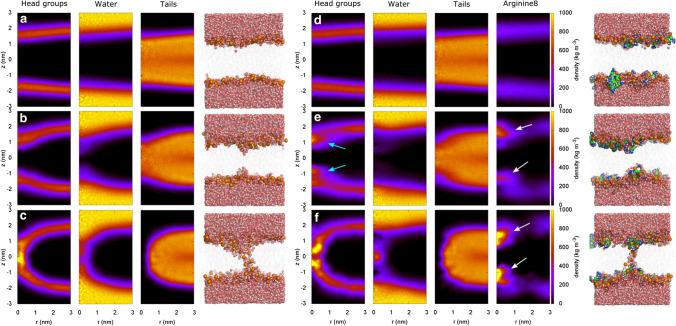
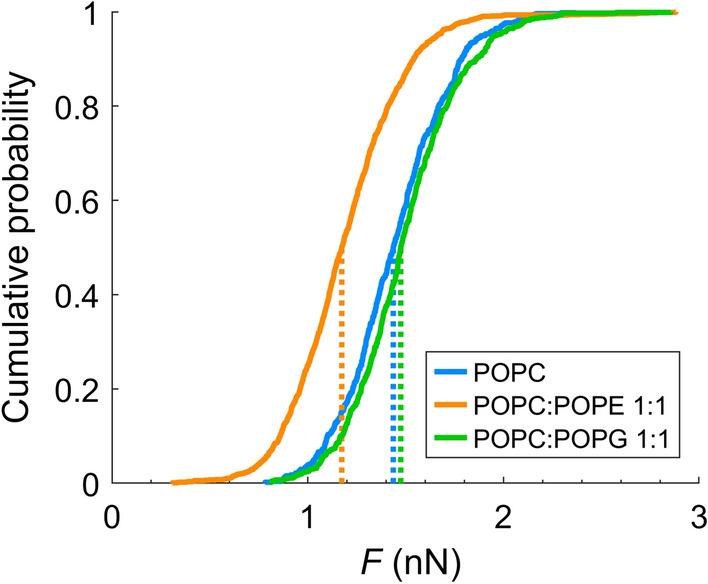
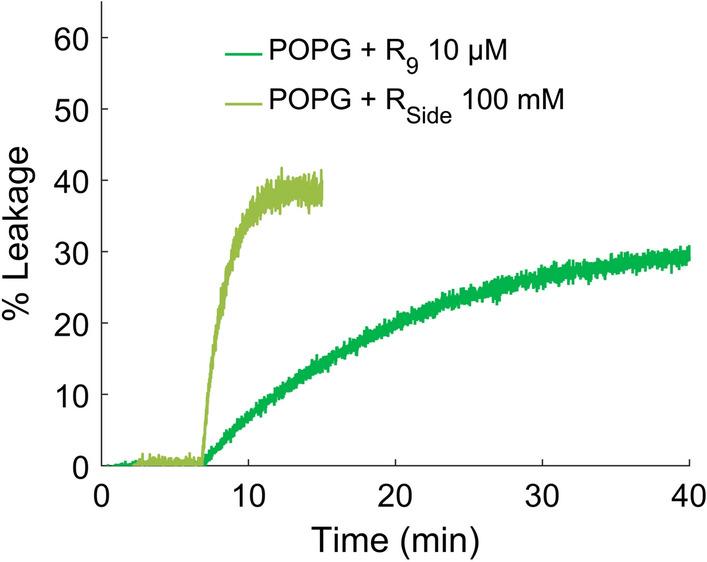
Arginine (R)-rich peptides constitute the most relevant class of cell-penetrating peptides and other membrane-active peptides that can translocate across the cell membrane or generate defects in lipid bilayers such as water-filled pores. The mode of action of R-rich peptides remains a topic of controversy, mainly because a quantitative and energetic understanding of arginine effects on membrane stability is lacking. Here, we explore the ability of several oligo-arginines R[Formula: see text] and of an arginine side chain mimic R[Formula: see text] to induce pore formation in lipid bilayers employing MD simulations, free-energy calculations, breakthrough force spectroscopy and leakage assays. Our experiments reveal that R[Formula: see text] but not R[Formula: see text] reduces the line tension of a membrane with anionic lipids. While R[Formula: see text] peptides form a layer on top of a partly negatively charged lipid bilayer, R[Formula: see text] leads to its disintegration. Complementary, our simulations show R[Formula: see text] causes membrane thinning and area per lipid increase beside lowering the pore nucleation free energy. Model polyarginine R[Formula: see text] similarly promoted pore formation in simulations, but without overall bilayer destabilization. We conclude that while the guanidine moiety is intrinsically membrane-disruptive, poly-arginines favor pore formation in negatively charged membranes via a different mechanism. Pore formation by R-rich peptides seems to be counteracted by lipids with PC headgroups. We found that long R[Formula: see text] and R[Formula: see text] but not short R[Formula: see text] reduce the free energy of nucleating a pore. In short R[Formula: see text], the substantial effect of the charged termini prevent their membrane activity, rationalizing why only longer [Formula: see text] are membrane-active.
精氨酸(R)丰富的肽构成了最相关的一类细胞穿透肽和其他膜活性肽,它们可以穿过细胞膜或在脂质双层中产生缺陷,如充满水的孔。富含 R 的肽的作用模式仍然是一个有争议的话题,主要是因为缺乏对精氨酸对膜稳定性影响的定量和能量理解。在这里,我们使用 MD 模拟、自由能计算、突破力谱和渗漏测定法来探索几种寡精氨酸 R[Formula: see text]和精氨酸侧链模拟物 R[Formula: see text]在脂质双层中诱导孔形成的能力。我们的实验表明,R[Formula: see text]但不是 R[Formula: see text]降低了带阴离子脂质的膜的线张力。虽然 R[Formula: see text]肽在部分带负电荷的脂质双层上形成一层,但 R[Formula: see text]导致其瓦解。作为补充,我们的模拟表明 R[Formula: see text]导致膜变薄和每个脂质的面积增加,同时降低孔成核的自由能。模型聚精氨酸 R[Formula: see text]在模拟中也同样促进了孔的形成,但没有导致整个双层失稳。我们得出的结论是,虽然胍基部分本质上是膜破坏的,但聚精氨酸通过不同的机制有利于带负电荷的膜中的孔形成。富含 R 的肽的孔形成似乎被具有 PC 头基的脂质所抵消。我们发现长 R[Formula: see text]和 R[Formula: see text]但不是短 R[Formula: see text]降低了成核孔的自由能。在短 R[Formula: see text]中,带电荷的末端的巨大影响阻止了它们的膜活性,这解释了为什么只有更长的 [Formula: see text]才具有膜活性。




 Zotero 插件