
冰藏期间白鲢鱼脂质氧化、挥发性化合物及振动光谱的评估及其与漂洗鱼糜品质的关系
Evaluation of Lipid Oxidation, Volatile Compounds and Vibrational Spectroscopy of Silver Carp () During Ice Storage as Related to the Quality of Its Washed Mince.
作者信息
Kunyaboon Sasinee, Thumanu Kanjana, Park Jae W, Khongla Chompoonuch, Yongsawatdigul Jirawat
机构信息
School of Food Technology, Institute of Agricultural Technology, Suranaree University of Technology, Nakhon Ratchasima 30000, Thailand.
Synchrotron Light Research Institute (Public Organization), Nakhon Ratchasima 30000, Thailand.
出版信息
Foods. 2021 Feb 25;10(3):495. doi: 10.3390/foods10030495.
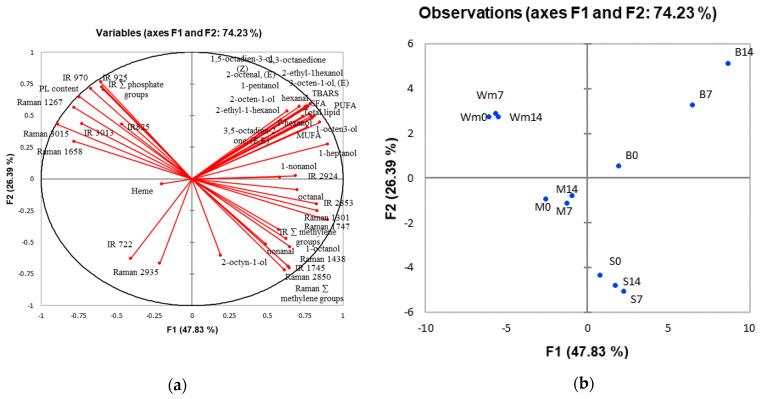
Changes in the lipid oxidation of silver carp () stored in ice for 14 days and that of its respective washed mince were evaluated. Total lipid, phospholipid, polyunsaturated fatty acid (PUFA) and monounsaturated fatty acid (MUFA) contents of the skin, belly flap and mince decreased as the storage time in ice increased. The washing process decreased the lipid contents but concentrated their phospholipid counterparts. The fish belly flap exhibited the highest thio-barbituric acid reactive substances (TBARS) value, while the mince had the lowest. 1-Hexanol, 1-octen-3-ol, and 1-hexanal were key volatile compounds detected in the belly flaps of fish stored for 7-14 days. Hexanal was the only major volatile compound found in washed mince prepared from fish stored for an extended period in ice, but in a much lower amount compared with that in the belly flap. FTIR (Fourier transform infra-red) spectra revealed a decrease in the number of double bonds, methylene groups and phosphate groups in lipids extracted from fish stored in ice for 7-14 days as compared with those extracted from fresh fish. Principle component analysis (PCA) revealed that the FT-Raman band at 1747 cm could be a potential marker for tracking the degree of lipid oxidation in the belly flap of silver carp stored in ice. In addition, IR bands indicating phosphate group (925, 825 cm) in oil extracted from washed mince were correlated with the extent of the lipid oxidation of the raw material.
评估了在冰中储存14天的鲢鱼及其相应洗涤鱼糜的脂质氧化变化。随着在冰中的储存时间增加,鱼皮、腹肉和鱼糜中的总脂质、磷脂、多不饱和脂肪酸(PUFA)和单不饱和脂肪酸(MUFA)含量均下降。洗涤过程降低了脂质含量,但提高了其磷脂含量。鱼腹肉的硫代巴比妥酸反应物质(TBARS)值最高,而鱼糜的最低。1-己醇、1-辛烯-3-醇和1-己醛是在储存7至14天的鱼腹肉中检测到的关键挥发性化合物。己醛是从在冰中长时间储存的鱼制备的洗涤鱼糜中发现的唯一主要挥发性化合物,但与腹肉中的含量相比要低得多。傅里叶变换红外光谱(FTIR)显示,与从新鲜鱼中提取的脂质相比,在冰中储存7至14天的鱼提取的脂质中双键、亚甲基和磷酸基团的数量减少。主成分分析(PCA)表明,1747 cm处的傅里叶变换拉曼谱带可能是追踪冰藏鲢鱼腹肉脂质氧化程度的潜在标志物。此外,从洗涤鱼糜中提取的油中指示磷酸基团的红外谱带(925、825 cm)与原料脂质氧化程度相关。
 Zotero 插件