
肌球蛋白马达蛋白:结直肠癌中的新型调节因子与治疗靶点
Myosin Motors: Novel Regulators and Therapeutic Targets in Colorectal Cancer.
作者信息
Naydenov Nayden G, Lechuga Susana, Huang Emina H, Ivanov Andrei I
机构信息
Department of Inflammation and Immunity, Lerner Research Institute, Cleveland Clinic Foundation, Cleveland, OH 44195, USA.
Departments of Cancer Biology and Colorectal Surgery, Cleveland Clinic Foundation, Cleveland, OH 44195, USA.
出版信息
Cancers (Basel). 2021 Feb 11;13(4):741. doi: 10.3390/cancers13040741.
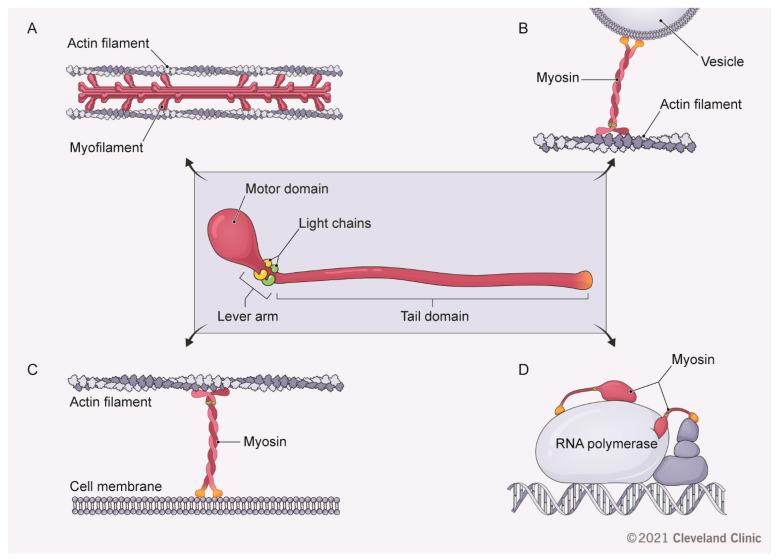
Colorectal cancer (CRC) remains the third most common cause of cancer and the second most common cause of cancer deaths worldwide. Clinicians are largely faced with advanced and metastatic disease for which few interventions are available. One poorly understood aspect of CRC involves altered organization of the actin cytoskeleton, especially at the metastatic stage of the disease. Myosin motors are crucial regulators of actin cytoskeletal architecture and remodeling. They act as mechanosensors of the tumor environments and control key cellular processes linked to oncogenesis, including cell division, extracellular matrix adhesion and tissue invasion. Different myosins play either oncogenic or tumor suppressor roles in breast, lung and prostate cancer; however, little is known about their functions in CRC. This review focuses on the functional roles of myosins in colon cancer development. We discuss the most studied class of myosins, class II (conventional) myosins, as well as several classes (I, V, VI, X and XVIII) of unconventional myosins that have been linked to CRC development. Altered expression and mutations of these motors in clinical tumor samples and their roles in CRC growth and metastasis are described. We also evaluate the potential of using small molecular modulators of myosin activity to develop novel anticancer therapies.
结直肠癌(CRC)仍然是全球第三大常见癌症病因和第二大常见癌症死亡原因。临床医生在很大程度上面临着晚期和转移性疾病,针对这些疾病几乎没有可用的干预措施。结直肠癌一个尚未被充分理解的方面涉及肌动蛋白细胞骨架的组织改变,尤其是在疾病的转移阶段。肌球蛋白马达是肌动蛋白细胞骨架结构和重塑的关键调节因子。它们作为肿瘤环境的机械传感器,控制与肿瘤发生相关的关键细胞过程,包括细胞分裂、细胞外基质粘附和组织侵袭。不同的肌球蛋白在乳腺癌、肺癌和前列腺癌中发挥致癌或抑癌作用;然而,它们在结直肠癌中的功能却鲜为人知。本综述重点关注肌球蛋白在结肠癌发展中的功能作用。我们讨论了研究最多的一类肌球蛋白,即II类(传统)肌球蛋白,以及与结直肠癌发展相关的几类非传统肌球蛋白(I、V、VI、X和XVIII类)。描述了这些马达在临床肿瘤样本中的表达改变和突变及其在结直肠癌生长和转移中的作用。我们还评估了使用肌球蛋白活性小分子调节剂开发新型抗癌疗法的潜力。

 Zotero 插件