
蛋白质跨膜转运的早期演化。
The very early evolution of protein translocation across membranes.
机构信息
Key Laboratory of Plant Resources Conservation and Sustainable Utilization, South China Botanical Garden, Chinese Academy of Sciences, Guangzhou, China.
Department of Biology, Oberlin College and Conservatory, K123 Science Center, Oberlin, Ohio, United States of America.
出版信息
PLoS Comput Biol. 2021 Mar 8;17(3):e1008623. doi: 10.1371/journal.pcbi.1008623. eCollection 2021 Mar.
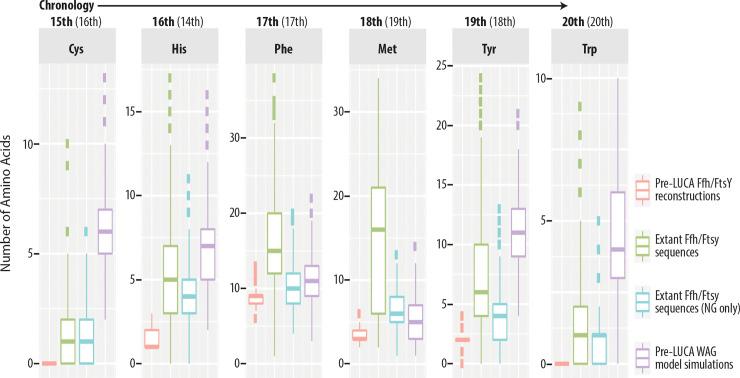
In this study, we used a computational approach to investigate the early evolutionary history of a system of proteins that, together, embed and translocate other proteins across cell membranes. Cell membranes comprise the basis for cellularity, which is an ancient, fundamental organizing principle shared by all organisms and a key innovation in the evolution of life on Earth. Two related requirements for cellularity are that organisms are able to both embed proteins into membranes and translocate proteins across membranes. One system that accomplishes these tasks is the signal recognition particle (SRP) system, in which the core protein components are the paralogs, FtsY and Ffh. Complementary to the SRP system is the Sec translocation channel, in which the primary channel-forming protein is SecY. We performed phylogenetic analyses that strongly supported prior inferences that FtsY, Ffh, and SecY were all present by the time of the last universal common ancestor of life, the LUCA, and that the ancestor of FtsY and Ffh existed before the LUCA. Further, we combined ancestral sequence reconstruction and protein structure and function prediction to show that the LUCA had an SRP system and Sec translocation channel that were similar to those of extant organisms. We also show that the ancestor of Ffh and FtsY that predated the LUCA was more similar to FtsY than Ffh but could still have comprised a rudimentary protein translocation system on its own. Duplication of the ancestor of FtsY and Ffh facilitated the specialization of FtsY as a membrane bound receptor and Ffh as a cytoplasmic protein that could bind nascent proteins with specific membrane-targeting signal sequences. Finally, we analyzed amino acid frequencies in our ancestral sequence reconstructions to infer that the ancestral Ffh/FtsY protein likely arose prior to or just after the completion of the canonical genetic code. Taken together, our results offer a window into the very early evolutionary history of cellularity.
在这项研究中,我们使用计算方法研究了一个蛋白质系统的早期进化历史,该系统共同将其他蛋白质嵌入和转运穿过细胞膜。细胞膜构成了细胞性的基础,细胞性是所有生物共有的古老而基本的组织原则,也是地球上生命进化的关键创新。细胞性的两个相关要求是,生物体能够将蛋白质嵌入膜中并将蛋白质转运穿过膜。完成这些任务的一个系统是信号识别颗粒 (SRP) 系统,其中核心蛋白成分是 FtsY 和 Ffh 的旁系同源物。与 SRP 系统互补的是 Sec 转运通道,其中主要的通道形成蛋白是 SecY。我们进行了系统发育分析,这些分析强烈支持了先前的推断,即 FtsY、Ffh 和 SecY 在生命的最后共同祖先 LUCA 存在时就已经存在,并且 FtsY 和 Ffh 的祖先存在于 LUCA 之前。此外,我们结合了祖先序列重建和蛋白质结构与功能预测,表明 LUCA 具有类似于现存生物的 SRP 系统和 Sec 转运通道。我们还表明,LUCA 之前的 Ffh 和 FtsY 的祖先与 FtsY 更相似,而不是 Ffh,但它本身仍然可以组成一个原始的蛋白质转运系统。FtsY 和 Ffh 祖先的复制促进了 FtsY 作为膜结合受体和 Ffh 作为能够与具有特定膜靶向信号序列的新生蛋白质结合的细胞质蛋白的专业化。最后,我们分析了我们祖先序列重建中的氨基酸频率,以推断祖先的 Ffh/FtsY 蛋白可能在经典遗传密码完成之前或之后出现。总之,我们的研究结果提供了一个了解细胞性早期进化历史的窗口。


 Zotero 插件